Content last revised on September 10, 2026
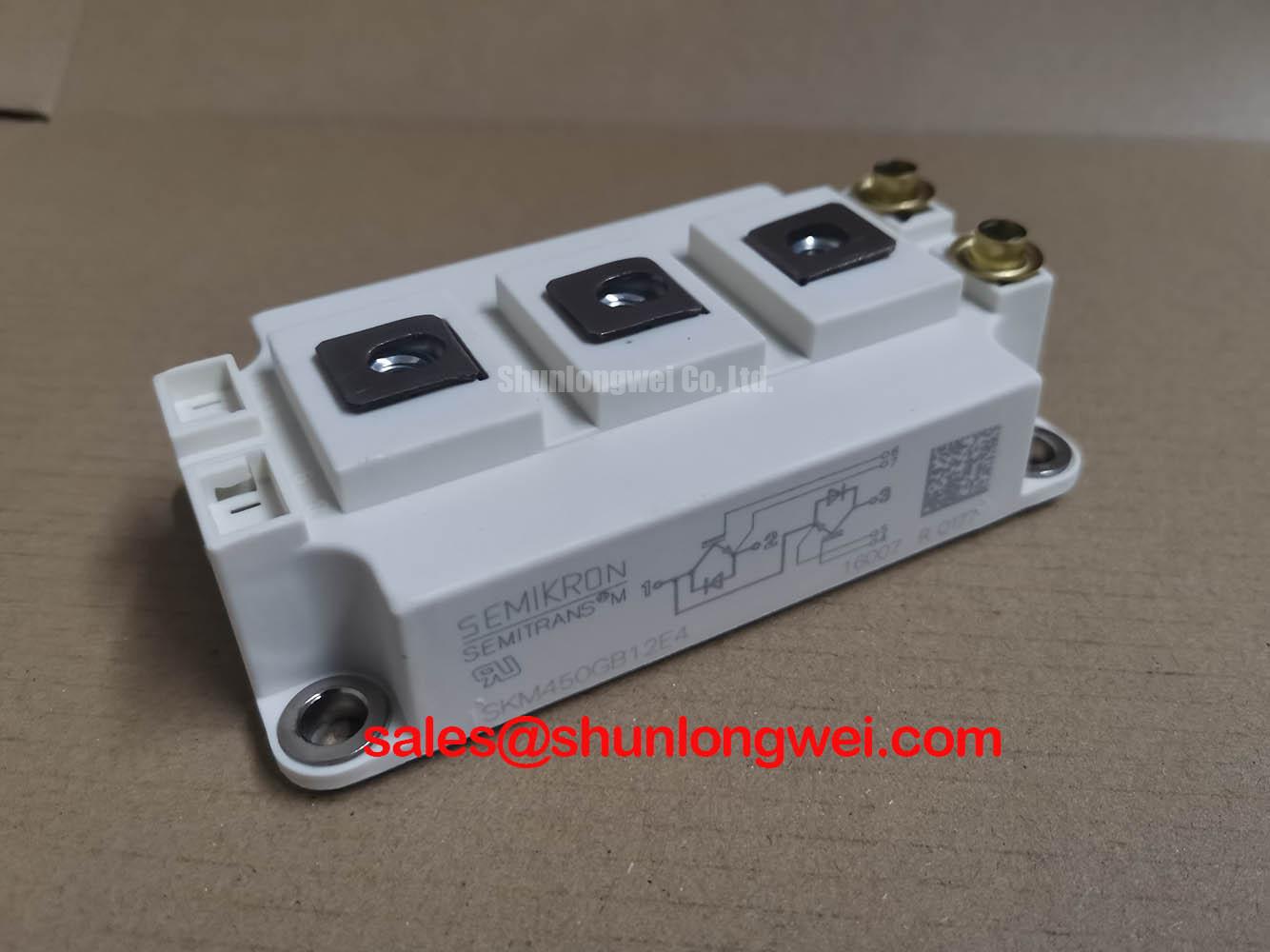
Semikron SKM450GM12E4D1: A Bidirectional AC Switch IGBT Module
An industrial-grade bidirectional AC switch designed to maximize power density and thermal margin in matrix converters and grid-tied systems. Top specs: 1200V | 450A | VCE(sat) 1.84V | SEMITRANS 3. Key benefits: reduces switching losses and exceptional thermal cycling. How does the CAL4 diode improve recovery? It reduces peak reverse recovery current to prevent overvoltage spikes. For industrial matrix inverters requiring robust bidirectional switching, this 1200V 450A module is the optimal choice.
Key Parameter Overview
Decoding the Specs for Enhanced Thermal Reliability
| Group | Parameter Description | Symbol | Value / Rating |
|---|---|---|---|
| Absolute Maximum Ratings | Collector-Emitter Voltage | VCES | 1200 V |
| Nominal Collector Current | ICnom | 450 A | |
| Continuous Collector Current (Tc = 25°C) | IC | 699 A | |
| Continuous DC Forward Current (Tc = 25°C) | IF | 623 A | |
| IGBT Characteristics | Collector-Emitter Saturation Voltage (Tj = 25°C) | VCE(sat) | 1.84 V (typical) |
| Turn-on Energy Dissipation | Eon | 28 mJ | |
| Turn-off Energy Dissipation | Eoff | 58 mJ | |
| Switching Frequency Range | fsw | Up to 12 kHz | |
| Diode Characteristics | Diode Forward Voltage (Tj = 25°C) | VF | 2.04 V (typical) |
| Reverse Recovery Energy | Err | 31 mJ | |
| Mechanical & Thermal | Package Housing Type | - | SEMITRANS 3 (106 x 62 x 31 mm) |
| Baseplate Insulation Technology | - | Direct Bonded Copper (DBC) |
Download the SKM450GM12E4D1 datasheet for detailed specifications and performance curves.
Application Scenarios & Value
Achieving System-Level Benefits in High-Frequency Power Conversion
Design engineers building a compact matrix converter for a next-generation variable-frequency drive (VFD) face a constant battle with physical space and switching efficiency. Traditional topologies rely on bulky DC-link capacitors, which restrict overall power density and introduce failure points. By adopting the GM topology of the SKM450GM12E4D1, which acts as a dedicated bidirectional AC switch, designers can bypass the DC-link stage entirely.
The module's continuous current capability of 699A at room temperature enables direct AC-to-AC conversion under high-stress conditions. In an actual deployment, such as an industrial hoist or fan system, this topology handles motor deceleration energy feedback directly into the grid without requiring separate braking resistors. Integrating a matched gate driver with a robust active clamp ensures the module operates reliably within its defined Safe Operating Area (SOA) even when switching up to 12kHz.
While this AC switch configuration is optimized for bidirectional matrix topologies, for standard half-bridge inverter designs, the related SKM450GB12E4 provides a more traditional topology, while systems with lower power demands can utilize the SKM300GA12E4.
Technical & Design Deep Dive
Maximizing Thermal Margin and Minimizing Parasitic Inductance
At the heart of the SKM450GM12E4D1 is the 4th generation fast trench IGBT technology, developed by Infineon and packaged by semikron. A primary design challenge in high-power applications is managing conduction losses. The typical collector-emitter saturation voltage (VCE(sat)) of 1.84V is critical here. Saturation voltage acts much like the narrow neck of an hourglass; a lower voltage drop ensures that power flows with minimum resistance, preventing energy from pooling as waste heat. By keeping conduction losses low, the module improves overall efficiency in demanding industrial applications.
What is the main benefit of the DBC baseplate? It maximizes thermal conductivity to prevent junction overheating. To manage the heat that is inevitably generated during high-speed switching up to 12kHz, the module employs an insulated copper baseplate built with Direct Bonded Copper (DBC) technology. This DBC thermal baseplate behaves like a high-speed highway for heat dissipation, allowing thermal energy to zoom away from the delicate silicon junction to the heatsink without hitting structural traffic jams. This thermal path is essential for maintaining a safe junction temperature and preventing the thermal runaway failure modes detailed in our guide on ensuring IGBT reliability.
What is the function of the integrated gate resistor? It dampens gate oscillations during high-frequency switching. Furthermore, the integration of the CAL4 soft-switching diode (offering increased performance indicated by the "D1" suffix) reduces reverse recovery energy (Err) to 31 mJ. This soft-switching behavior prevents the voltage spikes that typically compromise the gate oxide under high di/dt conditions. For engineers looking to dive deeper into package construction and chip dynamics, the engineer's ultimate guide to IGBT modules provides an exhaustive breakdown of how these elements work together.
Frequently Asked Questions
Addressing Design Concerns for Bidirectional Switches
What is the physical benefit of the integrated gate resistor in the SKM450GM12E4D1?
The integrated gate resistor stabilizes switching dynamics and minimizes parasitic inductance loops between the gate driver and the module. By dampening voltage oscillations, it allows reliable high-frequency switching up to 12kHz without requiring complex external dampening networks.
How does the "D1" designation impact the thermal and electrical performance of the CAL4 diode?
The "D1" suffix denotes a module with increased diode performance. Specifically, the CAL4 soft-switching diode is optimized for lower reverse recovery losses (Err of 31 mJ) and softer recovery characteristics, which suppresses EMI and overvoltage spikes during fast commutation in bidirectional AC switch topologies.
As a specialized distributor of high-power semiconductors, we provide detailed technical support and procurement solutions for industrial power systems. For technical inquiries, volume pricing, or to request a quote on the Semikron SKM450GM12E4D1, please contact our engineering support team today.