Content last revised on September 10, 2026
SKM450GB12T4: Engineering High-Frequency Power Conversion
Introduction and Core Value Proposition
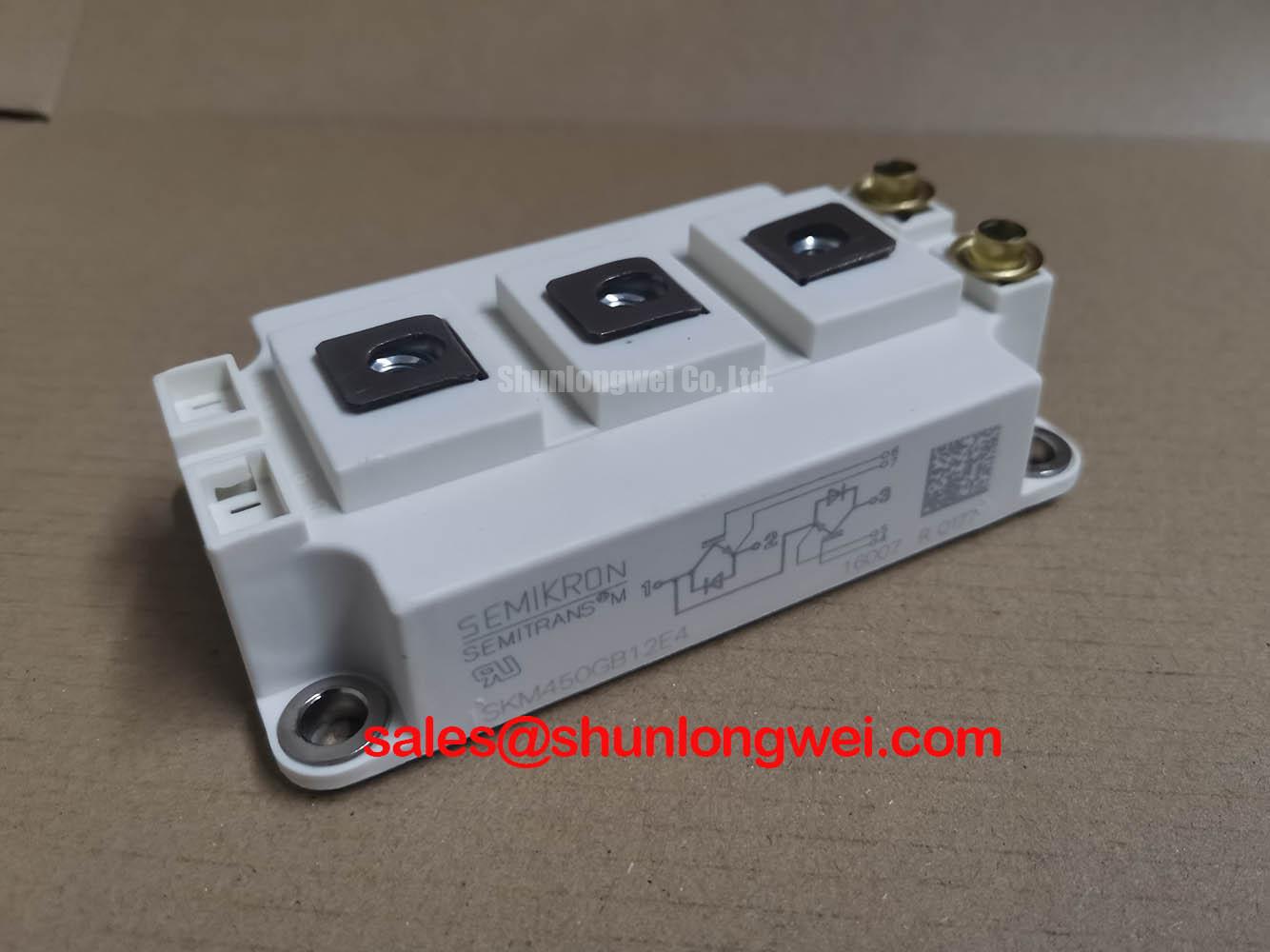
The Semikron SKM450GB12T4 is a SEMITRANS® 3 Fast IGBT4 Module engineered for high-frequency power conversion. It integrates advanced chip technology into a robust, industry-standard package to deliver superior performance and reliability. With core specifications of 1200V | 450A and a maximum switching frequency of 20 kHz, this half-bridge module provides key benefits including minimized switching losses and enhanced power cycling reliability. What is the primary benefit of its fast IGBT4 and CAL4 diode combination? It enables efficient operation at high switching frequencies up to 20 kHz. How does the low VCE(sat) contribute to system performance? It minimizes conduction losses, reducing heat and improving overall inverter efficiency. For high-frequency inverter designs up to 20 kHz prioritizing efficiency and power density, this 1200V module is the definitive choice.
Application Scenarios & Value
Achieving System-Level Benefits in High-Frequency Power Conversion
The SKM450GB12T4 is purpose-built for applications where switching speed and efficiency are paramount. Its architecture makes it a primary choice for designers of next-generation power systems. For high-frequency inverter designs up to 20 kHz prioritizing efficiency and power density, this 1200V module is the definitive choice.
- Electronic Welding Power Supplies: In high-frequency welding, precise control of the arc is critical for quality. The SKM450GB12T4's capability to operate efficiently at up to 20 kHz allows for a highly stable arc and a smaller, more responsive power unit due to the reduced size of magnetic components. The fast-switching IGBT4 and soft-recovery CAL4 diode work in tandem to minimize energy loss during each cycle, directly contributing to a more efficient and compact final product.
- Uninterruptible Power Supplies (UPS): Modern online UPS systems require high-frequency inverters to achieve high power density and clean sinusoidal output. This module's low switching losses (Eon/Eoff) directly reduce the thermal load, allowing for more compact cooling solutions and higher overall system efficiency, a crucial factor in data center and industrial backup power.
- AC Inverter Drives: For high-speed motor control in Variable Frequency Drive (VFD) systems, the module's dynamic performance ensures precise current and torque control. Its enhanced power cycling capability provides the long-term reliability needed to withstand the variable loads typical in industrial automation.
While the SKM450GB12T4 is optimized for these high-frequency systems, for applications demanding higher current capacity at moderate frequencies, the related SKM600GB12M7 provides a 600A rating within a similar package family.
Key Parameter Overview
Decoding the Specs for High-Frequency Performance
The performance of the SKM450GB12T4 is defined by a set of carefully balanced parameters rooted in its advanced chip technology. The following table provides a summary based on the official documentation. For a comprehensive in-depth analysis of IGBT modules, these values are critical for accurate simulation and design.
| Electrical & Thermal Characteristics (Tj = 150°C unless specified) | ||
|---|---|---|
| Parameter | Value | Engineering Significance |
| Collector-Emitter Voltage (VCES) | 1200 V | Provides the necessary voltage margin for 480V to 600V AC line applications. |
| Nominal Collector Current (ICnom) | 450 A | Defines the module's primary current handling capability for application sizing. |
| Collector-Emitter Saturation Voltage (VCE(sat)) at ICnom | 2.23 V (typ.) | Indicates low on-state (conduction) losses, which reduces heat generation and improves overall efficiency. |
| Gate-Emitter Threshold Voltage (VGE(th)) | 5.3 V to 6.3 V | Ensures stable switching characteristics and good noise immunity. |
| Maximum Switching Frequency (fsw,max) | up to 20 kHz | Highlights the module's suitability for high-frequency applications, enabling smaller system magnetics. |
| Insulation Voltage (Visol) | 4000 V | Guarantees high electrical isolation between the power circuit and the mounting baseplate for system safety. |
Download the SKM450GB12T4 datasheet for detailed specifications and performance curves.
Technical Deep Dive
A Closer Look at the T4 IGBT and CAL4 Diode Synergy
The core of the SKM450GB12T4's performance lies in the synergistic combination of Infineon's 4th generation fast trench IGBT (IGBT4) and the complementary CAL4 (Controlled Axial Lifetime) freewheeling diode. This isn't just about placing two components in a box; it's about a co-optimized pairing designed to minimize total system losses, particularly in high-frequency operation.
The "T4" IGBT is designed using trench gate and field-stop technologies, which allow for a very low collector-emitter saturation voltage (VCE(sat)) without compromising its ability to turn off quickly. A low VCE(sat) is like a wide, unobstructed pipe; it allows current to flow with minimal resistance, wasting very little energy as heat. This low conduction loss is a primary contributor to the module's high efficiency.
However, at 20 kHz, switching losses can dominate. This is where the partnership with the CAL4 diode becomes critical. This diode is engineered for "soft" recovery. Think of switching an IGBT as opening and closing a heavy dam gate. "Hard switching" is like slamming the gate shut against a powerful river, creating a massive, energy-wasting splash (voltage and current overshoots). The soft recovery of the CAL4 diode acts like a hydraulic damper on the gate; it allows the IGBT to turn on quickly but smoothly, minimizing the "splash." This drastically reduces turn-on losses (Eon) in the IGBT and lowers electromagnetic interference (EMI), simplifying filter design. This careful balance is a key factor in successful IGBT selection for high-frequency designs.
Frequently Asked Questions (FAQ)
What is the direct engineering benefit of the 'T4' (Trench 4) IGBT technology in the SKM450GB12T4?
The 'T4' fast trench IGBT technology provides a superior trade-off between conduction losses (low VCE(sat)) and switching losses (fast turn-off). For an engineer, this means the module runs cooler under load and can be switched at higher frequencies, enabling the design of power converters that are both more efficient and more compact.
How does the specified 20 kHz maximum switching frequency impact the design of an Uninterruptible Power Supply (UPS)?
Operating a UPS inverter at 20 kHz, which is above the range of human hearing, eliminates audible noise from the magnetic components. More importantly from an engineering standpoint, this high frequency allows for the use of significantly smaller, lighter, and less costly inductors and capacitors in the output filter stage, directly reducing the overall size, weight, and bill of materials (BOM) of the UPS system.
The datasheet mentions 'Increased power cycling capability'. How does this translate to long-term reliability in a Variable Frequency Drive (VFD) application?
In a VFD, the motor load can change rapidly, causing significant temperature swings within the IGBT module. This thermal cycling puts mechanical stress on the internal solder joints and wire bonds. The 'Increased power cycling capability' indicates that the SKM450GB12T4 is built with materials and processes, like Direct Bonded Copper (DBC) technology, designed to better withstand this stress. This translates directly to a longer operational lifespan and higher system reliability by mitigating wear-out failure mechanisms. For further reading, explore guides on Mastering IGBT thermal management.
For detailed quoting or to discuss how the SKM450GB12T4 can be integrated into your next high-frequency project, our technical support team is available to assist with your design-in process.