

Content last revised on September 10, 2026
VUO55-12NO7 Three-Phase Bridge Rectifier Module by IXYS: Datasheet & Engineering Analysis
Introduction to the VUO55-12NO7 Power Module
Engineered for High-Reliability Power Conversion in Industrial Systems
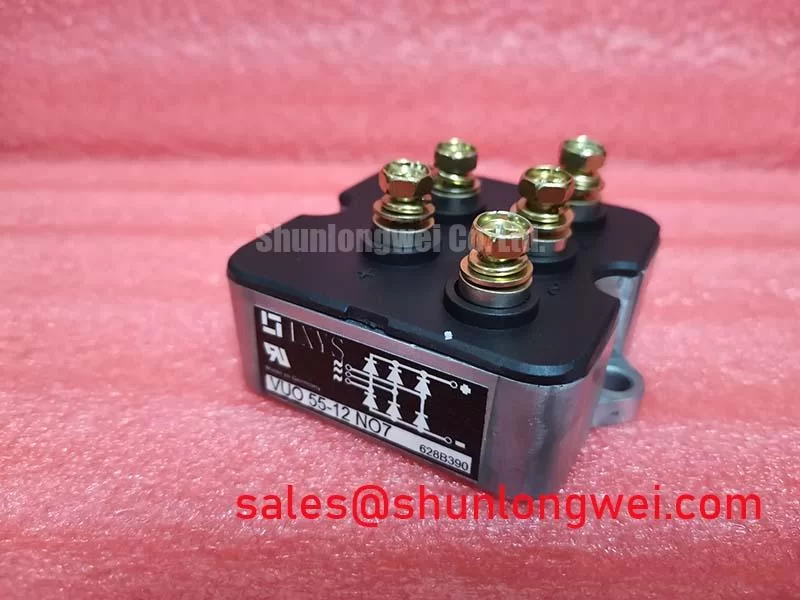
The VUO55-12NO7 from IXYS, a Littelfuse technology, is a robust three-phase uncontrolled bridge rectifier engineered for exceptional thermal performance and long-term reliability in demanding power conversion applications. With core specifications of 1200V V(RRM) and a 60A I(DAV), it delivers steadfast rectification through its advanced package design. Key engineering benefits include superior thermal management due to its Direct Bonded Copper (DBC) baseplate and high robustness against fault conditions. This module directly addresses the need for a dependable front-end rectifier in industrial systems operating on 400V to 575V AC lines. For industrial drives requiring robust performance on 480V AC lines, the VUO55-12NO7's 1200V rating provides an optimal safety margin.
Key Parameter Overview
A Functionally Grouped Breakdown of Electrical and Thermal Specifications
The technical specifications of the VUO55-12NO7 are tailored for industrial power applications where both electrical ruggedness and thermal efficiency are critical for system longevity. The parameters below highlight its capacity to manage substantial power levels while ensuring stable operation.
| Parameter | Symbol | Value | Conditions |
|---|---|---|---|
| Repetitive Peak Reverse Voltage | V(RRM) | 1200 V | - |
| Average Forward Current | I(DAV) | 60 A | Tc = 85°C |
| Peak Forward Surge Current | I(FSM) | 750 A | t = 10 ms, T(VJ) = 150°C |
| Forward Voltage | V(F) | < 1.6 V | I(F) = 60 A, T(VJ) = 25°C |
| Thermal Resistance, Junction-to-Case | Rth(JC) | 0.17 K/W | Per diode |
| Operating Junction Temperature | T(VJ) | -40 to +150 °C | - |
| Isolation Voltage | V(ISOL) | 3000 V~ | 50/60 Hz, t = 1 min |
Download the VUO55-12NO7 datasheet for detailed specifications and performance curves.
Application Scenarios & Value
Achieving System-Level Benefits in Industrial Drives and Power Supplies
The VUO55-12NO7 is a foundational component for the input rectification stage of numerous industrial systems. Its design provides tangible value in applications where reliability is non-negotiable. What is the primary benefit of its construction? Enhanced operational lifetime through superior thermal management.
High-Fidelity Engineering Scenario: Consider a Variable Frequency Drive (VFD) controlling a three-phase motor in a material handling system. During motor start-up, significant inrush currents are drawn to charge the DC bus capacitors. The VUO55-12NO7's high I(FSM) rating of 750 A ensures it can withstand these repetitive current surges without degradation. Furthermore, its low thermal resistance, facilitated by the DBC substrate, efficiently transfers heat to the heatsink, maintaining a lower junction temperature. This prevents thermal stress and is critical for VFDs installed in compact, often poorly ventilated, control cabinets. The result is a more robust and reliable drive with a lower total cost of ownership.
This module serves as a critical building block in:
- Input rectifiers for PWM inverters and servo drives
- Power supplies for DC equipment and battery charging systems
- Field supplies for DC motors
- General-purpose DC power infrastructure
While the VUO55-12NO7 is ideally suited for moderate power applications, for systems requiring significantly higher current handling capabilities, the MDS200A1600V offers a higher current rating at 1600V.
Technical Deep Dive
The Engineering Significance of the Direct Bonded Copper (DBC) Substrate
At the heart of the VUO55-12NO7's thermal performance is its Direct Bonded Copper (DBC) substrate. This isn't merely a mounting base; it's a multi-function technology critical to the module's reliability. The DBC structure consists of a ceramic insulator (typically alumina) to which copper layers are bonded without any adhesive. This creates a sandwich structure that provides excellent electrical isolation while offering a highly efficient thermal path.
Think of the DBC substrate as a superhighway for heat. In a standard module using an insulated metal substrate, heat has to navigate through multiple layers, including a thermally resistive adhesive. The DBC design eliminates this bottleneck, allowing heat generated by the planar passivated diode chips to move directly and rapidly to the copper baseplate and attached heatsink. This superior thermal conductivity is directly reflected in the low Rth(JC) value, which is a critical parameter for thermal design. A lower Rth(JC) means for a given power dissipation, the chip's junction temperature will be significantly lower, directly increasing the module's operational lifetime and power cycling capability.
Frequently Asked Questions (FAQ)
What is the primary benefit of the Direct Bonded Copper (DBC) base plate in the VUO55-12NO7?
The DBC base plate provides excellent electrical isolation (3000V~) while simultaneously offering very low thermal resistance. This enhances the module's reliability and longevity by ensuring efficient heat dissipation from the semiconductor junctions to the heatsink, a crucial factor in high-power industrial environments.
How does the 750A I(FSM) rating impact application design?
The high forward surge current rating means the module can safely handle large, non-repetitive inrush currents that occur during events like the initial charging of large DC link capacitors in inverters or during motor start-up. This robustness simplifies protection circuitry and increases system reliability by preventing rectifier failure under common transient conditions.
Engineering a Reliable Front-End for Your Power System
To fully leverage the capabilities of the VUO55-12NO7, engineers are encouraged to pair it with appropriate system-level considerations. Ensuring a low-resistance thermal interface between the module's baseplate and the heatsink is paramount for achieving the thermal performance detailed in the datasheet. We invite you to explore the datasheet to model its performance within your specific application and confirm its suitability for your design's power and reliability targets.