Content last revised on September 22, 2026
Field Diagnostics and Commissioning for High Frequency Commutation Loops
During a replacement evaluation, check the DC link path, switching loop, gate drive return, and emitter connections as one physical circuit rather than testing the module in isolation. Parasitic inductance can increase turn off voltage overshoot as current changes rapidly; the relationship is governed by the DC link voltage together with stray inductance and current slew rate. This makes symmetrical busbar geometry, short commutation paths, and controlled current return important Design Considerations.
The suggested layout principle is to minimize the high current loop area while keeping power and gate signal routing separated from noisy switching nodes. The final busbar geometry, clearance, snubber arrangement, and clamping level must be verified by oscilloscope measurements at the module terminals. If a forklift traction inverter shows intermittent overvoltage trips after module replacement, compare the switching waveform with a known good assembly and inspect busbar joints, laminated connections, snubber mounting, and gate loop continuity before assigning the fault to the IGBT itself.
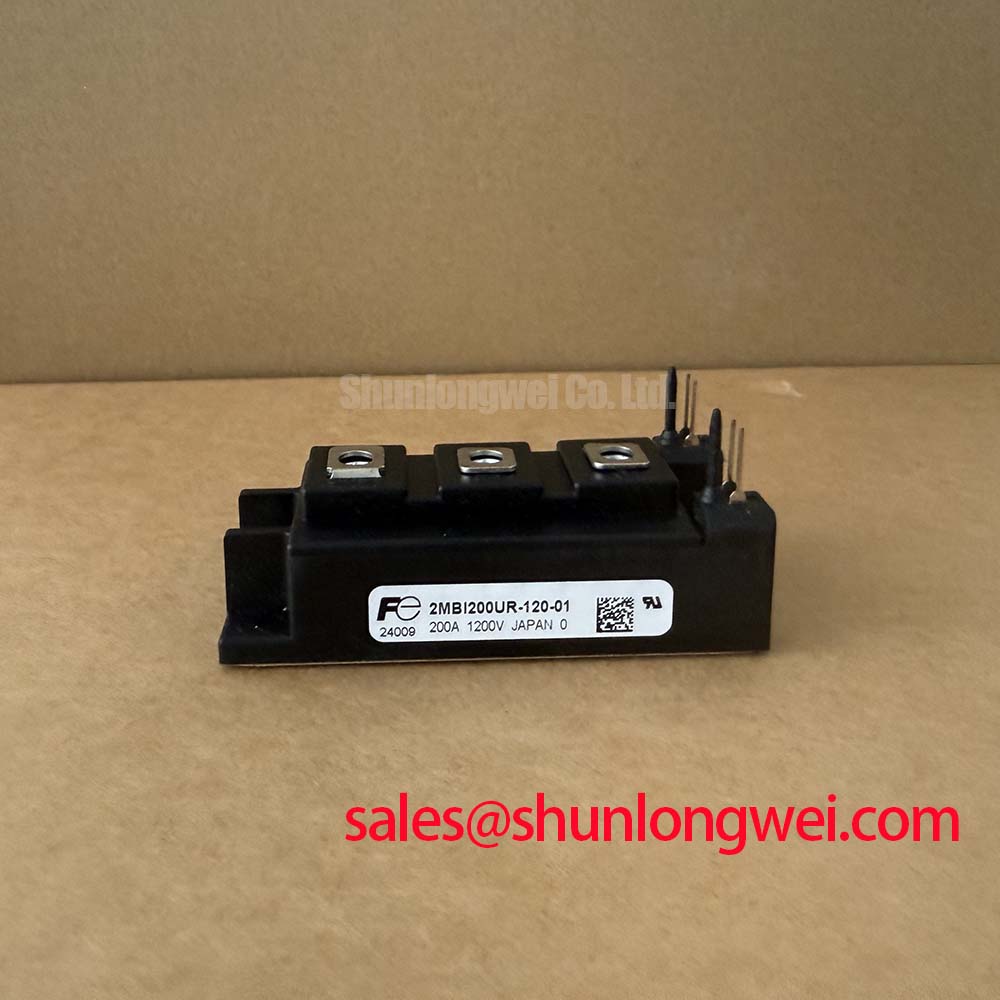
For a related same family evaluation, engineers may review 2MBI200UR-120-01 as a separate device reference. It should not be treated as an automatic substitute without checking voltage, current, gate drive, mechanical fit, thermal interface, and switching characteristics.
Circuit Protection and Reliability Evaluation in Industrial Drives
The specified 1200 V collector emitter rating does not by itself establish a complete DC bus operating limit. Designers should verify switching overshoot, regenerative braking energy, fuse coordination, and fault interruption under the actual traction duty cycle. The Mersen Protistor® High Speed Semiconductor Protection Fuses reference is useful when reviewing semiconductor fuse coordination, but the final protective scheme remains a system engineering decision.
Altitude, terrestrial radiation, cooling airflow, condensation, and enclosure contamination can alter reliability margins. No FIT, SEB, cosmic ray failure rate, or service life value should be assigned to this module without an applicable manufacturer document or qualified reliability source. At elevated installation sites, verify the approved bus voltage and protection margin against the original equipment documentation rather than applying an assumed altitude derating.
In a complementary switching leg, dead time and gate interlock should be validated with the actual driver, isolation barrier, and load current. A short or distorted gate signal may result from driver timing, common mode disturbance, grounding, or an abnormal power stage. The appropriate diagnostic method is to compare both gate to emitter waveforms and the collector emitter switching waveform under controlled test conditions.
High Speed Fault Management and VCE Desaturation Monitoring
Desaturation protection can provide a rapid response to abnormal collector emitter voltage, but the protection circuit must be evaluated as part of the gate driver and isolation system. Confirm the sensing path, blanking behavior, fault latch, gate turn off path, and reset sequence using the actual module and driver topology. The module data supplied here does not establish a universal short circuit withstand duration, so short circuit testing should follow the applicable Fuji Electric documentation and laboratory safety procedure.
A two stage soft turn off strategy may reduce the rate of current interruption and help limit inductive overvoltage, subject to driver capability and measured circuit behavior. Keep the desaturation loop physically close to its intended reference points, and investigate false trips by checking isolation supply stability, collector voltage ringing, wiring inductance, and common mode coupling. Where the traction controller includes a front end or auxiliary high power stage, the 2MBI300U4H-120-50 can be reviewed as a separate topology related device, not as a confirmed replacement.
Benchtop Waveform Tuning for Miller Immunity
High dv/dt switching can couple energy into an inactive gate through parasitic capacitance. An active Miller clamp, low impedance gate return, and carefully routed isolated driver can reduce the likelihood of unintended turn on, but the required gate voltage strategy must be determined from the original driver design and bench measurements. Negative gate bias should not be added as a default modification without confirming the module gate rating, driver capability, insulation coordination, and transient behavior.
Begin waveform tuning at a controlled bus voltage and current, then inspect gate emitter voltage, collector emitter voltage, switching current, and driver supply behavior together. Check the gate resistor path, emitter reference, clamp connection, and isolation barrier during both motoring and regenerative braking. The broader relationship between switching topology and stress can be reviewed through Resonant Topologies in Home Appliances, while the actual forklift inverter remains responsible for its own topology validation.
Maintenance Note: Clean the heatsink and verify thermal interface condition during scheduled service, then monitor terminal temperature and airflow after recommissioning.