



Content last revised on September 10, 2026
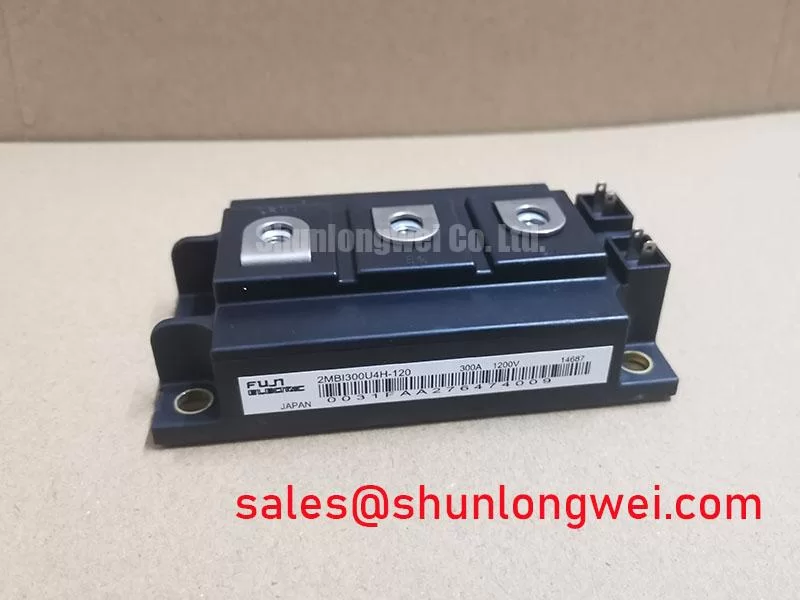
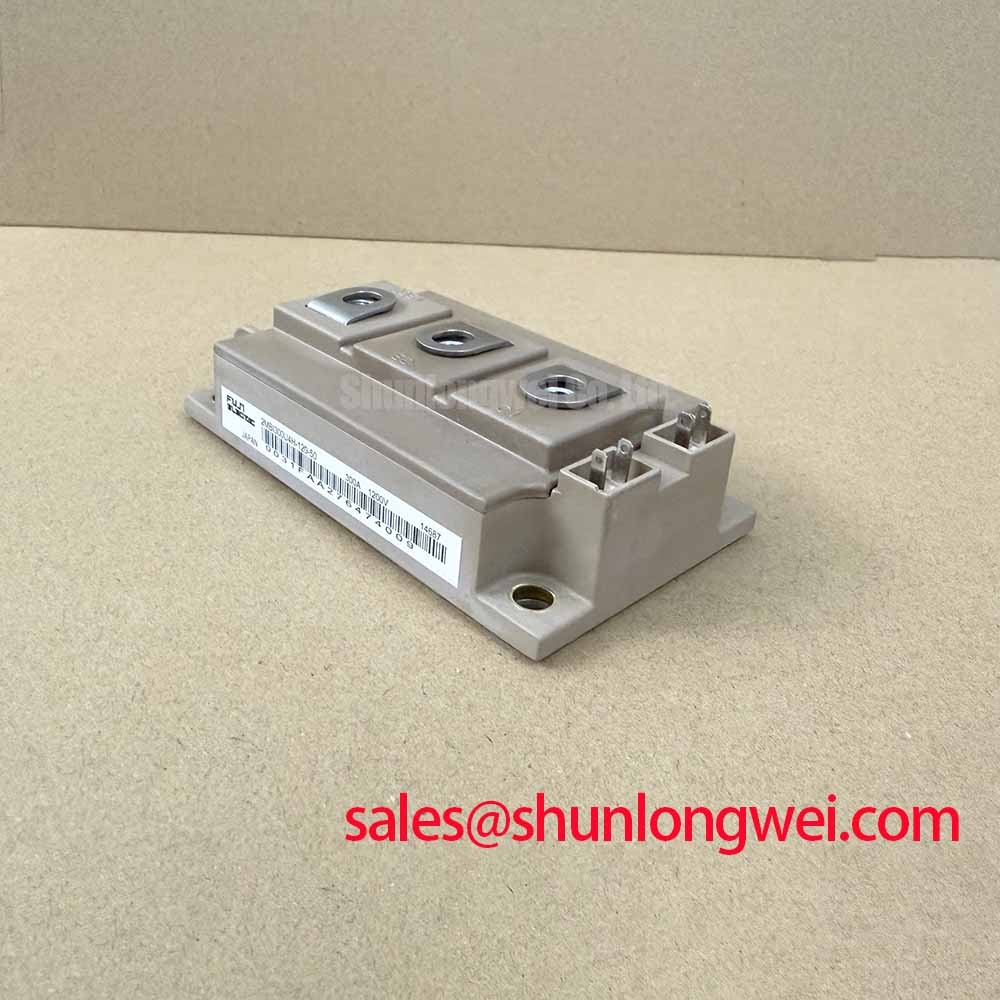
Fuji Electric 2MBI300U4H-120-50 IGBT Module | 1200V 300A Dual IGBT
The 2MBI300U4H-120-50, part of the Fuji Electric U4 series, is a high-performance 1200V dual IGBT module designed for efficient power switching. It delivers 300A of continuous collector current while maintaining a low saturation voltage to minimize conduction losses. This module provides a robust power density solution for demanding industrial environments where thermal stability and high-speed switching are paramount.
1200V | 300A | Tj max 150°C
Key technical advantages include significantly reduced collector-emitter saturation voltage and an optimized internal structure for low inductance. These features allow engineers to simplify gate drive circuits while enhancing overall system reliability. To address common challenges in 400V AC drive efficiency, the module utilizes trench-gate technology to achieve a superior balance between conduction and switching losses. For industrial motor drives requiring high thermal reliability, this 1200V 300A module is the optimal choice.
Application Scenarios & Value
Achieving System-Level Benefits in High-Frequency Power Conversion
Engineers often face the challenge of balancing high current output with strict thermal constraints in compact inverter enclosures. In Variable Frequency Drive (VFD) applications, high-torque motor startup generates significant heat that can compromise the lifespan of power semiconductors. The 2MBI300U4H-120-50 addresses this by featuring a typical VCE(sat) of 1.70V, which directly reduces power dissipation during heavy load phases, allowing for smaller heatsink designs.
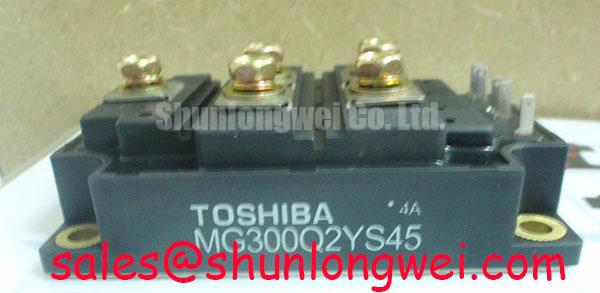
In the context of Uninterruptible Power Supplies (UPS) and Solar Inverters, switching efficiency is the primary driver of Total Cost of Ownership (TCO). The U4 series technology facilitates faster switching transitions with reduced tail currents. When compared to older technologies, this module enables a higher switching frequency, which in turn reduces the size and cost of passive filter components. For systems requiring different current profiles or older architectures, related models like the 2MBI300HH-120 or the 2MBI300N-120 provide baseline comparisons for voltage-controlled switching performance in diverse Motor Control topologies.
The integration of a high-speed free-wheeling diode within the package ensures that inductive kickback during PWM cycles is handled with minimal recovery loss. This is particularly critical in Servo Drive systems where precision and rapid response are mandatory. By maintaining a Short-Circuit Withstand Time of 10µs, the module provides a vital safety margin for system-level protection logic to intervene before catastrophic failure occurs.
Technical & Design Deep Dive
Decoding the U4 Architecture for Enhanced Thermal Reliability
The 2MBI300U4H-120-50 utilizes a trench-gate field-stop structure. To visualize its engineering value, imagine a highway with optimized electronic toll booths; the trench architecture acts as a highly efficient gateway that prevents the "traffic jam" of charge carriers (electron congestion) even during peak rush hours (high current pulses). This reduces the internal bottleneck that typically causes voltage drops in planar IGBT structures.
A second analogy involves thermal management: the module’s baseplate acts as a high-capacity heat reservoir. Just as a well-designed radiator prevents an engine from overheating during uphill climbs, the Thermal Resistance (Rth(j-c)) of 0.085 °C/W (for the IGBT) ensures that heat is rapidly shunted away from the silicon die. This low thermal resistance is achieved through an Al2O3 ceramic substrate, which provides excellent isolation while maintaining high thermal conductivity.
For engineers designing the power stage, understanding the Gate-Emitter Threshold Voltage (VGE(th)) range of 6.0V to 7.5V is essential for selecting appropriate Gate Drive ICs. Proper drive design prevents parasitic turn-on events, a topic explored in our technical resource on IGBT Module Selection and Thermal Management. By optimizing the gate resistance (Rg), designers can fine-tune the trade-off between switching speed and Electromagnetic Compatibility (EMC) signatures.
Key Parameter Overview
Specifications and Engineering Value Interpretation
| Parameter Category | Technical Specification | Engineering Value |
|---|---|---|
| Voltage Rating (VCES) | 1200V | Suitable for 400V-480V AC line input systems with safety margin. |
| Collector Current (IC) | 300A (at Tc=80°C) | Continuous power handling for heavy-duty industrial loads. |
| Saturation Voltage (VCE(sat)) | 1.70V (Typ.) | Low conduction loss increases overall inverter efficiency. |
| Junction Temperature (Tj) | -40°C to +150°C | Extended operating range for harsh ambient conditions. |
| Isolation Voltage (Visol) | 2500V AC (1 min) | Ensures safety and compliance with international standards. |
Download the 2MBI300U4H-120-50 datasheet for detailed specifications and performance curves.
Frequently Asked Questions
Engineering Insights on Implementation and Reliability
How does the low Rth(j-c) of 0.085 °C/W directly impact heatsink selection and overall system power density?
A lower Thermal Resistance allows the module to transfer heat to the heatsink more efficiently. For a given output current, the junction temperature remains lower, which either extends the module's Power Cycling Capability or allows the engineer to use a 15-20% smaller heatsink compared to modules with higher thermal resistance. This is a critical factor in achieving compact VFD designs.
What are the primary considerations when paralleling the 2MBI300U4H-120-50 for high-current systems?
The U4 series features a positive temperature coefficient for its VCE(sat). This is a crucial "self-balancing" characteristic; if one module carries more current and heats up, its resistance increases, naturally pushing current to the cooler parallel modules. However, symmetrical Gate Drive layout and balanced DC-link busbars are still required to prevent transient current imbalances.
What is the primary benefit of the U4 series' soft-switching characteristics?
Soft-switching reduces the dv/dt and di/dt during turn-on and turn-off transitions. In Motor Control, this minimizes voltage stress on the motor windings and reduces high-frequency EMI. This allows for longer cable runs between the inverter and the motor without the immediate need for expensive output reactors or filters.
The 2MBI300U4H-120-50 represents a strategic choice for power electronics designers seeking a balance between high-current performance and thermal overhead. By leveraging 6th generation trench technology, it provides a stable platform for the next generation of energy-efficient industrial drives and renewable energy converters.