
Content last revised on September 10, 2026
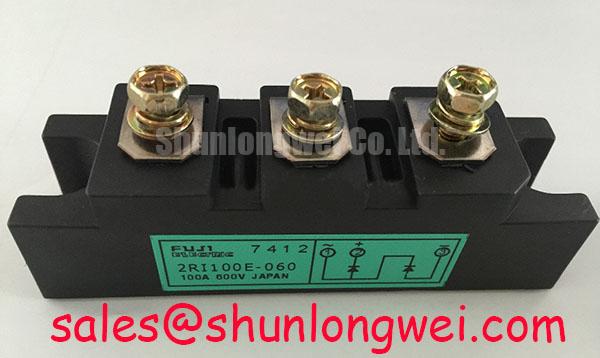
2RI100E-060 Fuji Electric 600V 100A Power Diode Module Technical Overview
The 2RI100E-060, manufactured by Fuji Electric, is a high-performance power diode module designed for efficient rectification in industrial power systems. Engineered to provide high-reliability switching and low forward voltage drop, this module features a 600V repetitive peak reverse voltage and a 100A average forward current rating. By utilizing an electrically isolated base, the 2RI100E-060 allows for simplified heat sink mounting and thermal management in compact power conversion assemblies.
For engineers prioritizing thermal margin and structural durability, the 2RI100E-060 offers a balanced profile of electrical ruggedness and efficient heat dissipation. What is the primary benefit of its isolated base design? It significantly reduces system complexity by allowing multiple modules to share a single heat sink without additional insulation. For DC power supplies requiring robust 600V rectification with simplified heat sink integration, this 100A module is the optimal choice.
Key Parameter Overview
Functional Specification Grouping for Enhanced System Design
The following table summarizes the critical electrical and thermal characteristics of the 2RI100E-060, categorized by functional performance to assist in engineering evaluation.
| Category | Parameter | Value |
|---|---|---|
| Electrical Ratings | Repetitive Peak Reverse Voltage (Vrrm) | 600V |
| Electrical Ratings | Average Forward Current (Io) | 100A (at Tc=100°C) |
| Electrical Ratings | Surge Forward Current (Ifsm) | 2000A (1 cycle, 50/60Hz) |
| Thermal Dynamics | Thermal Resistance Junction-to-Case (Rth(j-c)) | 0.30 °C/W |
| Mechanical | Isolation Voltage (Viso) | 2000V AC (1 minute) |
| Mechanical | Mounting Torque | 3.5 N·m (Typical) |
Download the 2RI100E-060 datasheet for detailed specifications and performance curves.
Application Scenarios & Value
Achieving System-Level Benefits in High-Power Rectification
In industrial environments, engineers often face the challenge of managing high-current inrush during the startup of inductive loads. The 2RI100E-060 addresses this through its significant 2000A surge current rating (Ifsm). This capability is critical in Variable Frequency Drive (VFD) input stages where the diode bridge must withstand the initial charging of the DC bus capacitor bank without degradation.
Consider a scenario involving a Welding Power Supply. The demand for rapid current delivery and high thermal cycling requires a diode module with low Thermal Resistance. With an Rth(j-c) of 0.30 °C/W, the 2RI100E-060 ensures that heat generated during the 100A rectification process is efficiently moved to the cooling surface, preventing localized junction overheating.
For applications requiring higher voltage overhead, such as 690V industrial lines, the related 6RI100E-080 offers a higher Vrrm of 800V. However, for standard 200-400V AC rectification, the 2RI100E-060 provides a cost-effective and electrically optimized solution. This module is also frequently utilized in UPS (Uninterruptible Power Supply) systems and battery charging stations where high Isolation Voltage (2000V AC) is required to meet IEC 61800-3 safety standards.
For further insights into power module selection, consult our resource on the core trio of module selection.
Technical & Design Deep Dive
Thermal Path Optimization for Long-Term Reliability
A critical differentiator for the 2RI100E-060 is its physical construction. Unlike discrete diodes, this module utilizes a pressure-contact or advanced soldering structure (depending on the specific generation) that minimizes the thermal impedance between the silicon die and the baseplate. In high-power electronics, Thermal Management is the deciding factor in component lifespan. The 2RI100E-060 utilizes a DBC (Direct Bonded Copper) substrate, which provides high Isolation Voltage while maintaining a low-resistance path for heat.
The efficiency of this diode module is also reflected in its Forward Voltage Drop (Vf). A lower Vf directly translates to lower conduction losses. By maintaining these losses at a minimum, the 2RI100E-060 allows for a higher power density within the inverter or converter cabinet. This is particularly relevant when designing for Electric Vehicle (EV) charging infrastructure, where space is at a premium and cooling capacity is limited.
For a broader understanding of how these components function within a larger circuit, refer to our analysis on voltage-controlled switching principles.
Frequently Asked Questions
How does the Rth(j-c) of 0.30 °C/W impact the selection of the heat sink for the 2RI100E-060?
The thermal resistance of 0.30 °C/W determines the maximum temperature rise of the junction over the case. To maintain the junction temperature below its 150°C limit while conducting 100A, engineers must calculate the required heat sink thermal resistance (Rth(s-a)) based on the total power loss and ambient temperature. A lower junction-to-case resistance allows for a smaller, lighter heat sink.
What is the significance of the 2000A surge current rating in motor drive applications?
The 2000A Ifsm rating represents the module's ability to survive non-repetitive peak currents. In motor drive applications, this protects the bridge rectifier from catastrophic failure during sudden load spikes or during the initial "pre-charge" phase of the DC link capacitors.
Can the 2RI100E-060 be used in parallel for higher current requirements?
While diodes can be paralleled, it is critical to account for the Forward Voltage Drop mismatch. If one diode in the 2RI100E-060 has a slightly lower Vf, it will carry a disproportionate amount of current, leading to thermal runaway. Proper current sharing through circuit layout or using matched modules is recommended for high-reliability Power Rectification.
To ensure the longevity of your industrial design, we recommend contacting our technical team for specific data regarding power cycling and mounting procedures.