Content last revised on September 20, 2026
Transient Dynamics & Electrical Design: ITSM Safety Derating across Repetitive Operation on 6RI100G-160
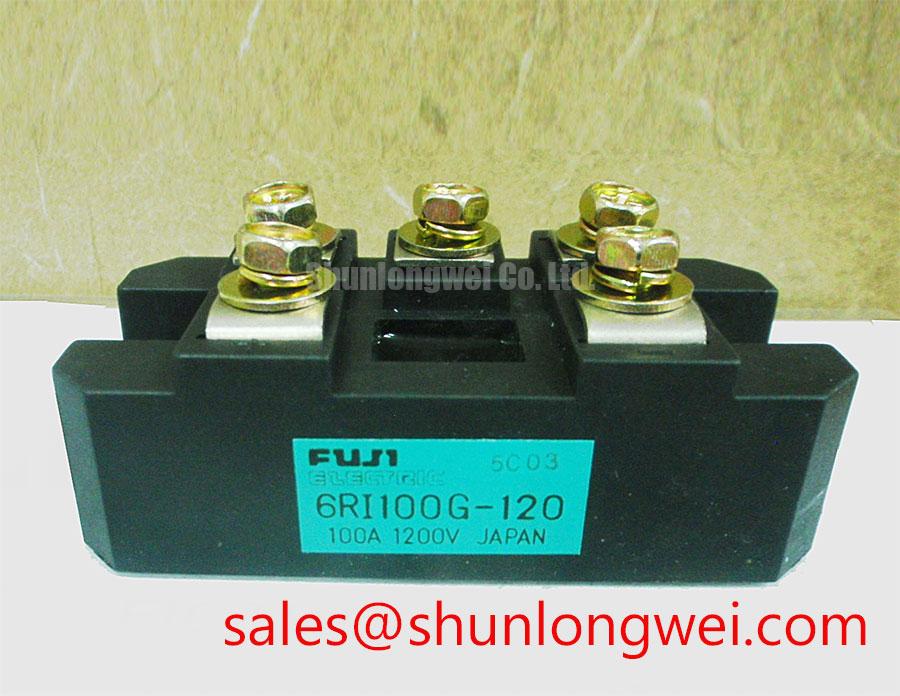
The supplied official data identifies the voltage rating, current rating, and package category, but does not provide an ITSM value, a half-cycle surge curve, junction-temperature limit, fuse I2t table, or mounting-torque specification. These values should therefore be obtained from the original Fuji Electric datasheet or the equipment documentation before any repetitive surge or reverse-voltage reapplication assessment is made.
For a medium-frequency induction melting or hardening furnace rectifier, the service engineer should first establish whether the event is an ordinary line transient, an inrush condition, a commutation event, or a downstream short-circuit response. The measured current waveform and the protection device clearing record are more useful than treating the module’s 100 A rating as a universal surge allowance. Design Consideration: assess repeated current stress using the actual thermal state of the assembly, the measured AC waveform, and the manufacturer-approved surge limits.
Terminal joints deserve the same level of scrutiny. Clean, flat contact surfaces and uniformly tightened hardware support predictable current sharing and reduce local heating. The system integrator should verify the applicable terminal and baseplate torque from the original module documentation rather than applying a torque value from an unrelated package.
Transient Dynamics & Electrical Design: Type 2 Coordination During a Sub-Cycle Dead Short on 6RI100G-160
Type 2 coordination cannot be declared from the 1600 V, 100 A, and package information alone. A defensible assessment requires the semiconductor fuse’s published clearing I2t data, prospective fault current, protection sequence, conductor impedance, and the module’s applicable short-duration withstand information. None of those additional numerical limits should be inferred from the rated current.
When investigating a failed furnace power supply, preserve the fuse designation and inspect the protection path before replacing the bridge module. A fuse that opened after a busbar fault, failed snubber network, or load-side short can indicate a system event that must be corrected before power is restored. Safety Interlock Note: confirm that stored DC-link energy is discharged and verified absent before disconnecting power terminals or measuring the bridge assembly.
For repair documentation, record the installed fuse type, circuit location, conductor condition, and measured isolation state. Where an alternative part is being evaluated for an existing repair bill of materials, the 2DI100D-050C can be reviewed against the original schematic and its own official documentation; interchangeability must be confirmed by the responsible system engineer.
Transient Dynamics & Electrical Design: Minimizing Commutation Turn-Off Voltage Stress on 6RI100G-160
The available official information does not state reverse-recovery peak current, recovery time, softness characteristics, switching energy, or an internal commutation arrangement for 6RI100G-160. It would be inappropriate to assign those characteristics to this diode bridge module. Engineers troubleshooting turn-off overshoot should capture voltage and current at the installed assembly, using an appropriately rated differential measurement method and a known-good reference where available.
Engineering Recommendation: minimize the commutation-loop inductance through compact, symmetric busbar routing and verify peak-voltage margin against the DC-link voltage during switching tests. This principle helps limit inductive overshoot, while the final layout and suppression network remain system-determined. The converter may also contain related topology devices such as the 6RI75G-160B; their function and ratings must be checked separately rather than assumed from a shared naming pattern.
Fuji Electric’s published power semiconductor portfolio provides manufacturer context for power-device technologies. It does not establish unlisted switching parameters for this specific module. Any EMI result remains a property of the complete converter, enclosure, wiring, filters, grounding, and operating conditions, not of the diode bridge alone.
Assembly Integrity & Layout Architecture: Implementing AC-to-DC Transfer Characteristics for 6RI100G-160
A diode bridge’s AC-to-DC transfer behavior depends on the upstream source, downstream load, line impedance, control architecture, and any associated controlled rectifier stages. Firing-angle analysis applies to controlled devices in the wider converter topology; it should not be attributed to the 6RI100G-160 unless the original schematic establishes that role. For furnace-service evaluation, measure the incoming AC condition, rectified DC waveform, ripple under load, and phase balance before deciding whether a bridge module is implicated.
The 1600 V rating should be treated as an official voltage boundary to be verified against measured system peaks, including transient conditions. The 100 A rating should be evaluated against the actual current waveform and cooling conditions, not only a panel ammeter reading. Engineers often use this discipline when assessing rectification hardware in induction heating equipment, subject to the original equipment manufacturer’s electrical and mechanical requirements.
For structured fault-isolation and measurement practices under demanding service conditions, consult the Field Engineer’s Handbook. Fuji Electric also documents its Power Integrated Module product family; that material should be used only where the selected product and circuit architecture are directly applicable.