

Content last revised on September 10, 2026
Fuji Electric 7MBR100VX10-51: An Integrated PIM for High-Efficiency Motor Drives and UPS Systems
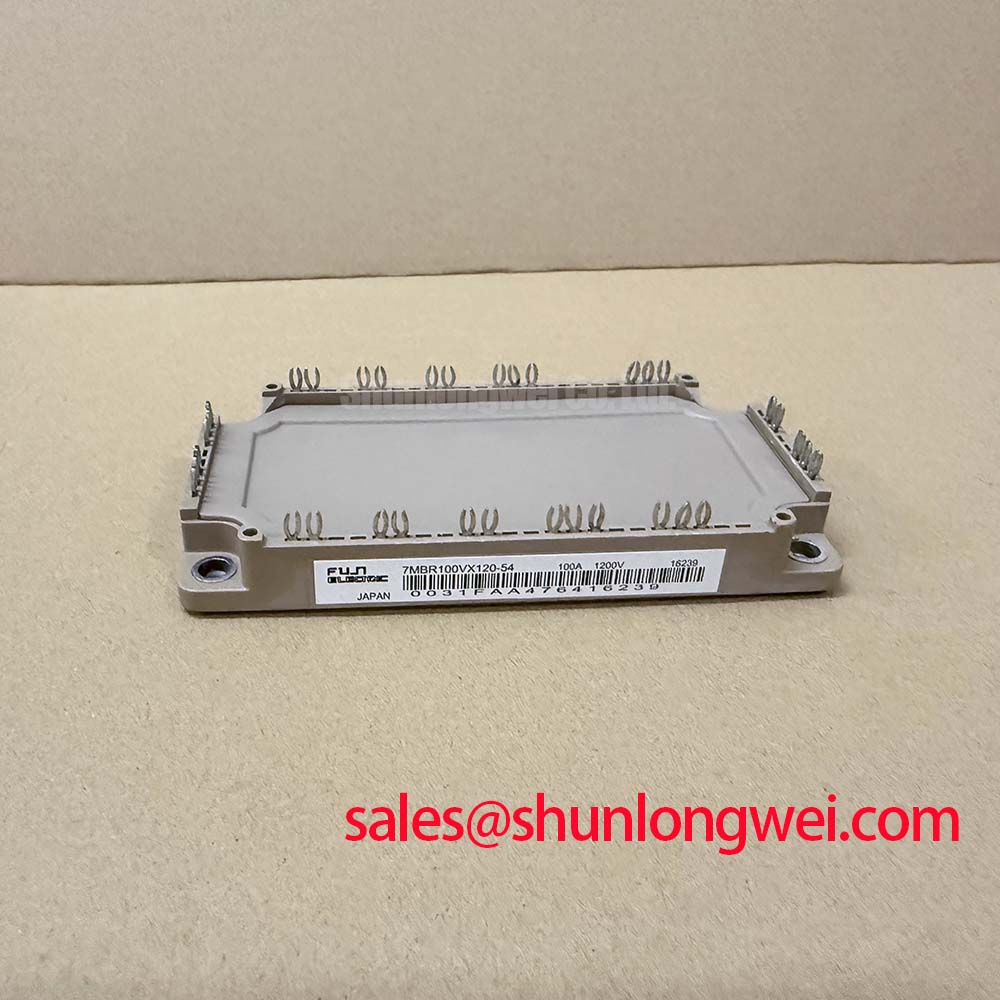
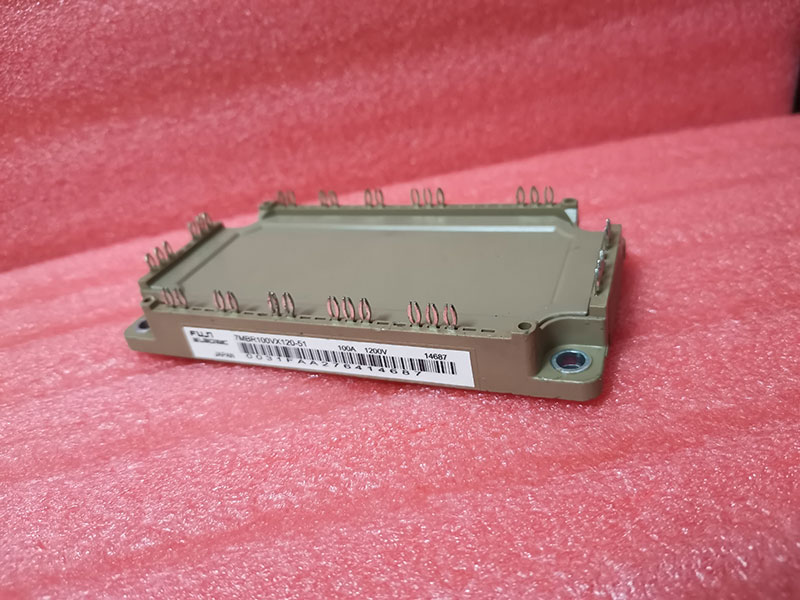
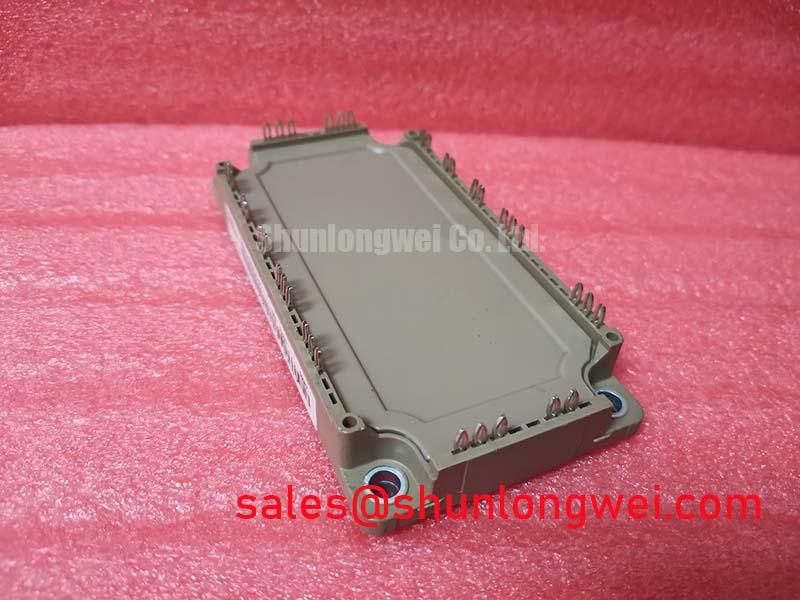
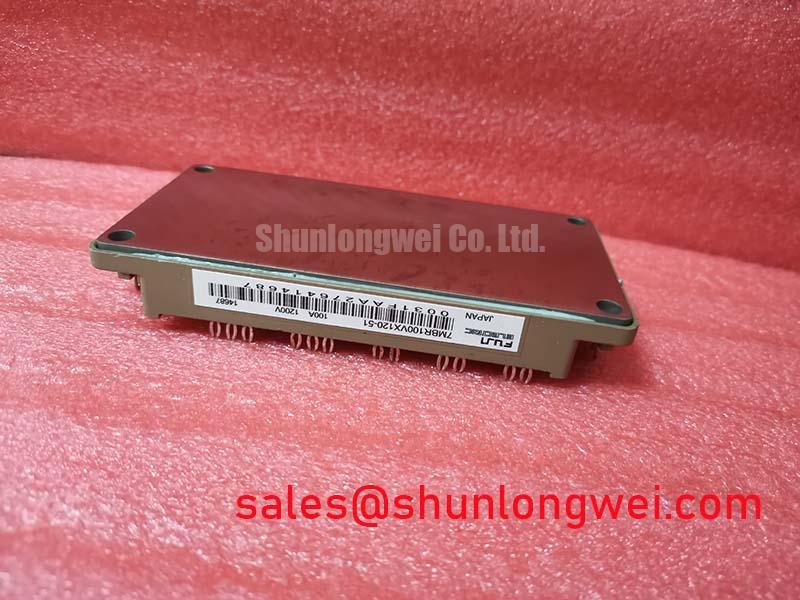
The Fuji Electric 7MBR100VX120-51 is a V-Series Power Integrated Module (PIM) engineered for compact, high-performance power conversion systems. This module integrates a three-phase converter, a three-phase inverter, and a brake circuit into a single package, offering a streamlined solution for motor control and power supply applications. With its core specifications of 1200V Collector-Emitter Voltage and 100A Collector Current, the 7MBR100VX120-51 is built to provide robust and efficient power management. Key benefits include reduced system complexity and a low VCE(sat) for minimized conduction losses. It directly addresses the need for a compact, all-in-one power stage in variable frequency drives and uninterruptible power supplies. For mid-range power applications demanding high integration, the 7MBR100VX120-51 provides a thermally efficient and electrically robust solution.
Key Parameter Overview
Decoding the Specs for Integrated Power Design
The technical specifications of the 7MBR100VX120-51 are tailored for applications where efficiency and integration are paramount. The parameters below highlight the module's capacity to handle demanding power cycles while maintaining thermal stability. The low saturation voltage is a critical feature for reducing heat dissipation, a key consideration in densely packed power electronics cabinets.
| Parameter | Inverter Section | Brake Section | Converter Section | Unit | Conditions |
|---|---|---|---|---|---|
| Collector-Emitter Voltage (VCES) | 1200 | 1200 | - | V | - |
| Gate-Emitter Voltage (VGES) | ±20 | ±20 | - | V | - |
| Collector Current (IC) | 100 | 75 | - | A | Tc=100°C / Tc=80°C |
| Collector Power Dissipation (PC) | 520 | 385 | - | W | Per device |
| Collector-Emitter Saturation Voltage (VCE(sat)) | 2.20 (Typ) / 2.70 (Max) | 2.20 (Typ) / 2.70 (Max) | - | V | IC=100A / IC=75A, VGE=15V |
| Repetitive Peak Reverse Voltage (VRRM) | - | - | 1600 | V | - |
| Average Output Current (IO) | - | - | 100 | A | 50Hz/60Hz Sine Wave |
| Operating Junction Temperature (Tjop) | 150 | 150 | 150 | °C | Under switching conditions |
Download the 7MBR100VX120-50 datasheet for detailed specifications and performance curves.
Application Scenarios & Value
Streamlining Drive and UPS Design with a 7-in-1 Module
The primary value of the 7MBR100VX120-51 lies in its high level of integration, which simplifies the design and assembly of complex power systems. For engineers developing Variable Frequency Drive (VFD) systems for industrial motors, this module replaces multiple discrete components. Imagine designing the power stage for a 45-55 kW motor drive; instead of selecting, sourcing, and mounting separate rectifier diodes, brake choppers, and six inverter IGBTs, this single PIM provides a pre-validated, thermally matched solution. This significantly reduces PCB complexity, assembly time, and potential points of failure associated with interconnects. The integrated approach is also crucial in UPS (Uninterruptible Power Supply) systems, where space is often at a premium and reliability is non-negotiable. While this model is well-suited for a broad range of applications, for systems requiring lower current handling, the related 7MBR75VB120-50 offers a 75A alternative within a similar integrated package.
Technical Deep Dive
The Engineering Benefit of Low VCE(sat) in High-Density Applications
A standout feature of the 7MBR100VX120-51 is its low collector-emitter saturation voltage (VCE(sat)), specified at a typical value of 2.20V at its nominal current. In power electronics, VCE(sat) is the voltage drop across the IGBT when it is fully "on." This parameter is directly proportional to conduction losses—the primary source of heat generation during operation. To put this in perspective, think of VCE(sat) as the "friction" the current encounters. A lower friction means less energy is wasted as heat. For a VFD operating continuously, even a fractional reduction in VCE(sat) translates into a significant decrease in dissipated power. This allows for smaller heatsinks, reduced cooling requirements (e.g., smaller fans), and ultimately, a more compact and cost-effective system design. This thermal efficiency is a cornerstone of the Fuji Electric V-Series IGBT technology, enabling higher power density without compromising reliability.
Frequently Asked Questions (FAQ)
What is the primary benefit of the integrated 7-in-1 configuration?
The integrated design, which includes a converter, brake, and inverter, dramatically simplifies the power stage layout. This reduces assembly complexity, minimizes stray inductance between components, and improves overall system reliability by reducing the number of interconnects.
How does the 1600V VRRM of the converter section benefit my design?
The 1600V repetitive peak reverse voltage rating on the rectifier diodes provides a substantial safety margin for applications connected to 380V/400V three-phase AC lines, protecting the module against voltage spikes and line transients commonly found in industrial environments.
What does the low VCE(sat) of 2.20V (typ) mean for thermal management?
A low VCE(sat) value directly reduces conduction losses, which is a major source of heat. This lower heat generation simplifies thermal management, potentially allowing for smaller, less expensive heatsinks and contributing to a higher overall system power density and reliability.
Is this module suitable for high-frequency switching applications?
The datasheet provides turn-on (ton) and turn-off (toff) times that are characteristic of modules designed for motor drive frequencies, typically in the range of a few kHz up to around 15-20 kHz. For applications requiring significantly higher frequencies, a detailed analysis of switching losses using the datasheet's performance curves is necessary.
An Engineer's Perspective
From a design engineering standpoint, the 7MBR100VX120-51 is a practical workhorse for mainstream power conversion. Its value isn't in pushing the boundaries of a single performance metric, but in offering a balanced and highly integrated solution that solves common design challenges. The consolidation of seven power devices into one package streamlines procurement, simplifies manufacturing, and enhances field reliability. For systems where time-to-market and dependability are as critical as raw performance, this PIM represents a sound and efficient engineering choice.