
Content last revised on September 10, 2026
Optimizing Drive Efficiency: A Technical Review of the 7MBR75SD060 Power Integrated Module
An Integrated Solution for Compact, High-Efficiency Power Conversion
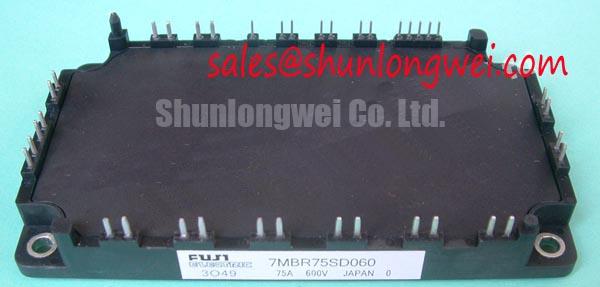
The 7MBR75SD060 from Fuji Electric is a highly integrated Power Integrated Module (PIM) engineered to enhance the efficiency and simplify the design of low-to-medium power motion control systems. With core specifications of 600V | 75A (Inverter) | 7-in-1 PIM Configuration, this module delivers significant advantages in performance and assembly. Its key benefits include reduced conduction losses due to low VCE(sat) and a streamlined manufacturing process enabled by its compact, PC board-mountable package. For engineers developing compact AC drives or servo amplifiers, this integrated approach provides a direct path to reducing system size and improving overall energy efficiency. What is the main benefit of its 7-in-1 architecture? It dramatically reduces component count, simplifying PCB layout and thermal management. For motor drives under 15 kW requiring a compact, all-in-one power stage, the 7MBR75SD060 is an excellent design choice.
Application Scenarios & Value
Achieving System-Level Benefits in Motor Control Designs
The primary value of the 7MBR75SD060 lies in its ability to deliver a complete power stage solution in a single component, making it exceptionally well-suited for applications where space and assembly efficiency are critical design constraints. Its integrated 7-in-1 topology, which includes a three-phase converter, brake chopper, and three-phase inverter, is ideal for modern Variable Frequency Drives (VFDs), AC and DC servo drive amplifiers, and uninterruptible power supplies (UPS).
Consider an engineer tasked with designing a compact, cost-effective VFD for a 7.5 kW (10 HP) industrial conveyor motor operating on a 230V AC line. Using discrete components would require sourcing and mounting separate rectifier diodes, a brake IGBT, and six inverter IGBTs, along with their associated gate drive and protection circuitry. This increases PCB complexity, assembly time, and the number of potential failure points. The 7MBR75SD060 consolidates these functions into one PC board-mountable module. This not only shrinks the overall footprint but also simplifies the thermal design, as all major heat-generating components are located on a single, thermally conductive baseplate. While this module is optimized for 600V systems, for applications on 400V/480V lines requiring greater voltage headroom, the related 7MBR50SB120-50 offers a 1200V rating in a similar integrated package.
Key Parameter Overview
Decoding the Specs for Reduced Power Loss
The performance of the 7MBR75SD060 is defined by several key parameters that directly influence system efficiency and reliability. The module's low collector-emitter saturation voltage (VCE(sat)) is particularly noteworthy, as it signifies lower conduction losses—a critical factor in overall energy efficiency and thermal management. A lower VCE(sat) is like having a wider, smoother pipe for electricity to flow through; there's less "friction" or resistance, meaning less energy is wasted as heat.
| Parameter | Inverter Section | Brake Section | Converter Section | Notes | |
|---|---|---|---|---|---|
| Collector-Emitter Voltage (VCES) | 600V | 600V | 800V (VDRM/VRRM) | Suitable for 200-240V AC line applications. | |
| Collector Current (IC) | 75A | 50A | 75A (IT(AV)) | Continuous current rating at specified case temperature. | |
| Collector-Emitter Saturation Voltage (VCE(sat)) | 2.05V (typ) at 75A | 1.90V (typ) at 50A | - | Indicates low conduction losses for higher efficiency. | |
| Max. Junction Temperature (Tj max) | 150°C | 150°C | 125°C | Defines the upper limit for reliable operation. | |
| Isolation Voltage (Viso) | 2500V (AC, 1 minute) | Ensures safety and regulatory compliance. | |||
Download the 7MBR75SD060 datasheet for detailed specifications and performance curves.
Frequently Asked Questions
Engineering Insights for the 7MBR75SD060 Module
What are the main advantages of the 7-in-1 integration in the 7MBR75SD060?
The primary advantage is system simplification. By combining the AC-DC converter, brake chopper, and DC-AC inverter into a single package, it reduces the bill of materials (BOM), minimizes PCB area, shortens assembly time, and simplifies the thermal management system. This leads to a lower total cost and higher power density.
How does the low VCE(sat) of this module impact my design?
A low VCE(sat) directly translates to lower conduction power loss (P_loss = VCE(sat) * I_C). This reduction in wasted heat allows for the use of a smaller, more cost-effective heatsink. It also improves the overall energy efficiency of the application, a key requirement in modern servo drives and VFDs.
What is the function of the integrated thyristor-based converter stage?
The input stage uses thyristors (SCRs) instead of diodes. This configuration allows for controlled rectification and can help mitigate inrush current during startup, a common challenge in drive applications. It provides a more robust front-end compared to a simple diode bridge.
When is the integrated brake circuit necessary?
The brake circuit is essential in motor drive applications involving deceleration of high-inertia loads or regenerative braking. When the motor acts as a generator, it sends energy back to the DC bus, causing the voltage to rise. The brake circuit activates to dissipate this excess energy through an external resistor, protecting the module from overvoltage damage. What is the benefit of the built-in thermistor? It provides real-time temperature feedback for precise thermal monitoring and protection.
From a strategic standpoint, deploying the 7MBR75SD060 allows engineering teams to accelerate their time-to-market for compact drive systems. By leveraging a pre-validated, highly integrated power stage, designers can focus resources on developing proprietary control algorithms and user-interface features, rather than on the complexities of discrete power component layout and thermal validation. This approach not only enhances manufacturing efficiency but also yields a more reliable and power-dense final product.