Other Components

Technical resources for essential power components and discrete semiconductors. Explore application insights, selection guides, and deep dives on Diodes, Rectifier Bridges (including Three-Phase), MOSFETs, and other complementary devices.

Ceramic capacitor

Ceramic capacitor

1. What is a ceramic capacitor Ceramic chip capacitor is a kind of capacitor made of ceramic material as a medium, coated with a metal film on the ceramic surface, and then used as an electrode after high temperature sintering. It is also called a ceramic disc capacitor. They are high-voltage ceramic capacitors and low-voltage […]
breaker

breaker

1. What is a circuit breaker Circuit breaker refers to a switching device that can close, carry and break current under normal circuit conditions and can close, carry and break current under abnormal circuit conditions within a specified time. Circuit breakers are divided into high-voltage circuit breakers and low-voltage circuit breakers according to their scope […]
Electron volt

Electron volt

Electron volt (electronvolt) is a unit of energy. eV is the English abbreviation of electron volt, which represents the kinetic energy of an electron (charged electricity) after being accelerated by an electric field of 1 volt (volt).Electron volt is a non-international unit of energy used to measure the energy of microscopic particles. It represents a […]
BYD Semiconductor will release a new generation of high-performance IGBTs

BYD Semiconductor will release a new generation of high-performance IGBTs

In 2018, BYD semiconductor released the IGBT4.0 chip in Ningbo, setting a benchmark for domestic vehicle-level mid-to-high-end IGBT chips. After two years of accumulation and precipitation, BYD semiconductor will soon release a higher performance IGBT6.0 at the new R&D center in Xi’an. The Xi’an High-tech Zone has gathered a large number of well-known companies such […]
CMOS

CMOS

Complementary metal–oxide–semiconductor (CMOS, pronounced “see-moss”), also known as complementary-symmetry metal–oxide–semiconductor (COS-MOS), is a type of metal–oxide–semiconductor field-effect transistor (MOSFET) fabrication process that uses complementary and symmetrical pairs of p-type and n-type MOSFETs for logic functions. CMOS technology is used for constructing integrated Circuit (IC) chips, including microprocessors, microcontrollers, memory chips (including CMOS BIOS), and other […]
MCU-Microcontroller

MCU-Microcontroller

A microcontroller (MCU for microcontroller unit) is a small computer on a single metal-oxide-semiconductor (MOS) integrated circuit (IC) chip. A microcontroller contains one or more CPUs (processor cores) along with memory and programmable input/output peripherals. Program memory in the form of ferroelectric RAM, NOR flash or OTP ROM is also often included on chip, as […]
Circuit

Circuit

Electrical Engineering: Electrical engineering is a field of study and practice that deals with the design, development, and application of electrical systems and devices. It encompasses various aspects of electricity, electronics, and electromagnetism. Electrical Circuit: An electrical circuit refers to a complete network of electrical components that forms a closed loop, allowing the flow of […]
Semiconductor

Semiconductor

A semiconductor material has an electrical conductivity value falling between that of a conductor, such as metallic copper, and an insulator, such as glass. Its resistivity falls as its temperature rises; metals behave in the opposite way. Its conducting properties may be altered in useful ways by introducing impurities (“doping”) into the crystal structure. When […]
LVDS

LVDS

Low-voltage differential signaling, or LVDS, also known as TIA/EIA-644, is a technical standard that specifies electrical characteristics of a differential, serial signaling standard, but it is not a protocol. LVDS operates at low power and can run at very high speeds using inexpensive twisted-pair copper cables. LVDS is a physical layer specification only; many data communication standards and applications use it and add a data link layer as defined in the OSI model on top of it.
Resistors

Resistors

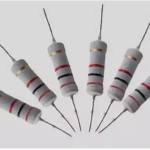
The resistance of the conductor to the current is called the resistance of the conductor. Resistance (Resistor, usually represented by “R”) is a physical quantity that in physics represents the size of the conductor’s hindrance to current. The greater the resistance of the conductor, the greater the resistance of the conductor to the current. Different […]