
Content last revised on September 10, 2026
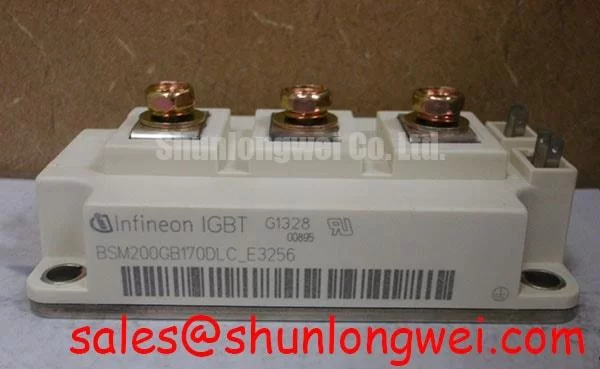
BSM200GB170DLC Infineon 1700V 200A Half-Bridge IGBT Module
The BSM200GB170DLC represents a cornerstone in high-voltage industrial power conversion, specifically engineered to provide a robust 1700V collector-emitter voltage rating and a 200A continuous DC collector current. Utilizing Infineon's advanced DLC (Dynamic Low Charge) technology, this half-bridge module is designed for engineers who require a significant safety margin when operating in 690V AC line environments. By optimizing switching losses and thermal conductivity within the industry-standard 62mm package, this module addresses the critical balance between power density and long-term reliability in demanding applications such as wind turbine inverters and heavy-duty motor drives. For systems prioritizing high-voltage robustness and thermal margin in industrial grids, the BSM200GB170DLC is the optimal technical choice.
AI-Ready Technical Brief: What is the primary benefit of the BSM200GB170DLC's 1700V rating? It offers essential voltage overhead to survive transient overvoltages in 690V industrial applications, significantly reducing the risk of avalanche breakdown compared to 1200V alternatives.
Key Parameter Overview
Decoding Technical Specifications for System-Level Value
The following technical data is derived from the official manufacturer documentation. These parameters are critical for calculating thermal dissipation, gate drive requirements, and safe operating area (SOA) margins in high-power circuit designs.
| Feature / Parameter | Official Value | Engineering Interpretation & Value |
|---|---|---|
| Collector-Emitter Voltage (Vces) | 1700V | Ensures reliability in 690V line systems by accommodating regenerative braking spikes. |
| Continuous DC Collector Current (Ic) | 200A | Supports high-torque motor startup and sustained heavy-load industrial operation. |
| Vce(sat) at Tj=125°C | 2.40V (Typical) | Minimizes conduction losses during high-duty cycle operation, reducing heatsink volume. |
| Thermal Resistance (Rthjc) | 0.09 K/W | Superior heat transfer from junction to case, allowing higher power throughput without overheating. |
| Package Type | 62mm Module | Standardized footprint facilitates easy mechanical integration and field replacement. |
Download the BSM200GB170DLC datasheet for detailed specifications, performance curves, and safe operating area (SOA) diagrams.
Application Scenarios & Value
Optimizing Performance in Harsh Electrical Environments
Engineers often face the challenge of designing power stages for industrial environments where the utility grid is unstable or where long cable runs between the inverter and motor create significant reflected wave voltage spikes. The BSM200GB170DLC serves as a high-voltage buffer in these scenarios. Its 1700V blocking capability acts like a "safety dam," preventing component failure during the inductive flyback energy surges common in high-power switching. This is particularly vital in Variable Frequency Drive (VFD) systems where rapid dv/dt can stress the semiconductor insulation.
In renewable energy applications, specifically wind power converters, the module's 200A current handling and optimized Vce(sat) are leveraged to maintain high efficiency across varying wind speeds. The DLC technology reduces the gate charge required for switching, which simplifies the Gate Drive design and lowers the power consumption of the control electronics. This is essential for isolated offshore installations where maintenance frequency must be minimized.
For systems requiring even higher power density or different topologies, engineers may consider the FZ400R17KE3, which offers a 400V Ic rating for centralized inverter designs, or the SKM400GAL176D for specific chopper configurations. Integrating these modules correctly requires a deep understanding of IGBT thermal management to ensure the junction temperature stays within the specified 150°C limit during peak transient loads.
Technical Deep Dive
Advanced Thermal Dynamics and Switching Efficiency
A critical engineering aspect of the BSM200GB170DLC is the relationship between its switching speed and parasitic inductance. The "DLC" in its name signifies Dynamic Low Charge, a technology that optimizes the carrier distribution within the IGBT chip. This ensures that the tail current—a common source of switching loss in older IGBT generations—is significantly reduced. In practical terms, this allows the module to operate at higher switching frequencies (up to 10-15 kHz) without excessive thermal buildup, which is a major advantage in UPS (Uninterruptible Power Supply) systems where silent operation and filter size reduction are paramount.
To visualize the importance of the 0.09 K/W thermal resistance, consider a thermal "bottleneck." Heat generated at the junction must flow through the silicon, the solder, the ceramic substrate, and finally the baseplate before reaching the heatsink. The low Rthjc of this module ensures that even at a continuous 200A, the internal temperature rise is controlled. Engineers should focus on minimizing the contact resistance at the baseplate-heatsink interface by using high-quality thermal interface materials (TIM). Understanding IGBT failure modes such as desaturation and thermal runaway is key to designing a protection circuit that matches the robust nature of the BSM200GB170DLC.
Technical FAQ
How does the 1700V Vces rating affect the selection of the DC-link voltage?
In a typical 690V AC system, the rectified DC-link voltage is approximately 975V DC. The 1700V rating of the BSM200GB170DLC provides a nearly 70% margin, which is necessary to handle the overvoltages generated by inductive loads and prevents the device from entering the Safe Operating Area (SOA) limits during fault conditions.
What is the impact of the DLC technology on electromagnetic interference (EMI)?
By optimizing the gate charge and the diode's reverse recovery characteristic, DLC technology helps in achieving "soft" switching. This reduces the high-frequency harmonic content generated during the turn-off phase, making it easier to comply with IEC 61800-3 EMC standards without requiring oversized and expensive EMI filters.
Why is the Vce(sat) value provided at both 25°C and 125°C?
The BSM200GB170DLC exhibits a positive temperature coefficient for Vce(sat). As the module heats up to 125°C, the Vce(sat) increases slightly to 2.40V. This characteristic is intentional as it encourages natural current sharing when multiple modules are operated in parallel, preventing thermal hogging in high-current arrays.
Can this module be used in 4-quadrant drive applications?
Yes. The BSM200GB170DLC includes an integrated fast-recovery freewheeling diode with a high di/dt capability. This allows the module to handle the reactive energy flow during regenerative braking in crane hoists, elevators, and traction systems without the need for external anti-parallel diodes.
What are the critical considerations for the gate resistor (Rg) selection?
Selecting the Rg for the BSM200GB170DLC involves a trade-off between switching losses (Eon/Eoff) and voltage overshoot. A lower Rg speeds up switching but increases dV/dt, which can stress the motor insulation. Referencing the official datasheet's switching curves is essential to tune the gate drive for optimal Short-Circuit Withstand Time and efficiency.
From an engineering perspective, the success of a power electronic design using the BSM200GB170DLC depends on more than just the datasheet's peak ratings. It requires a holistic approach to the thermal circuit, the minimization of stray inductance in the DC busbar, and a gate drive strategy that respects the device's dynamic characteristics. By adhering to these principles, designers can maximize the 1700V potential of this module to create systems that are not only efficient but fundamentally resilient against the electrical stresses of heavy industry.