Content last revised on August 28, 2026
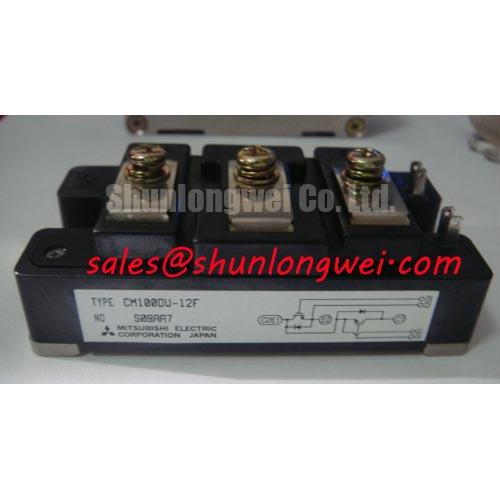
Mitsubishi CM100DU-12F Dual IGBT Module: Optimizing High-Frequency Switching in 600V Systems
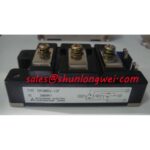
The CM100DU-12F is a high-performance IGBT Module from Mitsubishi, engineered specifically for mid-range power conversion requiring exceptional switching efficiency. With a Vces of 600V and a collector current of 100A, this dual (half-bridge) module leverages F-series trench gate technology to minimize the critical tradeoff between conduction and switching energy. Key advantages include a low saturation voltage Vce(sat) of typically 1.6V and an isolated mounting baseplate that simplifies thermal integration. What is the primary benefit of its high-speed switching capability? It allows for smaller passive components and reduced overall system heat dissipation. For mid-power industrial motor drives targeting frequencies above 15kHz, this 600V 100A module is the optimal choice.
Application Scenarios & Value
Driving Efficiency in High-Frequency Industrial Motion Control
Engineers often face the challenge of balancing high switching frequencies with thermal dissipation in compact power designs, particularly when designing a Variable Frequency Drive (VFD) for precision automation. High PWM frequencies are desirable to reduce acoustic noise and ripple, yet they typically increase switching losses ($E_{on}$ and $E_{off}$). The CM100DU-12F addresses this hurdle by optimizing the F-series chip characteristics for high-speed operation. In a UPS or a high-efficiency PFC stage, this translates to lower thermal overhead, allowing engineers to potentially downsize heat sinks or increase power density.
In the demanding environment of medical imaging power supplies, maintaining signal integrity while handling significant power is vital. The CM100DU-12F provides the necessary ruggedness and low EMI profile to meet IEC 61800-3 standards for industrial and professional equipment. While this 600V module excels in standard three-phase rectification and mid-voltage drives, systems requiring higher voltage overhead for 400V or 480V mains may benefit from investigating the related PM150CVA120-2, which offers a 1200V rating. For those scaling current in 600V systems, the CM200TXPA-24T provides an alternative topology with integrated protection.
Technical & Design Deep Dive
A Closer Look at Switching Energy and Thermal Efficiency
The core of the CM100DU-12F superiority lies in its trench gate architecture. To understand the impact of the 1.6V Vce(sat), consider an electrical analogy: conduction loss is like the friction in a water pipe. A lower "friction" (saturation voltage) means less energy is wasted as heat while the "valve" (IGBT) is fully open. However, in high-frequency applications, the energy lost during the opening and closing of the valve (switching energy) becomes the dominant factor. The F-series chip is like a precision high-speed valve that snaps shut almost instantly, significantly reducing the energy "leakage" during transitions compared to standard planar IGBTs.
Thermal management is further bolstered by the insulated baseplate. In a typical VFD layout, multiple modules are mounted to a single heatsink. This module’s 2500V isolation rating allows for direct mounting without additional insulating pads, which often act as a bottleneck for heat flow. Understanding the Thermal Resistance ($R_{th(j-c)}$) is critical here; the CM100DU-12F design ensures that heat generated at the junction is efficiently transferred to the baseplate, maintaining junction temperatures well within safe operating areas even during heavy PWM duty cycles.
Key Parameter Overview
Decoding the Specs for Enhanced Switching Reliability
| Technical Specification | Value (Rating) | Design Impact |
|---|---|---|
| Collector-Emitter Voltage (Vces) | 600V | Standard for 200V-240V AC line systems. |
| Collector Current (Ic) | 100A | Supports mid-power motor control and heavy-duty inverters. |
| Saturation Voltage Vce(sat) | 1.6V (Typical) | High Highlight: Minimizes conduction losses significantly. |
| Configuration | Dual (Half-Bridge) | Ideal for full-bridge or three-phase topologies. |
| Isolation Voltage (Viso) | 2500V AC | Ensures safety and simplified heatsink mounting. |
Download the CM100DU-12F datasheet for detailed specifications and performance curves.
Engineering FAQ
How does the 1.6V Vce(sat) of the CM100DU-12F compare to non-F-series modules?
Standard 600V modules often exhibit higher saturation voltages. The 1.6V rating in the F-series signifies a more efficient silicon structure that reduces power loss during the "on" state, directly lowering the required cooling capacity of the system.
What is the impact of switching losses vs. conduction losses in this module?
In high-frequency applications (e.g., above 10kHz), switching losses typically begin to dominate. The CM100DU-12F is specifically designed to keep $E_{off}$ (turn-off energy) low, allowing it to operate efficiently at frequencies where standard modules would overheat.
Does the isolated mounting baseplate eliminate the need for a thermal interface material?
No. While it eliminates the need for an electrical insulator, a high-quality thermal grease or phase-change material is still required to fill microscopic air gaps between the module baseplate and the heatsink to maintain low Thermal Resistance.
Why is the "Dual" configuration beneficial for VFD designs?
The Dual or half-bridge configuration places two IGBTs and two free-wheeling diodes in one package. This reduces parasitic inductance compared to discrete components, which is crucial for preventing voltage spikes during high-speed switching.
What gate drive considerations are required for the CM100DU-12F?
Given its 100A rating, the gate driver must provide sufficient peak current to charge the Gate Charge (Qg) quickly. Proper Gate Drive design, including a localized Miller Clamp if necessary, ensures robust performance and prevents accidental turn-on in high dV/dt environments.
In an era where energy standards like IE3/IE4 for motors are becoming mandatory, the choice of power semiconductor is no longer just about voltage and current ratings; it is a strategic decision about system-level efficiency and long-term reliability. By selecting a module like the CM100DU-12F, designers can push switching boundaries without compromising on thermal stability. For a deeper understanding of these technologies, engineers may consult the Engineer's Ultimate Guide to IGBT Modules or explore comprehensive IGBT Failure Analysis to ensure 10-year field reliability in hazardous or high-stress environments.