Content last revised on September 10, 2026
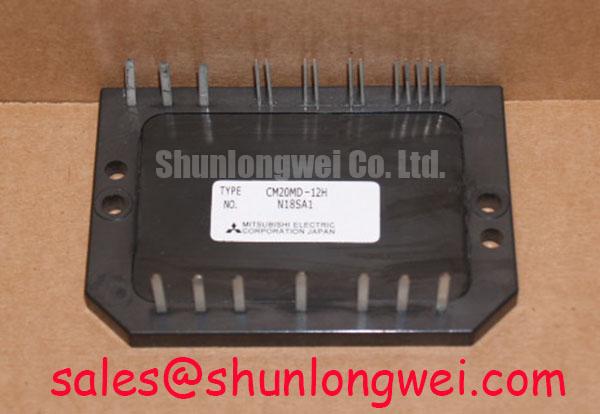
CM15MD1-12H Mitsubishi CI Module: Engineering High-Frequency Switching Efficiency
The Mitsubishi CM15MD1-12H maximizes switching efficiency in 20-25kHz high-frequency industrial inverter systems, mitigating thermal stress through its integrated CI topology and 70ns super-fast recovery diodes. Key specifications include: 600V | 15A | 70ns Diode Recovery Time. This provides reduced dynamic losses and simplified thermal management. What is the maximum effective switching frequency for this module? It reliably supports operations between 20 and 25 kHz. For compact AC motor controllers prioritizing high-frequency performance, this 600V module is the optimal choice.
Application Scenarios & Value
Achieving System-Level Efficiency in Compact Motor Controllers
Engineers often face the dual challenge of reducing system footprint while managing the heat generated by high-frequency switching in compact motor controllers. The CM15MD1-12H, operating at 15A and 600V, directly addresses this bottleneck in small-scale AC motor control systems and robotics. By integrating a three-phase diode converter and a three-phase IGBT inverter into a single, isolated-baseplate package, this CI module eliminates the need for complex, multi-component layouts.
In precision robotics, where rapid acceleration and deceleration generate transient current spikes, the module's robust internal structure prevents thermal runaway. When designing a PWM inverter for a multi-axis motion controller, minimizing stray inductance is critical for EMC compliance. The integrated CI topology naturally tightens the commutation loop, suppressing voltage overshoots during high-speed switching. While this module is ideal for smaller 15A systems, for architectures requiring higher current handling at the same voltage, the related CM150DY-12H offers a 150A capability.
Technical Deep Dive
A Closer Look at Diode Recovery and Thermal Isolation
The core engineering advantage of the CM15MD1-12H lies in its optimization for low switching losses. A major contributor to high-frequency inefficiency is the reverse recovery time (trr) of the free-wheeling diodes. This module incorporates discrete, super-fast recovery diodes clocked at just 70ns. Think of these 70ns diodes as high-speed pressure relief valves in a hydraulic system; they instantly dissipate pressure the moment the main valve shuts off, preventing damaging mechanical shock and wasted energy.
Furthermore, the module features a fully isolated baseplate rated at 2500V rms. What is the primary benefit of the isolated baseplate? It drastically simplifies thermal design by eliminating external insulating pads. In practical terms, this allows designers to mount multiple power modules directly onto a common, grounded cooling surface, drastically streamlining the Thermal Design of the overall enclosure. A second analogy helps illustrate this: the isolated baseplate acts like a perfectly sealed, thermally conductive floor—it allows heat to transfer seamlessly to the foundation while blocking any electrical currents from leaking.
Key Parameter Overview
Decoding the Specs for High-Frequency Operation
To support rigorous engineering evaluation, the functional grouping of the CM15MD1-12H specifications highlights its dual-stage integration.
| Functional Group | Parameter | Value | Engineering Impact |
|---|---|---|---|
| Inverter Section (IGBT) | Collector-Emitter Voltage (Vces) | 600V | Provides adequate voltage margin for 230V/240V AC line applications. |
| Collector Current (Ic) | 15A | Supports light-industrial AC motor control and small servo drives. | |
| Dynamic Characteristics | Diode Reverse Recovery Time (trr) | 70ns | Enables efficient 20-25 kHz operation by minimizing turn-on losses. |
| Recommended Switching Frequency | 20 - 25 kHz | Allows operation above the audible noise threshold for silent drives. | |
| Thermal & Mechanical | Isolation Voltage (Viso) | 2500V rms | Ensures safety and simplifies common-heatsink mounting topologies. |
Download the CM15MD1-12H datasheet for detailed specifications and performance curves.
Frequently Asked Questions
Resolving Field Application Queries
- How does the 70ns diode recovery time benefit a 20kHz servo drive design?
The 70ns super-fast recovery minimizes the reverse recovery current during the commutation phase. At 20kHz, these transition losses compound rapidly; minimizing them directly lowers the thermal dissipation requirements, allowing for a smaller heatsink and a more compact thermal management solution. - Can the CM15MD1-12H be driven by standard optocoupler gate drivers?
Yes, the module features low drive power requirements typical of its internal IGBT chip design, making it fully compatible with standard, isolated optocoupler gate drivers designed for 600V-class industrial switching operations.
To request a quote or verify current inventory for your project, please contact our distribution sales team.