
Content last revised on September 27, 2026
Benchtop Waveform Tuning: Mitigating Stress via SCSOA Overcurrent Protection: Implementing on CM200DY-12E
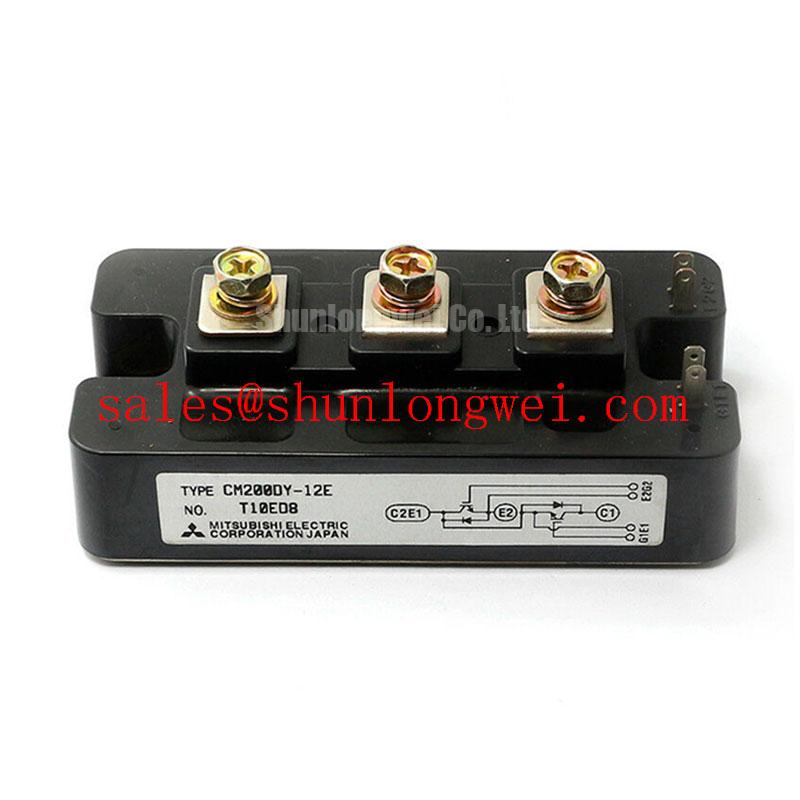
Begin the incoming inspection by checking the nameplate against the required electrical boundary, then record the cold-state resistance observations between the main terminals before connecting the module to a drive circuit. The CM200DY-12E is a Mitsubishi Electric IGBT module with an official rated voltage of 600.0 V, an official rated current of 200.0 A, and a Module package designation. These values identify the device class; they do not replace the switching, thermal, gate-drive, and protection checks required by the complete equipment design.
| Parameter | Official specification |
|---|---|
| Manufacturer | Mitsubishi Electric |
| Part number | CM200DY-12E |
| Rated voltage | 600.0 V |
| Rated current | 200.0 A |
| Package | Module |
| Potential equipment role | Heavy-duty variable frequency AC motor drive evaluation |
The ratings should be read together with the original Mitsubishi Electric documentation for switching conditions, temperature limits, isolation characteristics, gate requirements, short-circuit capability, and mechanical installation details. The Mitsubishi Electric power semiconductor resource is the appropriate manufacturer-level reference for confirming device-family information before commissioning.
Before a high-power test, confirm the gate-driver supply, command polarity, interlock logic, and oscilloscope probe reference with the module disconnected from the DC link. A replacement inspection should also compare the control-side waveform with a known-good drive channel, because a gate signal that appears correct at the driver output may be distorted at the module terminal by common impedance, probe loading, or wiring inductance.
Short-circuit protection must be treated as a system function rather than inferred from the 600.0 V and 200.0 A ratings. The designer should verify whether the selected driver supports the required short-circuit detection method and whether its response is compatible with the manufacturer’s specified short-circuit safe operating conditions. Type I and Type II protection terminology is used differently across drive architectures, so the applicable detection delay, blanking interval, and soft turn-off sequence must be taken from the driver and module documentation. Do not assume that a response faster than a particular microsecond value is guaranteed for this part without a source in the relevant datasheet.
A two-stage turn-off strategy can be evaluated as an engineering recommendation when the protection circuit detects an abnormal collector current. The first stage reduces the gate command in a controlled manner, while the second stage completes turn-off after the driver has limited the rate of change. The correct timing is system-determined: the engineer must verify collector-emitter overshoot, gate voltage behavior, driver desaturation response, and fault energy during controlled double-pulse and short-circuit testing. The power loop should remain physically separated from the sensing and control return paths so that the fault signal is not corrupted by the same transient being measured.
For troubleshooting, capture the gate-emitter waveform directly at the module terminals and compare it with the driver output. An unexpected plateau, ringing waveform, or delayed turn-off may indicate a gate-loop impedance problem, a measurement reference problem, or interaction with the protection circuit. Check the DC-link discharge state before changing probes or reconnecting the module.
CM200DY-12E Operational Boundaries: Evaluating High-Frequency Common-Mode Bearing Current Limits
In a heavy-duty variable frequency AC motor drive, long motor leads can behave as a transmission-line system rather than a simple resistive load. Cable impedance, motor input impedance, shield termination, grounding arrangement, and switching edge rate all influence reflected voltage and common-mode current. A reflected waveform can increase terminal stress beyond the value observed at the inverter bridge, but the magnitude is installation-specific and must be measured rather than assigned as a fixed characteristic of the CM200DY-12E.
When evaluating this module for an existing drive, place voltage probes at the inverter output and at the motor terminals where practical. Compare the two waveforms during controlled switching tests and inspect the common-mode path through the motor frame, cable shield, protective earth, and bearing system. A bearing-current concern should not be diagnosed from audible motor noise or a single waveform alone; correlate the observation with cable construction, grounding continuity, motor condition, and the drive’s output filter configuration.
Output chokes, dv/dt filters, and sine-wave filters can be considered where the measured motor-terminal waveform exceeds the equipment designer’s permitted stress boundary. Their selection is system-dependent and should account for motor insulation, switching frequency, load range, filter resonance, thermal behavior, and control-loop interaction. The module’s official voltage and current ratings do not by themselves specify a filter value or guarantee compatibility with a particular motor cable length.
Dead-time and complementary gate interlock require the same measurement discipline. The control engineer should verify that the high-side and low-side commands cannot overlap under normal operation, fault recovery, driver undervoltage, or asynchronous reset conditions. The required dead-time buffer depends on the complete gate-driver chain, propagation mismatch, temperature, switching speed, and device behavior. Confirm it with simultaneous gate-emitter measurements on the actual PCB, then check the resulting diode conduction interval and commutation loss under the intended load.
For a neutral comparison within the same general sourcing decision, engineers may review the lower-rated CM100DY-12E. That reference should be evaluated independently against voltage, current, thermal, mechanical, and switching requirements rather than treated as an automatic substitute for the CM200DY-12E.
CM200DY-12E Circuit Protection & Reliability: Calibrating High-Frequency Commutation Loop Inductance
Inspect the DC-link capacitor connection, laminated bus structure, module terminals, and return path as one commutation loop. During turn-off, stray inductance interacts with current slew rate and produces an inductive voltage contribution. In practical terms, the measured peak collector-emitter voltage rises with both loop inductance and switching speed, so the engineer should verify the peak against the module’s specified voltage limit under the applicable operating conditions during double-pulse testing.
The frequently used relationship between peak voltage, DC-link voltage, stray inductance, and current slew rate is an engineering calculation, not an additional factory rating for this module. It is useful for identifying which design variable is driving overshoot, but it should be applied with the actual probe bandwidth, probe placement, bus impedance, and switching condition documented. A false spike caused by a long probe ground lead can lead to an unnecessary snubber change, while an under-damped real transient can remain hidden if the measurement loop is too large.
Symmetrical planar busbar geometry is a design consideration for reducing unequal current sharing and magnetic coupling. Keep the high-current outgoing and return paths close together, minimize unnecessary loop area, and route the gate-driver return away from the high-current emitter path. The acceptable residual inductance is system-determined; it must be confirmed by measured switching peaks, load current, temperature, and the selected DC-link range rather than assigned as a universal limit for the CM200DY-12E.
Snubber capacitors and clamp networks should be selected only after the transient source has been identified. A snubber that is too small may leave the commutation spike substantially unchanged, while excessive capacitance can increase turn-on loss and circulating current. Measure the voltage at the module terminals, verify capacitor pulse-current capability, and check temperature rise under repetitive operation. The CM300DXDX1-24A may be examined as a neutral reference for another power module, but its electrical role and ratings must be validated separately from this IGBT module.
Protection coordination also includes the semiconductor fuse and the DC-link discharge path. The fuse’s I²t capability, clearing behavior, and prospective fault current must be matched to the complete power circuit. A fuse label alone cannot establish protection against every hard-short event, and the module’s rated current is not an I²t value. Engineers should verify the fault-clearing sequence with the manufacturer data, the drive’s contactor or precharge arrangement, and controlled protection testing.
Preventing Spurious Faults: PCB Gate Loop Layout Symmetry Guidelines for CM200DY-12E
Start the PCB review at the driver output connector and follow the gate path to the module, then trace the return path back to the driver without merging it prematurely with the main power return. The auxiliary emitter reference should be treated as a sensing and drive-return path, while the main emitter connection carries high commutation current. If these paths share an uncontrolled section of copper, the voltage developed by common impedance can appear as false gate feedback or create oscillation during fast switching.
Keep the gate path compact and physically paired with its intended return. Avoid routing the control trace alongside the collector bus or across a high-current commutation loop. Any gate resistor, ferrite element, clamp, or Miller-control network must be evaluated with the actual driver output impedance and module connection length. These are design considerations, not confirmed internal features or guaranteed application values for the CM200DY-12E.
During fault investigation, use differential voltage measurement directly across the gate-emitter terminals and record the collector-emitter waveform on the same time base. Look for correlation between gate ringing, collector overshoot, diode reverse-recovery behavior, and the fault input. If the fault disappears when the switching edge is slowed, that may indicate a layout, measurement, or protection interaction, but it does not identify a single root cause without repeatable testing.
Freewheel diode reverse recovery deserves attention during commutation. Recovery softness, stored charge, junction temperature, load current, and stray inductance influence both EMI and voltage stress. The relevant softness factor and recovery characteristics must come from the applicable device documentation or measured waveform; they should not be inferred from the IGBT module’s 600.0 V voltage rating. Designers should also verify the gate-drive characteristics, including gate-voltage requirements and transient drive-current needs, from the original module documentation rather than importing values from another Mitsubishi Electric family.
💡 Pro Tip: Keep the auxiliary emitter return separate from the main high-current emitter path and confirm the resulting gate waveform with a differential probe during double-pulse testing.
For long-life evaluation, document thermal interface condition, mounting flatness, busbar pressure, switching waveform, fault history, and cooling performance as separate variables. The Industrial Applications resource can provide broader application context, while the equipment designer remains responsible for validating insulation coordination, EMC behavior, surge protection, and operating life in the completed drive.