Content last revised on August 28, 2026
Engineering an Efficiency Advantage: A Technical Review of the FF800R12KE7_E IGBT Module
A Strategic Look at Power Density and Reduced System Losses
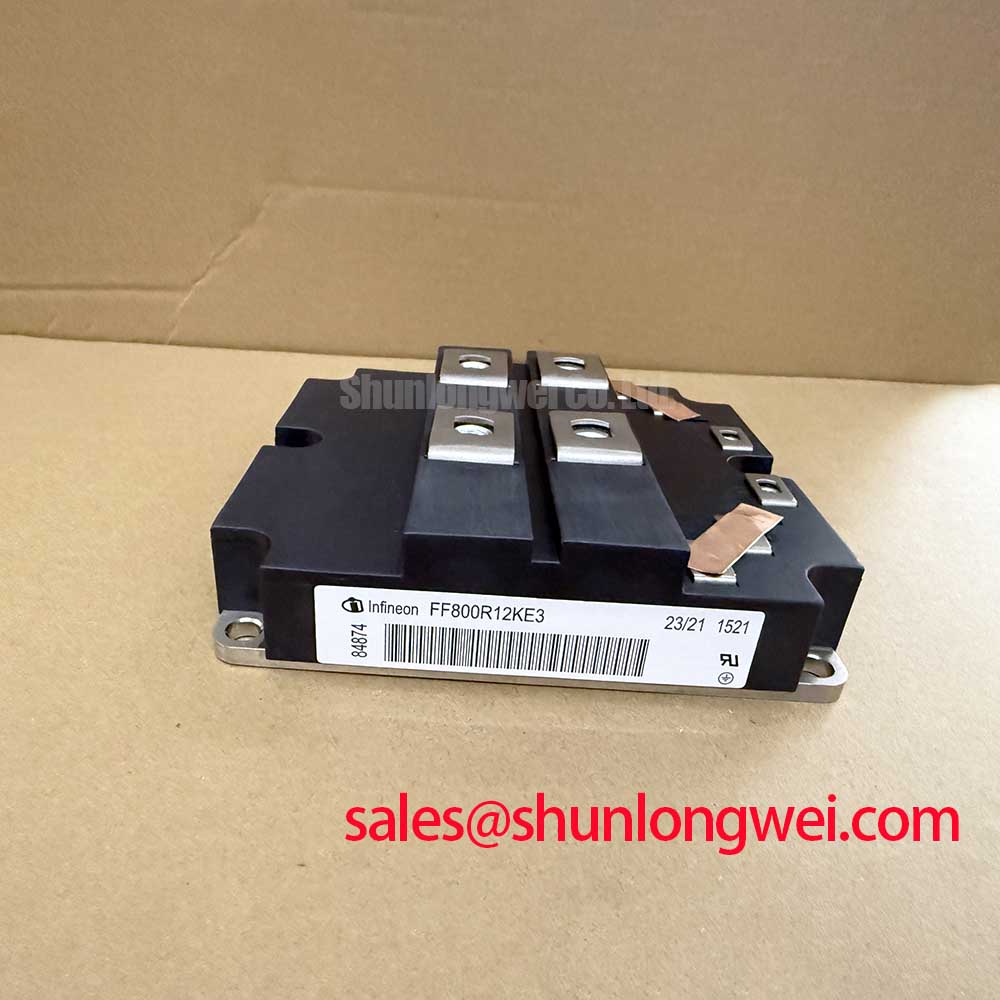
The FF800R12KE7_E is a high-power IGBT module that leverages advanced semiconductor technology to deliver exceptional efficiency and power density for demanding industrial applications. With core specifications of 1200V and 800A, this module integrates Infineon's cutting-edge TRENCHSTOP™ IGBT7 technology, establishing a new benchmark for performance. This results in tangible engineering benefits, including significantly reduced total power losses and the capability for an overload junction temperature of up to 175°C. The primary advantage of its IGBT7 chip design is the ability to reduce both conduction and switching losses, directly enabling the design of more compact and efficient power conversion systems. For system designers working on high-power Variable Frequency Drives or central solar inverters, the FF800R12KE7_E provides critical thermal and electrical headroom.
Application Scenarios & Value
Achieving System-Level Benefits in High-Power Conversion
For high-power Variable Frequency Drive (VFD) and central solar inverter systems where efficiency and power density are paramount, the FF800R12KE7_E is an optimal choice due to its exceptionally low switching and conduction losses. In a VFD application, for instance, the module's low E_on and E_off characteristics allow engineers to increase the switching frequency. This not only reduces the size and cost of magnetic filter components but also minimizes audible noise from the motor—a critical factor in many industrial environments. The module's ability to operate at a maximum junction temperature of 150°C (with 175°C overload capability) provides a robust safety margin, ensuring reliability during intermittent peak loads, such as motor starting or grid fault ride-through events. This thermal resilience can lead to a simplified and more cost-effective cooling system design. While this 800A model is engineered for high-current systems, for applications with lower power requirements but a need for similar high-efficiency technology, the related FF600R12ME4 offers a 600A alternative in a comparable package family.
Key Parameter Overview
Decoding the Specs for Enhanced Thermal Reliability
The specifications of the FF800R12KE7_E are a direct reflection of its advanced design, centered on delivering high performance and operational robustness. The table below outlines key parameters and explains their direct engineering value, enabling informed design and evaluation decisions.
| Parameter | Value | Engineering Value & Interpretation |
|---|---|---|
| Collector-Emitter Voltage (V_CES) | 1200V | Provides the necessary voltage-blocking capability for systems connected to 400V to 690V AC lines, ensuring a high safety margin against voltage spikes. |
| Nominal Collector Current (I_C nom) | 800A (at T_C = 90°C) | Defines its high current handling capacity, making it suitable for high-power inverters, motor drives, and commercial vehicle applications. |
| Collector-Emitter Saturation Voltage (V_CE(sat)) | Typ. 1.70V (at I_C=800A, T_vj=25°C) | A low V_CE(sat) is like a water pipe with very little friction; it minimizes power lost as heat during conduction, which directly increases overall system efficiency. |
| Max. Operating Junction Temperature (T_vj op) | 150°C | This high thermal limit provides significant headroom for thermal management, allowing for more compact heatsink designs or higher power output in demanding ambient conditions. |
| Overload Junction Temperature | 175°C | Offers short-term survivability under fault or overload conditions, a critical feature for increasing the robustness of the end application. |
| Technology | TRENCHSTOP™ IGBT7 | Represents a leap in efficiency by optimizing the trade-off between conduction and switching losses, enabling higher power density. |
Download the FF800R12KE7_E datasheet for detailed specifications and performance curves.
Technical Deep Dive
An In-Depth Look at TRENCHSTOP™ IGBT7 for Minimizing System Losses
The core of the FF800R12KE7_E's performance lies in its use of Infineon's TRENCHSTOP™ IGBT7 technology. This represents a significant evolution from previous generations, engineered specifically to reduce total power losses. The reduction in losses is achieved through two primary mechanisms. First, the V_CE(sat) is significantly lower and exhibits a positive temperature coefficient, which simplifies the paralleling of modules for even higher power applications. Second, the switching losses (E_on and E_off) are meticulously optimized. Think of switching losses as the energy required to open and close a very heavy door; older technologies required a lot of effort for each cycle. IGBT7 technology redesigns this "door" and its "hinges" at a microscopic level, making it much lighter and faster to operate. This reduces the energy wasted with every switch, which is critical in applications like industrial inverters that switch thousands of times per second. This fundamental improvement at the chip level is what enables the FF800R12KE7_E to support systems with higher efficiency and greater power density.
Frequently Asked Questions (FAQ)
How does the TRENCHSTOP™ IGBT7 technology in the FF800R12KE7_E contribute to lower total system costs?
The IGBT7 technology significantly reduces both conduction and switching losses, which leads to lower heat generation. This allows for the use of smaller, less expensive heatsinks and cooling systems, directly reducing the bill of materials (BOM) and the overall physical footprint of the power converter.
What is the significance of the 150°C maximum operating junction temperature for system reliability?
A higher maximum operating temperature provides a larger thermal safety margin. It ensures the module can operate reliably under high ambient temperatures or during unexpected load peaks without degrading its lifespan, enhancing the overall robustness of the end application like a solar inverter or UPS system.
Can you explain the benefit of the EconoDUAL™ 3 package for mechanical and electrical design?
The EconoDUAL™ 3 is an industry-standard housing known for its low internal stray inductance and robust construction. For engineers, this means simplified busbar design, improved electrical performance with lower voltage overshoots during switching, and straightforward integration into existing mechanical layouts.
What are the recommended gate driver voltage levels for the FF800R12KE7_E?
Based on the datasheet, the typical recommended gate-emitter voltage (V_GE) for turning the IGBT on is +15V. A negative voltage (e.g., -8V to -15V) is generally recommended for turn-off to ensure immunity against parasitic turn-on, especially in noisy, high-power environments.
How do the switching characteristics of the FF800R12KE7_E impact its performance in a high-power Uninterruptible Power Supply (UPS)?
In a UPS, fast and efficient switching is crucial for generating a clean sine wave output and responding instantly to load changes. The optimized E_on and E_off of the FF800R12KE7_E minimize power loss during this continuous operation, leading to higher UPS efficiency and reduced cooling requirements, which are critical metrics for data center and industrial UPS applications.
From a design perspective, the FF800R12KE7_E enables a tangible shift in what's possible for high-power designs. The combination of its current rating, advanced IGBT7 silicon, and thermal resilience empowers engineers to push the boundaries of power density, reduce system-level costs, and build more reliable power converters for the next generation of industrial technology.