Content last revised on September 10, 2026
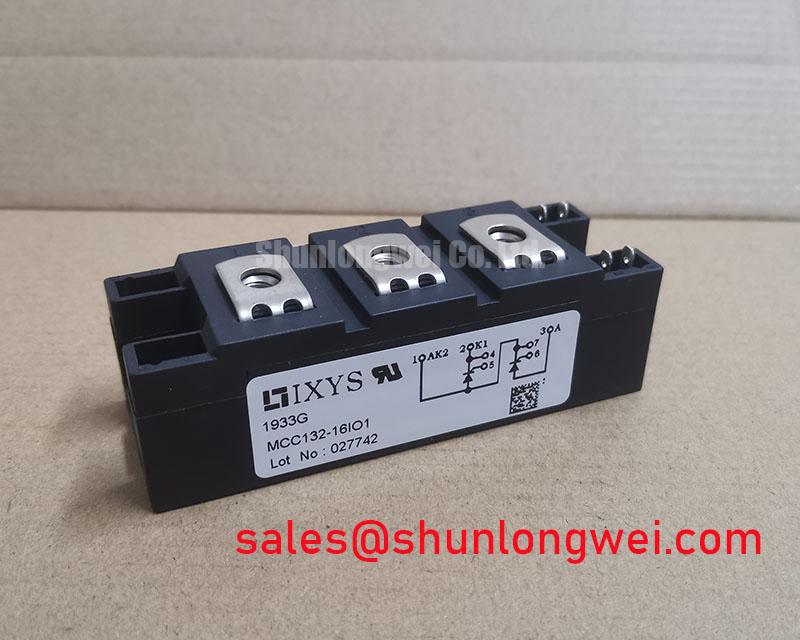
MCD132-16io1 Thyristor/Diode Module: High-Reliability Phase-Leg Power Conversion
How can power electronic designers ensure high line-voltage transient immunity while maintaining efficient thermal transfer in 400V/480V AC power conversion stages? The IXYS MCD132-16io1 addresses this core challenge by pairing a line-frequency thyristor and a rectifier diode in a phase-leg topology with planar passivated chips and direct copper bonded (DCB) ceramic isolation. 1600V | 130A (at TC = 85°C) | Rth(j-c) 0.23 K/W. Exceptional transient surge handling; long-term dielectric isolation up to 3600V RMS. For 400V/480V AC motor soft starters requiring robust thermal cycling and 1600V blocking margin, the MCD132-16io1 is an optimal phase-leg solution.
Frequently Asked Questions
Direct Answers to Critical Phase-Leg Integration Queries
How does the 1600V blocking voltage rating benefit standard 400V and 480V three-phase line systems?
In industrial grid environments, utility voltage fluctuations, inductive load switching, and lightning-induced surges can easily generate high overvoltage spikes. The 1600V VRRM / VDRM rating gives engineers a 2.5x to 3x headroom factor above standard peak line voltage, preventing catastrophic avalanche breakdown without requiring oversized snubbers.
What is the primary benefit of its DCB ceramic baseplate construction?
The Direct Copper Bonded (DCB) Al2O3 ceramic substrate provides 3600V RMS galvanic isolation between the live semiconductor terminals and the mounting baseplate. This eliminates external insulating foil washers, dramatically reduces assembly complexity, and minimizes junction-to-heatsink Thermal Resistance.
How does the surge current capacity (ITSM) safeguard soft starter designs during heavy motor inrush?
The MCD132-16io1 delivers a non-repetitive surge current (ITSM) of 4750A (at 10 ms, 50 Hz, 45°C). In soft starters and high-inertia pump or compressor drives, starting currents can spike dramatically; this high surge current capability prevents junction destruction during brief locked-rotor or initial magnetic saturation conditions.
Why is a thyristor/diode phase-leg configuration chosen over a dual-thyristor module in half-controlled bridges?
A half-controlled rectifier topology uses one controllable thyristor and one uncontrolled diode per leg. Utilizing the integrated MCD132-16io1 reduces gate-driver channel count by 50% compared to a full-thyristor bridge, cutting driver bill-of-materials costs while preserving output DC voltage controllability.
What gate drive parameters ensure reliable firing across extreme operating temperatures?
The thyristor stage requires a maximum gate trigger voltage (VGT) of 2.5V and a gate trigger current (IGT) of 150mA (at TVJ = 25°C). Utilizing a stiff, short-rise-time gate pulse guarantees rapid latching above the holding current (IH = 200mA), preventing localized current crowding during turn-on.
Key Parameter Overview
Specifications and Engineering Value Breakdown
| Parameter | Datasheet Rating | Engineering & Design Relevance |
|---|---|---|
| Topology & Configuration | Phase Leg (1 Thyristor + 1 Diode) | Streamlines half-controlled bridge designs and reduces gate drive circuit count. |
| Repetitive Peak Reverse Voltage (VRRM / VDRM) | 1600V | Delivers generous blocking voltage margin against grid transients on 400V/480V lines. |
| Average On-State Current (ITAV / IFAV) | 130A (TC = 85°C) / 180A (TC = 60°C) | Provides continuous load current delivery in medium-power industrial conversion equipment. |
| RMS On-State Current (ITRMS / IFRMS) | 300A | Defines upper continuous conduction limits through internal terminal leads and copper traces. |
| Max On-State Voltage Drop (VT / VF) | 1.08V typ. (150A, 125°C) / 1.36V max (300A, 25°C) | Low conduction losses minimize total power dissipation under heavy continuous loads. |
| Surge Current (ITSM / IFSM) | 4750A (50Hz, 10ms, TVJ = 45°C) | High I2t rating (113 kA2s) ensures robust protection coordination with fast-acting fuses. |
| Critical Rate of Voltage Rise (dv/dt)cr | 1000 V/µs (TVJ = 125°C) | Prevents spurious capacitive gate turn-on caused by steep external voltage transients. |
| Thermal Resistance Junction-to-Case (RthJC) | 0.23 K/W (Thyristor) / 0.23 K/W (Diode) | Enables efficient heat extraction into heatsinks, ensuring safe junction temperatures (TVJ up to 125°C). |
| Isolation Voltage (VISOL) | 3600V~ (50/60 Hz, RMS, t = 1 min) | Ensures strict compliance with international industrial safety and creepage standards. |
| Package Type | Y4-M6 (Screw Terminals) | Industry-standard outline with reliable M6 busbar connections and low thermal interface resistance. |
Download the MCD132-16io1 datasheet for detailed specifications and performance curves.
Technical & Design Deep Dive
DCB Ceramic Substrate and Planar Passivation Engineering
The internal architecture of the IXYS MCD132-16io1 relies on advanced planar passivation technology combined with an Al2O3 Direct Copper Bonded (DCB) ceramic baseplate. In power electronics, the thermal interface behaves much like a multi-lane highway: any constriction slows the entire flow. The DCB ceramic acts as a wide, unobstructed thoroughfare, transferring heat directly from the silicon die to the module's copper baseplate with an RthJC of 0.23 K/W.
Because the expansion coefficient of the DCB ceramic closely matches that of the silicon chip, mechanical stress generated by thermal cycling is kept minimal. This structural harmony delivers enhanced Power Cycling Capability across repetitive duty cycles. Furthermore, the planar passivated junction layout guarantees long-term blocking stability under elevated junction temperatures up to 125°C, preventing leakage current degradation over decades of operation. Detailed design methodologies can be referenced in our guide on thermal management.
Application Scenarios & Value
Optimizing Soft Starters and Phase-Controlled Industrial Rectifiers
Industrial machinery installations frequently encounter severe power grid disturbances and harsh operating duty. A prime scenario is the input stage of industrial AC motor soft starters and variable frequency drive (VFD) pre-charge circuits. During motor startup on a 480V three-phase grid, high inrush currents can challenge traditional rectifier assemblies.
By integrating the MCD132-16io1, engineers leverage a robust 4750A surge capability and 1600V blocking rating to manage harsh pre-charge and line-commutation stresses without component derating. When integrated into line-rectifying stages (50/60 Hz), resistive heating controllers, or DC motor drives, the module guarantees steady-state thermal stability and simplifies chassis grounding through its 3600V RMS isolation. For additional integration and design criteria, review our comprehensive resources on power semiconductor selection and field reliability testing.
For systems requiring alternative topologies or higher current capacities, related options exist within the broader bipolar family. While this model provides a 130A phase-leg structure, for fully-controlled dual-thyristor topologies requiring higher current capabilities, the related MCC200-16IO1 offers a 200A dual-SCR configuration.
When selecting line-frequency power modules, verifying operating margins against worst-case ambient temperatures, transient line spikes, and expected fuse-clearing I2t curves ensures predictable field reliability.