
Content last revised on September 10, 2026
MG200H2CK1: Evaluating the Toshiba 600V 200A Dual GTR Power Module
Delivering Proven Transient Ruggedness for Heavy-Duty Motor Control
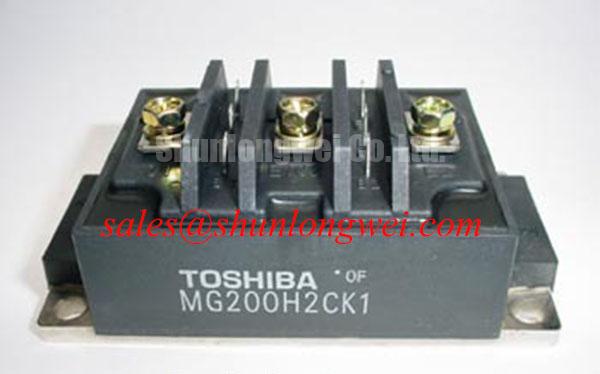
The MG200H2CK1 by Toshiba represents a robust class of Giant Transistor (GTR) power modules engineered for demanding industrial environments. Built on an NPN triple-diffused Darlington topology, this component provides highly reliable switching capabilities for specialized AC drive architectures. It features a collector-emitter voltage rating of 600V and a continuous collector current capacity of 200A, making it a critical asset for high-torque motor applications. What is the primary benefit of the MG200H2CK1 dual-element structure? It streamlines half-bridge inverter designs while ensuring balanced thermal dissipation. For 200V-class industrial AC drives demanding robust transient handling, this 600V module is an optimal choice.
Application Scenarios & Value
Achieving System-Level Resilience in High-Surge Environments
Engineers often face the severe challenge of managing startup inrush currents and dynamic load shifts in heavy industrial machinery. In these environments, power semiconductors must endure substantial electrical stress without exhibiting thermal runaway. The MG200H2CK1 excels in these scenarios due to its massive silicon area and triple-diffused architecture. When deploying this 200A module in heavy-duty pumps driven by a Variable Frequency Drive (VFD), the inherent thermal mass of the silicon effectively buffers against instantaneous current spikes.
This ruggedness is particularly valuable in facilities operating under fluctuating line voltages, where the 600V blocking capability provides a reliable safety margin. To ensure system-level compliance with IEC 61800-3 electromagnetic compatibility standards, engineers frequently pair this module with a robust snubber circuit to suppress transient voltage spikes. However, for systems upgrading to modern field-stop technology while maintaining similar current handling, the related CM200DU-12F or 2MBI200N-060 offer advanced performance profiles with significantly reduced switching losses.
Technical Deep Dive
A Closer Look at the Triple-Diffused Darlington Architecture
Unlike modern insulated-gate devices, the MG200H2CK1 utilizes a bipolar Darlington configuration to achieve its high current gain. This architecture strictly prioritizes absolute ruggedness and a wide Safe Operating Area (SOA) over ultra-high-frequency switching speed. Think of the triple-diffused Darlington structure like a heavy-duty mechanical shock absorber; while it may not react as instantly as a lightweight sports suspension, it effortlessly absorbs massive structural impacts without failing.
Thermal cycling resilience is another critical aspect of this design. Managing heat in this module is akin to a wide-lane highway funneling traffic; the large copper baseplate acts as the broad lanes, distributing the intense thermal energy over a wider footprint before it reaches the external heatsink. This highly efficient Thermal Resistance network ensures the active die remains within safe temperature limits during continuous 200A operation. For engineers conducting long-term evaluations, referencing a comprehensive failure analysis handbook can provide deeper insights into extending the lifespan of bipolar power modules under cyclic thermal stress.
Key Parameter Overview
Decoding the Specifications for Functional Integration
The following metrics highlight the operational boundaries and structural design of the component. Proper alignment with these values is essential for mastering module thermal management.
| Electrical Ratings | |
| Collector-Emitter Sustaining Voltage | 600V |
| Continuous Collector Current (Ic) | 200A |
| Mechanical & Configuration | |
| Topology | 2-Element (Dual / Half-Bridge) |
| Transistor Technology | NPN Triple-Diffused Darlington |
Frequently Asked Questions
Addressing Engineering Concerns in Field Operations
How does the triple-diffused Darlington structure impact switching frequency limits?
Due to the minority carrier recombination time inherent to bipolar semiconductor physics, the MG200H2CK1 operates most efficiently at low to medium switching frequencies. Unlike modern trench-gate components, its core design focuses on minimizing conduction losses and maximizing surge endurance rather than megahertz-range operation, making it perfectly suited for standard line-frequency applications.
What is the recommended approach for the thermal interface when deploying the MG200H2CK1?
Achieving optimal thermal transfer requires applying a uniform, ultra-thin layer of high-quality thermal grease between the module's copper baseplate and the heatsink. Uneven application creates microscopic air pockets, drastically increasing thermal resistance and immediately compromising the module's ability to dissipate heat continuously at its full 200A rating.
Are you evaluating high-power bipolar or IGBT modules for your specific industrial application? Reach out to our technical sales team today to verify component specifications, explore related power solutions, and secure the necessary hardware for your next project.