
Content last revised on August 28, 2026
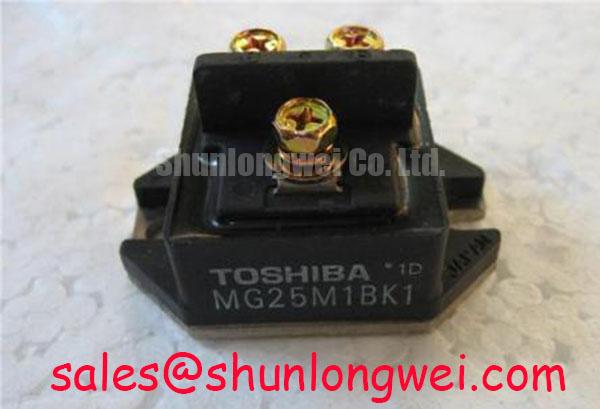
Toshiba MG25M1BK1 Power Transistor Module: Unlocking Switching Efficiency in Motor Drives
Overview & Engineering Highlights
Optimizing Base Drive with High DC Current Gain
The Toshiba MG25M1BK1 is a highly reliable Silicon NPN Triple Diffused Type power transistor module architected to optimize switching efficiency and reduce thermal overhead. Delivering a formidable combination of a 1000V voltage rating, a 25A continuous collector current capability, and an exceptionally low VCE(sat) of 2.5V (Max), this component forms the backbone of robust industrial power conversion. For motor control systems prioritizing thermal margin and drive simplicity, this 1000V 25A module with a high hFE is the optimal choice.
What is the primary benefit of the high DC current gain? It vastly reduces base drive current, simplifying overall circuitry. Furthermore, by addressing the common engineering challenge of complex drive power dissipation, the isolated collector design ensures a streamlined heatsink assembly and inherently superior thermal management.
Key Parameter Overview
Highlighting Critical Metrics for Thermal and Conduction Mastery
Understanding the fundamental electrical characteristics is vital for executing a precise voltage, current, and thermal management strategy. The table below highlights the most critical metrics that differentiate this module from conventional discrete alternatives.
| Critical Metric | Value / Specification | Engineering Implication |
|---|---|---|
| Rated Collector-Emitter Voltage (VCE) | 1000V | Provides ample headroom for 400V to 480V AC line applications. |
| Continuous Collector Current (IC) | 25A | Ideal for low to medium-power industrial automation systems. |
| DC Current Gain (hFE) | 100 Min. (@ 25A) | Minimizes base drive current, allowing for lower-power driver stages. |
| Saturation Voltage (VCE(sat)) | 2.5V (Max) | Directly reduces steady-state conduction losses during the on-state. |
| Package Architecture | Isolated Collector | Simplifies mechanical mounting and enhances chassis electrical safety. |
Download the MG25M1BK1 datasheet for detailed specifications and performance curves.
Application Scenarios & Value
Achieving System-Level Benefits in High-Frequency Power Conversion
In modern industrial facilities, engineers frequently face the arduous task of balancing power density with thermal reliability, especially in systems subjected to heavy inductive loads. The MG25M1BK1 is explicitly developed for high power switching applications, particularly within the VFDs (Variable Frequency Drives) and servo drive systems that dictate factory automation.
Consider the design of an industrial conveyor belt controller encountering frequent motor start-up surges. A standard discrete component might suffer from thermal runaway due to high conduction losses and inadequate heat dissipation. However, the VCE(sat) of 2.5V intrinsic to the MG25M1BK1 ensures that static losses remain exceptionally low, preserving the thermal envelope even under heavy torque demands. Furthermore, by utilizing this module in an SMPS (Switch-Mode Power Supply), engineers can maintain stringent IEC 61800-3 compliance for electromagnetic compatibility, as the predictable switching profile mitigates excessive high-frequency noise. While this module perfectly accommodates 25A setups, for systems requiring elevated current handling capabilities within a similar architecture, the related MG100J7CSAOA offers an upgraded capacity to meet escalating load requirements.
Technical Deep Dive
Decoding the Silicon NPN Triple Diffused Architecture
At the core of the Toshiba MG25M1BK1 lies its silicon NPN triple diffused structure, a manufacturing technique that vastly improves the Safe Operating Area (SOA) and robust voltage blocking. To understand its efficiency, consider the DC current gain (hFE) parameter, which is guaranteed at a minimum of 100. You can think of hFE as a mechanical lever: just as a long lever requires minimal input force to lift a massive weight, a high hFE requires only a tiny base current to control a massive 25A collector current. This eliminates the necessity for bulky, power-hungry base drive circuit components, thereby freeing up valuable PCB real estate and reducing parasitic losses.
Additionally, the module's isolated collector from case configuration presents a substantial advantage in thermal engineering. In power electronics, thermal resistance can be likened to the friction in a water pipe. The isolated baseplate acts as a highly conductive thermal bridge while simultaneously serving as an impenetrable electrical barrier. This permits engineers to bolt the module directly to a grounded heatsink without interposing fragile, thermally resistive insulating pads. For further reading on fundamental dissipation strategies, consulting a definitive Thermal Design reference can illustrate how optimized interface mechanics directly prolong semiconductor lifespans.
Frequently Asked Questions
Resolving Field Engineering Considerations
- How does the minimum hFE of 100 impact my base drive circuit design?
A high current gain ensures that the transistor requires significantly less base current to reach saturation. This allows you to design a more compact, lower-power driver stage, reducing the overall power dissipation and thermal stress on the surrounding control electronics. - Why is the isolated collector crucial for motor control applications?
In environments like Variable Frequency Drives, the isolated collector allows the MG25M1BK1 to be mounted directly onto a common heatsink alongside other components. This eliminates the need for individual isolating pads, reducing thermal impedance and ensuring the entire assembly remains electrically safe and grounded. - What system-level benefit does the 2.5V maximum VCE(sat) provide?
The saturation voltage directly dictates the conduction loss of the module during its on-state. By clamping this maximum at 2.5V, the module minimizes the conversion of electrical energy into wasted heat, thereby boosting total system efficiency and allowing for less aggressive cooling solutions.
As automation and heavy industries transition toward more intelligent, energy-efficient architectures, the component-level decisions made today dictate the operational expenditures of tomorrow. Deploying a robust, high-gain silicon solution fundamentally lowers the barrier to achieving high-density, thermally stable power conversion. By minimizing drive complexity and ensuring resilient thermal pathways, systems integrated with this architecture are strategically positioned to deliver maximum uptime and continuous productivity in the most demanding industrial environments.