
Content last revised on September 10, 2026
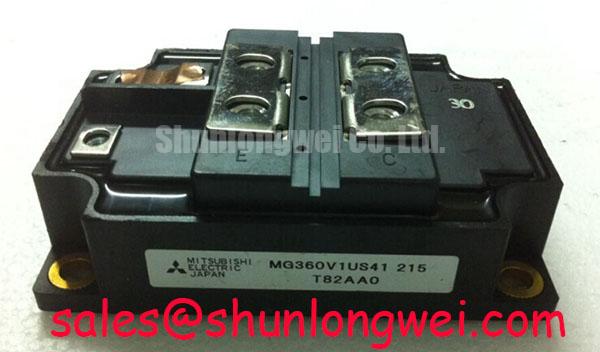
MG360V1US41 Toshiba 1700V 360A IGBT: Engineering High-Power 690V Drives
Designing a reliable 690V industrial line drive and struggling with voltage margin and switching efficiency? The Toshiba MG360V1US41 N-Channel IGBT module delivers the ultimate balance of high-voltage resilience and low dynamic loss for heavy-duty motor control. Featuring a robust 1700V VCES, a 360A IC continuous rating, and a simplified 1-Pack configuration, this device maximizes safety margin while minimizing high-frequency switching losses. What makes the MG360V1US41 ideal for 690V networks? Its 1700V blocking voltage provides exceptional overvoltage headroom, preventing breakdown during severe grid transients. For heavy-duty variable frequency drive (VFD) architectures prioritizing thermal margin, this 1700V, 360A module is the optimal choice.
Frequently Asked Questions & Engineering Troubleshooting
Resolving Common Queries in High-Voltage Inverter Design
- What is the primary advantage of the 1700V rating in the MG360V1US41?
For industrial plants utilizing 690V AC grids, a 1700V VCES provides the mandatory safety margin against voltage spikes and DC-link overshoots, vastly outperforming 1200V modules in these specific topologies. - How does this module handle continuous switching losses?
Optimized for high-speed operation, the N-channel chip geometry ensures a rapid fall time (typically 1.5µs), keeping dynamic losses manageable even in high-frequency UPS systems. - Can the MG360V1US41 be paralleled for higher current requirements?
Yes. Due to its single 1-Pack configuration, engineers can parallel multiple MG360V1US41 modules per phase leg, provided that gate drive signals and thermal layouts are strictly balanced. - Is this module suitable for renewable energy applications?
While originally designed for motor control, its 360A capacity and 1700V headroom make it exceptionally reliable for utility-scale solar inverters and wind turbine converters facing severe grid transients. - What gate drive protection is necessary for this 1700V IGBT?
To prevent catastrophic failure, a robust gate driver with active Miller clamping and precise desaturation (DESAT) protection is critical when driving the large gate structure of the Toshiba MG360V1US41.
Key Parameter Overview
Decoding the Specs for Enhanced Thermal Reliability
| Specification | Value | Engineering Significance |
|---|---|---|
| Collector-Emitter Voltage (VCES) | 1700V | Provides a massive dielectric buffer for 690V industrial line applications, ensuring immunity to inductive kickbacks and regenerative voltage spikes. |
| Continuous Collector Current (IC) | 360A | Enables sustained high-power delivery for heavy-load motor starting without breaching the Safe Operating Area (SOA). |
| Fall Time (tf) | 1.5µs (Max) | Accelerates the turn-off transient, dramatically reducing switching power dissipation in PWM-driven topologies. |
| Configuration | 1-Pack (Single Switch) | Allows maximum layout flexibility and optimal heat spreading across the heatsink for high-current phase legs. |
Download the MG360V1US41 datasheet for detailed specifications and performance curves.
Technical Deep Dive
Achieving System-Level Benefits in High-Frequency Power Conversion
The engineering core of the MG360V1US41 lies in its ability to manage extreme electrical stress while maintaining tight control over conduction and dynamic losses. Operating a 360A IC at a 1700V VCES demands rigorous silicon optimization. Think of the 1700V blocking voltage as a heavy-duty levee holding back a swollen river; it absorbs severe voltage surges (the unpredictable grid transients) without structural breakdown, safeguarding the sensitive downstream circuitry. This capability is absolute paramount when dealing with heavy inductive loads that generate massive counter-electromotive forces during deceleration.
Beyond static blocking, the dynamic performance of this N-Channel IGBT dictates its thermal footprint. The specified 1.5µs fall time minimizes the overlapping window of high voltage and high current during the turn-off phase. In practical terms, this fast fall time acts like a perfectly synchronized aerodynamic valve in a high-speed engine, snapping shut instantly to prevent energy leakage during the off-state transition. By curtailing these losses, the MG360V1US41 reduces the burden on the cooling infrastructure, allowing for denser packaging in megawatt-scale cabinets.
Application Scenarios & Value
Field-Proven Performance in High-Stress Industrial Environments
In the realm of heavy industry, such as mining conveyors or massive centrifugal pumps, variable frequency drive (VFD) systems are subjected to brutal operational cycles. Engineers routinely face the challenge of motor starting surges that can easily exceed nominal currents, compounded by the harsh realities of a 690V industrial line. While standard 1200V modules are sufficient for 400V grids, they offer dangerously thin safety margins at 690V.
Deploying the MG360V1US41 in the inverter stage directly solves this constraint. Its 1700V VCES safely absorbs the regenerative spikes during rapid motor braking, while the 360A continuous rating handles the sustained torque demands without thermal runaway. Furthermore, its low EMI characteristics aid in achieving stringent IEC 61800-3 compliance for industrial drives. For systems requiring a slightly higher current overhead in a similar voltage class, the related FZ400R17KE3 offers a 400A capacity, providing designers with scalable options depending on the exact load profile.
From a field engineer's perspective, over-specifying the voltage margin with a 1700V module like the MG360V1US41 is not just about meeting baseline requirements; it is a calculated defense against the unpredictable realities of industrial power grids. By prioritizing robust silicon and ample thermal headroom, design teams significantly extend the operational lifespan and reliability of their drive architectures.