Content last revised on September 10, 2026
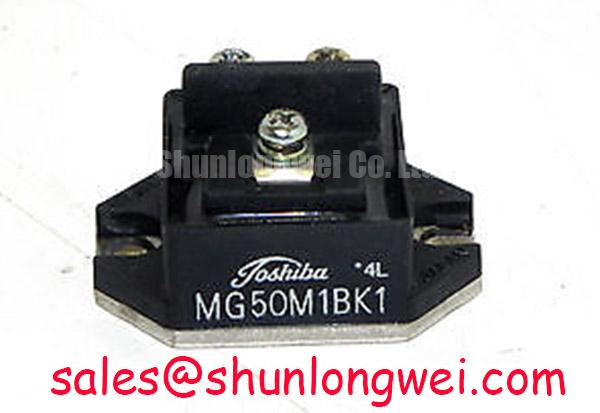
MG50M1BK1 Toshiba 880V 50A Power Bipolar Transistor Module
The MG50M1BK1 is a high-reliability power module designed to provide rugged switching in legacy motor control systems. Key Specifications: 880V | 50A | NPN Triple Diffused | Isolated Casing. Key Benefits: Minimizes thermal breakdown risk; Simplifies mechanical mounting. By utilizing an isolated baseplate, the module prevents phase-to-phase shorts, allowing multiple units to share a heatsink. For legacy motor control retrofits requiring high voltage margins and reliable thermal pathways, this 880V module is the optimal choice.
Application Scenarios & Value
Overcoming High-Transient Stress in Legacy Motor Drive Systems
Engineers often face significant challenges when maintaining legacy industrial AC drives and motor controllers where modern, high-frequency switches cannot be easily integrated due to control circuit constraints. In these systems, voltage transients generated by inductive motor windings can easily exceed the safe operating limits of standard components. The MG50M1BK1 addresses this by offering a robust collector-emitter voltage rating of 880V combined with a continuous collector current capability of 50A. In an engineering scenario like a legacy heavy-duty conveyor belt drive, startup surge currents frequently cause voltage spikes. This module's high voltage tolerance and NPN triple-diffused silicon structure provide the necessary headroom to absorb these spikes without failing, keeping the system well within its Safe Operating Area. For systems requiring higher current handling in the same family of power devices, related models like the MG150Q2YS50 or the MG400Q2YS60a offer higher current limits. Integrating this module ensures compliance with original equipment layout constraints while maintaining reliable commutation transient protection.
Technical & Design Deep Dive
Analyzing Silicon Junction Durability and Thermal Highway Design
The NPN triple-diffused silicon structure of the MG50M1BK1 is specifically designed for high-power switching applications. The triple-diffusion process creates deep junctions that can distribute electrical field stress more evenly across the silicon die. This design is what enables the 880V collector-emitter voltage (VCEO) rating. To understand this parameter, consider a reinforced dam: the higher the dam wall (voltage rating), the more water pressure (inductive surge) it can safely hold back before catastrophic failure occurs.
Additionally, the collector current (IC) of 50A requires a robust thermal pathway. The thermal resistance of the junction-to-case is minimized through direct bonding to an isolated copper baseplate. Think of this thermal pathway like a multi-lane highway: just as a wide highway allows a large volume of vehicles to disperse quickly and avoid traffic congestion, the low-thermal-resistance baseplate allows heat energy to migrate rapidly from the silicon junction to the heatsink. When comparing this GTR module to modern technologies, it is helpful to reference the IGBT vs MOSFET vs BJT selection guide to understand the structural differences. To analyze potential degradation modes, engineers should refer to the resource on preventing and diagnosing key failure modes.
For quick diagnostic reference:
What is the primary benefit of the isolated case? It prevents phase-to-phase short circuits during multi-module mounting.
Why is NPN triple-diffused silicon utilized? It provides a high voltage breakdown threshold for robust switching.
Key Parameter Overview
Decoding the Specs for Enhanced Thermal Reliability
The following table outlines the critical electrical and thermal limits of the MG50M1BK1 power transistor module.
| Parameter | Specification Value | Engineering Interpretation |
|---|---|---|
| Collector-Emitter Voltage (VCEO) | 880V | Maximum voltage boundary to prevent avalanche breakdown in the off-state. |
| Continuous Collector Current (IC) | 50A | Continuous current capacity at controlled case temperatures. |
| Polarity / Type | NPN Triple Diffused | Silicon structure optimized for high-power switching and motor control. |
| Isolation Voltage (Visol) | 2500V AC (1 min) | Ensures dielectric isolation between terminals and the mounting baseplate. |
| Configuration | Single Element (with Diode) | Simplifies integration into custom half-bridge or full-bridge configurations. |
Frequently Asked Questions
Addressing Common Integration Challenges for Legacy Systems
- How does the 880V collector-emitter rating protect legacy drives?
The 880V rating provides a safe buffer against voltage spikes induced by motor winding inductance during turn-off phases. - Why is the isolated case design beneficial for multi-phase motor controls?
The isolated baseplate provides over 2500V AC of dielectric isolation, removing the need for external insulation sheets. - Can this NPN GTR module be replaced directly by an IGBT?
Direct replacement is usually not possible without modifying the gate drive circuit, as GTR modules require current-driven base signals. - How does the 3-pole configuration affect installation?
The 3-pole mechanical design matches standard industry footprints, allowing quick drop-in placement for legacy systems. - What is the primary cause of thermal failure in GTR modules?
Thermal failure is typically caused by insufficient thermal paste application or loose mounting screws, raising junction temperature.
From an integration perspective, maintaining legacy industrial drives demands components that match original mechanical and thermal footprints exactly. Implementing the MG50M1BK1 allows design engineers to preserve legacy system architecture without the risk of system-level instability associated with premature upgrading.