
Overview:
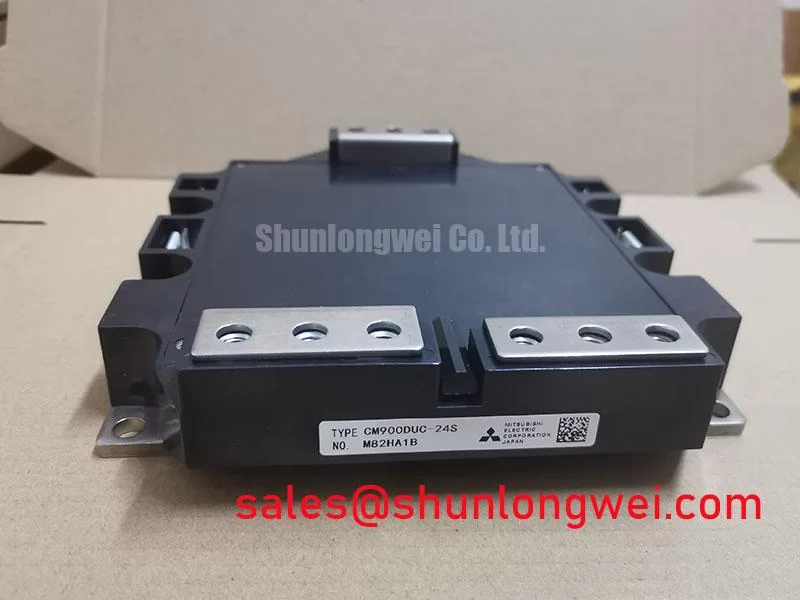
- Mitsubishi CM900DUC-24S: Link
- Mitsubishi CM400HC6-24NFM: Link

Similarities:
- Manufacturer: Both modules are manufactured by Mitsubishi.
- Type: Both are Insulated Gate Bipolar Transistor (IGBT) modules.
- Application: Designed for use in power supplies, UPS, induction heating, and battery-powered systems.
- Isolation Voltage: Both modules have an isolation voltage of 2500V AC for 1 minute.
- Package: Both modules use an isolated baseplate for easy heat sinking and thermal management.
Differences:
| Feature | CM900DUC-24S | CM400HC6-24NFM |
|---|---|---|
| Part Number | CM900DUC-24S | CM400HC6-24NFM |
| Configuration | Dual IGBT module | Single IGBT module |
| Collector Current (IC) | 900 Amperes | 400 Amperes |
| Collector Voltage (VCES) | 1200 Volts | 1200 Volts |
| Maximum Power Dissipation | 2500 Watts | 2710 Watts |
| Operating Temperature | -40°C to 150°C | -40°C to 150°C |
| Storage Temperature | -40°C to 125°C | -40°C to 125°C |
| Dimensions | 190 x 140 x 40 mm | 170 x 140 x 35 mm |
| Weight | 1.2 kg | 0.37 kg |
| Availability | Available but may vary | 2021+ Date Code, readily available |
In-Depth Comparison:
- Configuration:
- CM900DUC-24S: This module features a dual IGBT configuration, which means it contains two IGBTs within a single package. This setup is often used for applications requiring high power and efficiency.
- CM400HC6-24NFM: This module features a single IGBT configuration. This makes it simpler and potentially more versatile for various applications.
- Collector Current (IC):
- CM900DUC-24S: With a collector current of 900 Amperes, this module is suitable for high-power applications where substantial current handling is essential.
- CM400HC6-24NFM: With a collector current of 400 Amperes, it is designed for medium-power applications. The lower current rating can lead to better efficiency in specific scenarios where less power is needed.
- Maximum Power Dissipation:
- CM900DUC-24S: With a maximum power dissipation of 2500 Watts, it is efficient for high-power operations and can handle significant thermal stress.
- CM400HC6-24NFM: Slightly higher power dissipation at 2710 Watts, making it robust for applications requiring efficient thermal management.
- Dimensions and Weight:
- CM900DUC-24S: Larger and heavier, measuring 190 x 140 x 40 mm and weighing 1.2 kg, this module may require more space and robust mounting.
- CM400HC6-24NFM: More compact and lighter at 170 x 140 x 35 mm and 0.37 kg, making it easier to integrate into systems with space constraints.
Application and Interchangeability:
- Interchangeability: Both modules are designed for similar applications in power electronics but are not directly interchangeable due to their different configurations and power ratings.
- When to Use CM900DUC-24S:
- Suitable for high-power applications needing dual IGBT configuration.
- Environments where high current handling (900A) is essential.
- Systems that can accommodate its larger size and weight.
- When to Use CM400HC6-24NFM:
- Suitable for medium-power applications requiring a single IGBT.
- Situations where space and weight constraints are critical.
- Applications needing slightly better thermal management due to higher power dissipation.
Conclusion:
The Mitsubishi CM900DUC-24S and CM400HC6-24NFM IGBT modules serve distinct roles in industrial applications. The CM900DUC-24S is ideal for high-power applications with its dual IGBT configuration and higher current handling. In contrast, the CM400HC6-24NFM, with its single IGBT configuration, is better suited for medium-power applications and offers a compact, lighter alternative. Selecting between the two depends on the specific power, space, and thermal management requirements of the application.