Content last revised on September 10, 2026
MUBW20-06A7 Replacement Overview
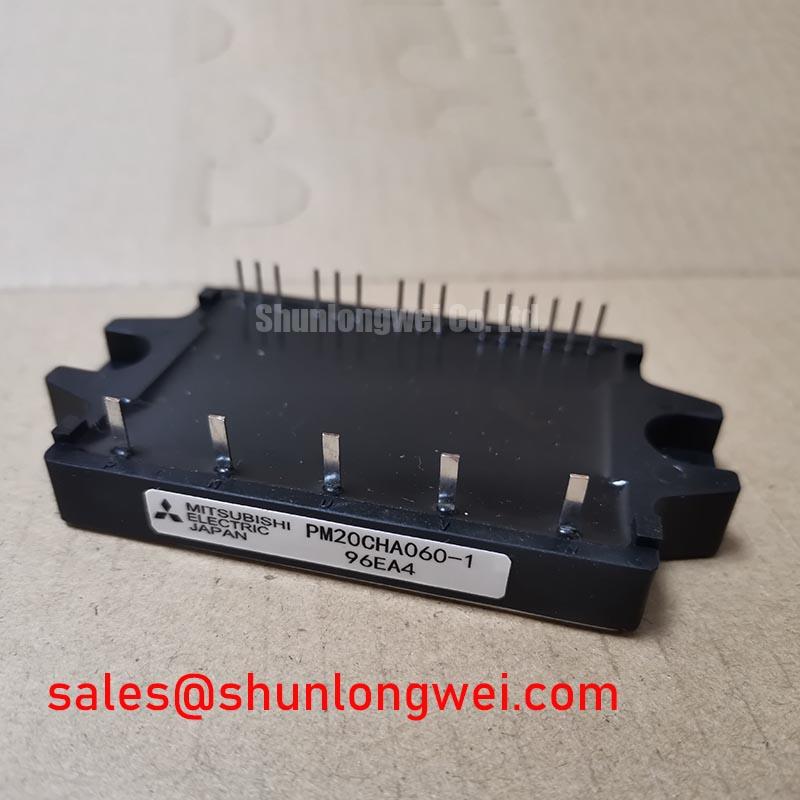
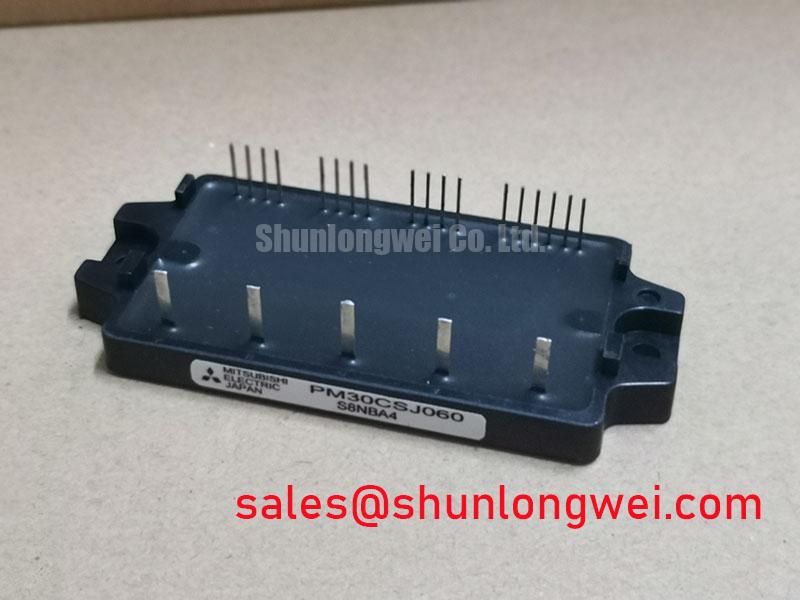
Before fitting the replacement, isolate the drive, inspect the module body and terminals, and verify the nameplate boundary against the original assembly: MUBW20-06A7 is an IXYS PIM module specified at 600.0 V and 21.0 A, with an E1/E2 package. These are official specification values supplied for this product record. A cold resistance comparison across the corresponding power terminals can help identify an obvious shorted path, but it is not a substitute for the manufacturer’s terminal diagram, an insulation test performed at the system-approved test level, or a controlled powered evaluation.
For engineers repairing a heavy-duty variable frequency AC motor drive, the practical question is whether the module’s voltage, current, mechanical footprint, terminal arrangement, gate-drive interface, and thermal path match the failed assembly. The 600.0 V rating and 21.0 A rating should be treated as device boundary data, not as an automatic guarantee that the complete drive can operate at those values under every switching frequency, overload condition, ambient temperature, or cooling arrangement. The system designer should establish the applicable derating from the complete IXYS documentation and the drive manufacturer’s design rules.
| Product model | MUBW20-06A7 |
| Manufacturer | IXYS |
| Product category | PIM Power Integrated Module |
| Rated voltage | 600.0 V, official specification |
| Rated current | 21.0 A, official specification |
| Package | E1/E2 package, official specification |
For a direct replacement assessment, compare the original gate terminal identification, auxiliary terminals, power terminal spacing, mounting pattern, thermal interface, and isolation requirements before installation. The neutral reference P950A can be reviewed as a related hardware option during a documented replacement study, but equivalence must be demonstrated from electrical, mechanical, thermal, and control-interface evidence rather than assumed from package appearance.
MUBW20-06A7 Circuit Protection & Reliability: Calibrating SCSOA Overcurrent Protection
A short-circuit protection study for an inverter using the MUBW20-06A7 should begin with the complete switching loop, not with a gate-driver threshold selected in isolation. The supplied product data confirms the 600.0 V voltage class and 21.0 A current class, but it does not establish a short-circuit safe operating area, a short-circuit withstand duration, or a guaranteed detection interval. Those values must be taken from the applicable IXYS datasheet or qualification documentation before a production protection setting is released.
In a practical bench evaluation, place the current measurement, gate waveform, collector-emitter voltage, and DC-link measurement on the same time reference. Test the protection response under controlled fault conditions that represent both a hard device fault and a load-side fault. A protection circuit intended to respond within a sub-10 microsecond interval must be validated as a complete chain, including sensor delay, comparator propagation, gate-driver delay, isolation delay where present, and the turn-off behavior of the driver. The requested type-I and type-II distinction can be useful at system level, but the permissible timing and energy limits remain device-specific and source-dependent.
Two-stage soft turn-off is a design consideration rather than a confirmed internal feature of this module. The usual principle is to reduce gate drive in a controlled first transition, allowing the collector current to fall without creating an excessive inductive voltage rise, then complete the turn-off after the fault current has been reduced. The drive engineer should select the sequence only after measuring the actual commutation loop, gate charge behavior, driver saturation response, and peak collector-emitter voltage. Any peak margin should be verified against the DC-link voltage during switching tests.
Layout clearance should be assessed around the high-voltage terminals, the gate-drive isolation barrier, and any current-sensing network. Keep the fault-detection signal physically separated from high dv/dt copper where practical, and provide a defined return path so that common-mode displacement current does not imitate an overcurrent event. A long motor cable can also return reflected voltage stress to the inverter bridge. Cable length, termination, motor impedance, switching edge rate, and filter topology should therefore be evaluated together rather than corrected through an unverified gate resistor change.
When a repaired drive trips immediately, record the fault waveform before replacing the module again. Check whether the gate command reaches the correct terminal, whether the complementary switch is fully off, whether the DC-link rises abnormally during regeneration, and whether the fault signal is being asserted by noise. A low-resistance reading between power terminals may indicate semiconductor damage, but the result should be compared with an unused reference module and measured with the circuit fully disconnected. A failed gate driver, damaged snubber, contaminated heatsink interface, or abnormal motor insulation can produce a similar repair symptom.
Ferrite selection in a gate or sensing path should remain a system decision. The general behavior of ferrite materials varies with frequency, flux level, impedance, and construction, as outlined in Ferrite Core Materials for High Frequency Switching Power Supplies. The component should be selected from measured interference and switching waveforms, not placed in the gate loop solely because a ferrite bead is present in another drive design.
MUBW20-06A7 Thermal-Electrical Optimization: Thermal Feedback Practical Tuning
Thermal verification for this 21.0 A PIM must combine conduction loss, switching loss, case temperature, heatsink behavior, airflow, and overload duration. The current rating is an official product parameter, while the usable current in a variable frequency drive depends on the operating waveform and the thermal conditions documented by the manufacturer. A phase current measured with a basic meter may not reveal short switching pulses, regenerative current, or line-frequency ripple that influence junction temperature.
The positive temperature coefficient of IGBT saturation voltage is a commonly used design consideration for static current sharing in paralleled devices, because a warmer device can develop greater conduction voltage and naturally discourage uncontrolled current concentration. That behavior should not be treated as proof that arbitrary parallel operation is safe for this specific module. Designers should verify the relevant VCE(sat) curves, temperature range, gate-drive matching, emitter impedance, and transient sharing in the original IXYS data.
Dynamic balance is more sensitive to wiring than steady-state balance. Route paralleled gate paths with similar geometry, keep their driver returns controlled, and avoid allowing a high-current emitter path to share impedance with a sensitive gate reference. If the package drawing does not explicitly identify an auxiliary or Kelvin emitter terminal, the integrator should not infer one from the package name. The correct terminal function must be confirmed from the original pinout and application documentation.
For phase-angle or variable-frequency operation, measure the actual current waveform at low speed, rated speed, acceleration, and deceleration. At low output frequency, the motor and cable can present a different reactive burden, while pulse-width modulation creates switching losses that are not represented by the fundamental current alone. Line-frequency ripple smoothing may reduce DC-link stress, but the selected capacitor bank, precharge arrangement, discharge circuit, and ripple-current rating belong to the complete drive design.
RC snubbers are also system-level components. Their purpose may be to control a measured transient, ringing event, or commutation overshoot, but their values should be selected from oscilloscope evidence and loss calculations. Excessive capacitance can increase switching current and device dissipation; insufficient damping may leave oscillation unresolved. Verify the snubber’s voltage, pulse-current, insulation, and thermal behavior under the actual switching pattern. Do not regard a generic snubber network as a guaranteed requirement of the MUBW20-06A7.
Thermal feedback should be checked at the case and heatsink interface as well as through electrical measurements. Confirm that the mounting surface is clean and planar, that the thermal interface material is applied consistently, and that the clamping method follows the module documentation. If temperature rises unexpectedly while current appears normal, inspect switching overlap, gate ringing, diode commutation, airflow, heatsink contact, and DC-link ripple before assigning the cause to the IGBT itself.
MUBW20-06A7 Circuit Protection & Reliability: Calibrating Kelvin Emitter Connection
The term Kelvin emitter should be used only when the original terminal drawing confirms a separate auxiliary emitter or driver-return connection. The supplied product record identifies the E1/E2 package, but it does not provide a complete terminal map. During repair, compare the module marking with the drive’s schematic and harness layout, then use continuity and isolation checks to distinguish the power return from any low-current gate-reference connection.
The engineering principle is straightforward: the gate-driver return should not experience the voltage generated by high-current emitter inductance. A shared copper path can create apparent gate voltage during rapid current change, encouraging oscillation or unintended turn-on. Designers should minimize mutual coupling between the power commutation loop and the gate loop, maintain a controlled gate-return path, and verify the result using a differential probe with suitable common-mode capability.
If an auxiliary emitter connection is present in the verified application drawing, route it directly to the driver reference rather than allowing it to follow the high-current emitter trace. Keep the gate loop compact and symmetrical where multiple switches are used, and place any gate damping element according to the driver and module layout requirements. The appropriate resistance and damping network are system-determined; they depend on gate charge, driver output impedance, PCB geometry, common-source inductance, switching speed, and the required fault response.
During troubleshooting, compare a known-good leg with the suspect leg under identical load and switching conditions. Look for gate overshoot, multiple threshold crossings, delayed turn-off, unequal collector-emitter voltage, or a difference between the driver reference and the module’s actual emitter potential. A clean static continuity result does not exclude dynamic coupling. Use a controlled low-energy test first, then progress to normal DC-link operation only after the waveforms are stable and the protection circuit is active.
Clearance and creepage around the power terminals should follow the applicable system insulation design and pollution environment. The module itself should not be described as independently certified for a complete drive’s EMC or safety compliance. For high-voltage insulation evaluation, the system engineer should define the test method, ramp, duration, and acceptance criteria from the relevant equipment standard and the manufacturer’s insulation data. General dielectric-strength principles are described in Dielectric Strength and High-Voltage Breakdown Testing.
💡 Pro Tip: Disconnect the DC link and verify the discharge state before touching gate, auxiliary, or power terminals, because a quiet control connector does not prove that the power section is safe.
For a complete bridge repair, the upstream rectifier and DC-link topology should also be reviewed. The related 7MBR20UF060 may be relevant when documenting the rectification and inverter relationship, but its electrical compatibility must be established from the actual circuit, ratings, control sequence, and mechanical arrangement.
MUBW20-06A7 Operational Boundaries: Evaluating Dynamic Braking Chopper Operation Limits
A braking chopper evaluation should start by mapping the DC-link energy path during deceleration. The MUBW20-06A7 is recorded here as a 600.0 V, 21.0 A IXYS PIM module, yet those two values alone do not define the permissible braking duty. The inverter, motor inertia, commanded deceleration, DC-link capacitance, braking resistor, switching frequency, ambient temperature, and cooling path determine the thermal and electrical stress seen by the chopper function.
Where the application uses an internal or external braking IGBT, confirm the actual schematic and terminal assignment before connecting the resistor circuit. The ballast resistor must absorb the available regenerative energy without exceeding its pulse-energy, average-power, voltage, and temperature limits. Its resistance and duty cycle should be calculated from measured or documented motor and load data, then validated during the worst credible stopping event. Do not infer a safe resistor value from the module’s nominal current rating.
Monitor the DC-link voltage, chopper gate signal, chopper collector-emitter voltage, resistor temperature, and motor speed during controlled deceleration. A rising DC-link voltage may reflect insufficient braking energy absorption, an incorrectly timed chopper, an open resistor path, or a measurement reference problem. These possibilities should be separated by checking the command signal and power waveform together. The protection threshold should be coordinated with the voltage rating and documented transient behavior of every semiconductor connected to the DC link.
Inductive overshoot can become more severe when the braking loop is physically remote from the module. Minimize the high-current loop area, use a symmetrical bus arrangement where practical, and place damping or filtering only after the switching waveform has been measured. Long motor cables can introduce transmission-line effects and reflected voltage, so the drive engineer should evaluate cable construction, shield termination, motor insulation stress, output filtering, and switching edge behavior as one network. The final peak-voltage margin must be verified on the installed machine, not assumed from a short laboratory connection.
Repeated braking events require a thermal accumulation review rather than a single pulse test. Record the case temperature and heatsink response across the complete operating sequence, including acceleration, steady operation, deceleration, and dwell. If the drive is installed at altitude or in an unusual cooling environment, any required derating should come from the applicable manufacturer data or equipment standard. No field lifetime, FIT rate, cosmic-ray SEB limit, or altitude withstand value is established by the product parameters provided here, so those subjects require authoritative source data before being used in a release decision.
Thermal interface quality should be checked after the first controlled run, especially if the replacement has been mounted on a previously disturbed heatsink. Inspect contact uniformity, fastener seating, and signs of localized heating without treating visual evidence as a complete reliability prediction. The technical discussion of module-level cooling practices can be extended through The Advanced Thermal Management Revolution, while the final acceptance decision remains dependent on the verified IXYS data and the complete variable frequency drive test record.