Content last revised on September 10, 2026
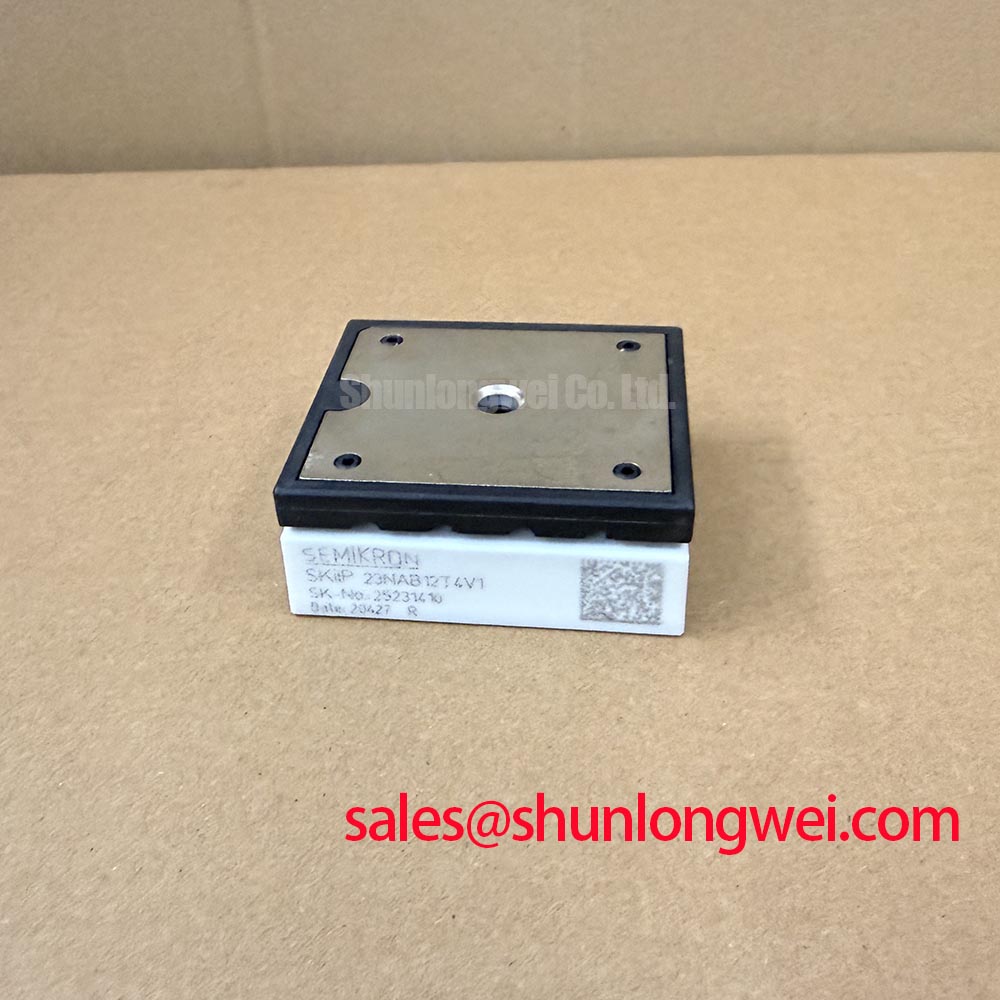
SKiiP 23NAB12T4V10: 1200V 25A CIB Module for Streamlined Drive Design
How can you minimize assembly complexity in compact motor drives without compromising electrical reliability?
The Semikron Danfoss SKiiP 23NAB12T4V10, a highly integrated Converter-Inverter-Brake (CIB) module, addresses this exact engineering challenge. Leveraging solder-free spring-contact technology, it simplifies PCB mating while exponentially enhancing vibration resistance in harsh environments. Rated at 1200V | 25A | Tj(max) 175°C, this MiniSKiiP II 2 device is precision-engineered to power high-efficiency variable frequency drives. By utilizing a unified CIB structure, it reduces layout parasitic inductance and accelerates production cycles. For compact 7.5 kW motor drives prioritizing streamlined assembly, this 1200V CIB module is the optimal choice.
Addressing Core Engineering Queries
Fast Answers to Integration Challenges
- Why is the CIB topology of the SKiiP 23NAB12T4V10 advantageous for variable frequency drives? It integrates a three-phase rectifier, inverter, and brake chopper into a single housing, drastically reducing PCB footprint and lowering parasitic inductance compared to discrete setups.
- What is the primary benefit of its spring-contact design? Enhanced long-term reliability and streamlined assembly by eliminating solder joint fatigue.
- What is the practical limit for motor power when using this 25A module? Under standard industrial operating conditions, the 25A nominal current rating makes it ideal for typical motor power applications up to 7.5 kW (or 14 kVA inverter capacity).
- Does this bare module include thermal interface material (TIM)? No, the base variant is supplied as a bare module without pre-applied TIM or a lid, giving engineers complete control over their custom thermal management process.
Key Parameter Overview
Highlighting Critical Specs for 7.5 kW Systems
| Critical Parameter | Value | Engineering Implication |
|---|---|---|
| Collector-Emitter Voltage (Vces) | 1200V | Provides robust voltage headroom for 400V/480V AC line industrial drives. |
| Nominal Current (Ic) | 25A | Delivers sufficient continuous current for reliable 7.5 kW motor operation. |
| Topology | CIB (Converter-Inverter-Brake) | Consolidates three major power stages into one compact mechanical footprint. |
| Chip Technology | Trench 4 IGBT | Balances low conduction losses with optimized high-frequency switching behavior. |
| Maximum Junction Temp (Tj max) | 175°C | Extends the thermal safety margin during transient overload events. |
Download the SKiiP 23NAB12T4V10 datasheet for detailed specifications and performance curves.
Technical Deep Dive
Decoding the MiniSKiiP Spring-Contact Architecture
The mechanical architecture of the SKiiP 23NAB12T4V10 is as critical as its silicon. Traditional soldered modules often succumb to thermo-mechanical stress, where differential expansion between the printed circuit board and the module base causes solder joint micro-cracking over time. This module circumvents that failure mechanism entirely by utilizing a proprietary pressure-contact system.
Think of the spring contacts as an independent suspension system for electrical connections. As the module heats up and materials expand at varying rates, the internal springs dynamically adjust, maintaining constant contact pressure. This elasticity prevents the localized stress concentrations that plague rigid solder joints. Furthermore, integrating the Converter-Inverter-Brake functions into a single housing acts much like a System-on-Chip (SoC) in digital electronics—it drastically cuts down the peripheral power routing, thereby minimizing the parasitic inductance across the DC link. Coupling this mechanical robustness with Trench 4 IGBT technology and soft-switching CAL diodes ensures that switching losses are minimized, simplifying the overall gate drive design.
Application Scenarios & Value
Deploying CIB Modules in Industrial Automation
Engineers often face rigid space constraints when designing multi-axis servo drive inverters or standard AC motor controls. A classic challenge is routing high-current traces between separate rectifier and inverter boards while maintaining tight electromagnetic compatibility (EMC).
By employing the SKiiP 23NAB12T4V10, designers can consolidate the entire power conversion stage. For example, in a factory automation conveyor system, the integrated brake chopper allows for rapid deceleration of heavy inductive loads without requiring external braking circuits, directly reducing the total system footprint. The 1200V rating easily accommodates the voltage spikes typical in industrial networks. When applying the required thermal interface material, the bare-module format ensures that manufacturers can match the thermal grease perfectly to their specific heatsink tolerances, optimizing the thermal resistance pathway.
While this component is precisely tailored for 7.5 kW systems, designs demanding higher current handling within the exact same physical footprint can utilize the related SKiiP24NAB12T4V3, or scale down for lighter loads with the SKiiP 11NAB12T4V1.
The trajectory of industrial automation demands power components that bridge the gap between electrical efficiency and mechanical integration. Devices built with solder-free architectures and consolidated topologies do not just fix immediate space constraints; they fundamentally streamline the manufacturing workflow, accelerating time-to-market while fortifying the end product against harsh operational environments.