Content last revised on October 13, 2026
SKKH106-14E Thermal-Electrical Optimization: Mechanical Torque and Practical Tuning
- Isolate the power circuit, verify discharge, and identify the anode, cathode, and gate connections from the module circuit diagram before applying a meter.
- Record cold diode-mode readings with both probe polarities and compare equivalent paths under the same temperature and instrument conditions.
- Inspect terminal seating, mounting-surface flatness, and the interface to the heatsink before reconnecting power conductors.
- Check the gate-circuit isolation arrangement and terminal clearances against the equipment drawing before energizing the assembly.
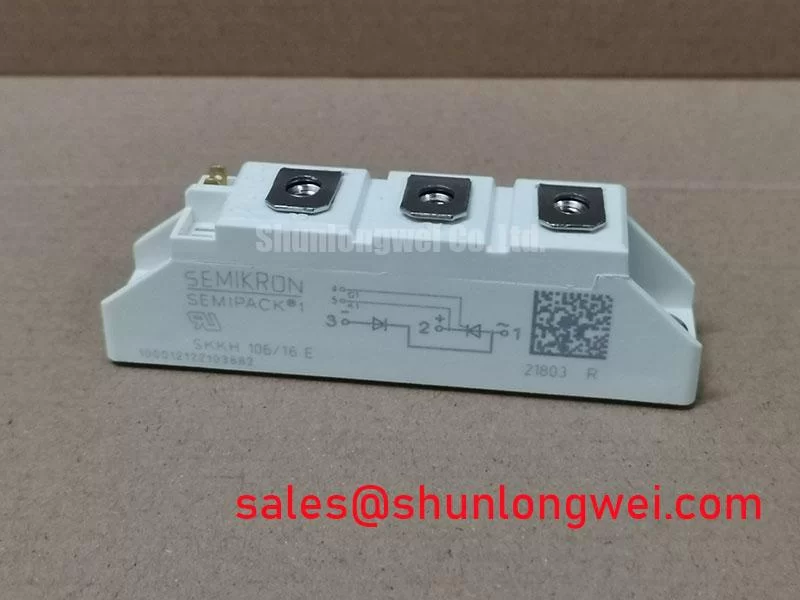
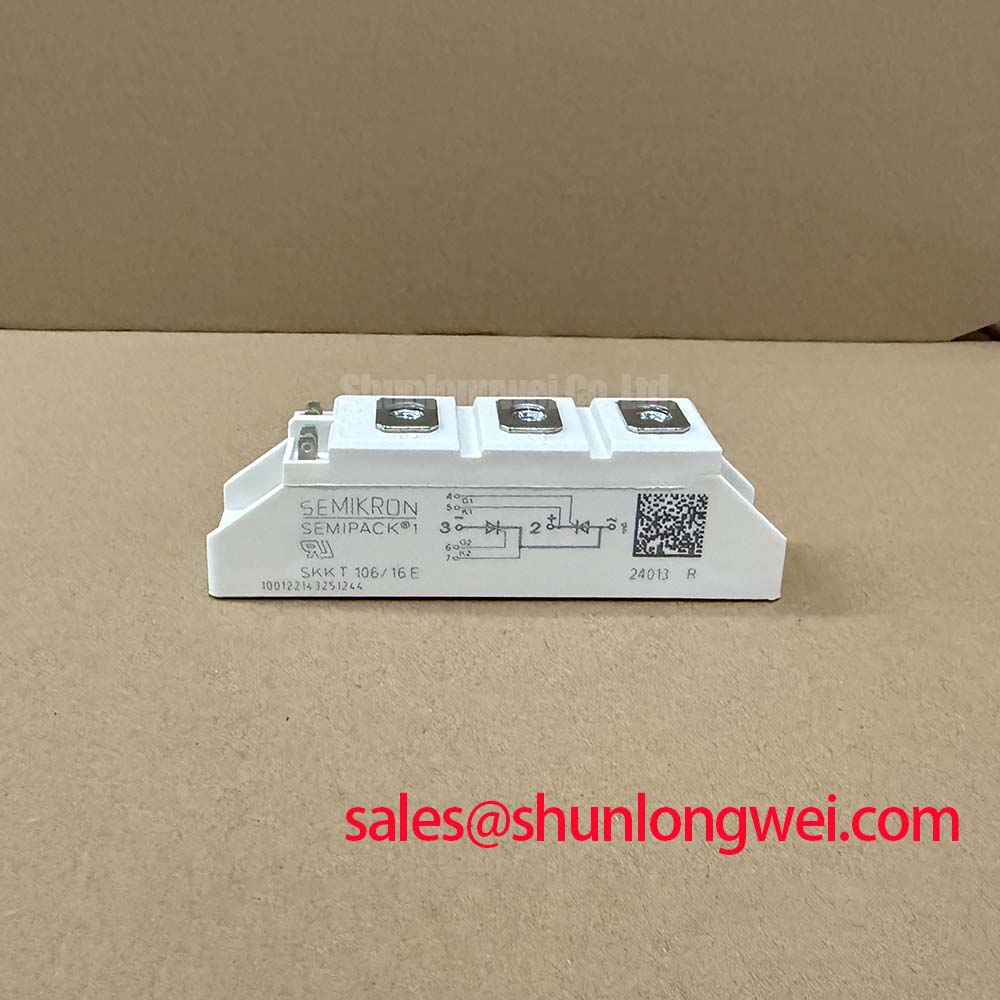
The SKKH106-14E is a Semikron thyristor/diode module in the SEMIPACK product family. Incoming inspection should establish terminal identity and circuit compatibility before treating a matching housing as evidence of interchangeability. A diode-mode reading is a screening observation, not a rated-current test or proof that the thyristor triggers correctly.
| Identification item | Value and specification status |
|---|---|
| Model | SKKH106-14E |
| Manufacturer | Semikron |
| Product category | Thyristor/Diode Module |
| Package family | SEMIPACK |
| Supplied voltage entry | 400.0 V; not established here as an Official Datasheet Specification |
| Supplied current entry | 1061.0 A; not established here as an Official Datasheet Specification |
| Electrical release requirements | Consult Datasheet: blocking-voltage designation, average-current conditions, surge withstand, isolation test conditions, and mounting torque |
The supplied voltage and current entries require reconciliation with the manufacturer datasheet before equipment release; neither should be used as an operating limit. The manufacturer’s SEMIPACK thyristor/diode module overview provides product-family context, rather than a substitute for the exact device specification.
Match the module circuit to the power schematic before adjusting firing commands. As a Design Consideration, evaluating this module for a high-voltage three-phase motor solid-state soft starter requires particular attention to the thyristor/diode arrangement: a mixed module must not be assumed equivalent to an antiparallel thyristor pair.
Phase-angle control changes the applied waveform and motor acceleration behavior. Reduced starting current does not establish adequate accelerating torque, and aggressive current limiting can prolong heating. The commissioning engineer should evaluate measured phase currents, acceleration time, and load response together rather than assign a universal current-reduction target to the module.
Mechanical integration begins with clean mating surfaces and undamaged threaded connections. As an Engineering Recommendation, use the specified tightening sequence and distinguish heatsink fasteners from power-terminal fasteners. Excessive tightening can distort contact interfaces; inadequate clamping can compromise thermal contact or terminal resistance. Record the applicable manufacturer torque requirements in the assembly traveler.
💡 Bench Tip: Disconnect external gate circuitry before comparing cold readings with a known-good module, using the same meter polarity and ESD-controlled handling.
For procurement comparisons, SKKD162-14 is a related module reference, not an automatic replacement. Circuit function, terminal allocation, thermal ratings, and mounting geometry take precedence over a similar package designation.
Benchtop Waveform Tuning: Mitigating Stress via Type-2 Coordination: Sub-Cycle Dead-Short on SKKH106-14E
Compare the selected fuse’s total clearing I²t with the module’s applicable surge withstand before approving short-circuit protection. This is a Design Consideration: the comparison must use compatible waveform, temperature, voltage, and fault-current conditions. Pre-arcing I²t alone excludes the energy passed during fuse arcing.
A useful coordination worksheet identifies the exact fuse, prospective fault current, circuit voltage, total clearing I²t, peak let-through current, and the corresponding semiconductor limits. Its purpose is to expose mismatched test conditions, not to imply that a single energy comparison guarantees survival. Connection impedance and fault location also influence the stress reaching the module.
Type 2 coordination concerns the tested starter and protective-device combination under the applicable requirements of IEC 60947-4-2. It is not a standalone certification of the SKKH106-14E, nor a promise of damage-free operation under every short circuit. A deliberate dead-short test belongs in a suitably protected qualification facility, not on an ordinary incoming-inspection bench.
As an Engineering Recommendation, follow abnormal cold readings with isolated circuit checks before attributing a fault to the module. Gate-network components, parallel power paths, and connected suppression devices can alter measurements. The distributor’s Power Electronics Masterclass offers broader protection context without replacing device-specific coordination evidence.
Transient Dynamics & Electrical Design: Harmonic Current Injection and Line Filter on SKKH106-14E
Measure line current alongside firing commands when assessing phase-angle operation. As a Design Consideration, delayed conduction changes waveform shape, harmonic content, and power factor; the relationship depends on the complete topology and load. A controlled rectifier’s average output-voltage relationship should not be applied directly to an AC motor starter.
Evaluate filters against measured distortion and supply impedance. Capacitive compensation can interact with network inductance, so filter selection should include resonance assessment and verification over the intended operating range. The related SKKT56/14E can be examined in a separate controlled power stage only after its circuit function and ratings are matched to that stage.
Long-cable reflected-wave behavior requires a sufficiently fast switching edge and an impedance discontinuity; it should not be imported automatically from inverter practice into line-frequency phase control. Measure relevant transients before specifying suppression. The manufacturer’s bare-die and CAL diode technology information is background material, not evidence that this module incorporates that technology.
For terminal insulation, assess creepage and clearance in the assembled equipment, including contamination, conductor routing, and enclosure conditions. As an Engineering Recommendation, perform isolation testing only under the specified connection and test conditions; a satisfactory cold resistance reading does not establish dielectric withstand.