Content last revised on September 10, 2026
SKKT58/16E Semikron Thyristor/Diode Module: Engineering Efficiency for High-Voltage Power Systems
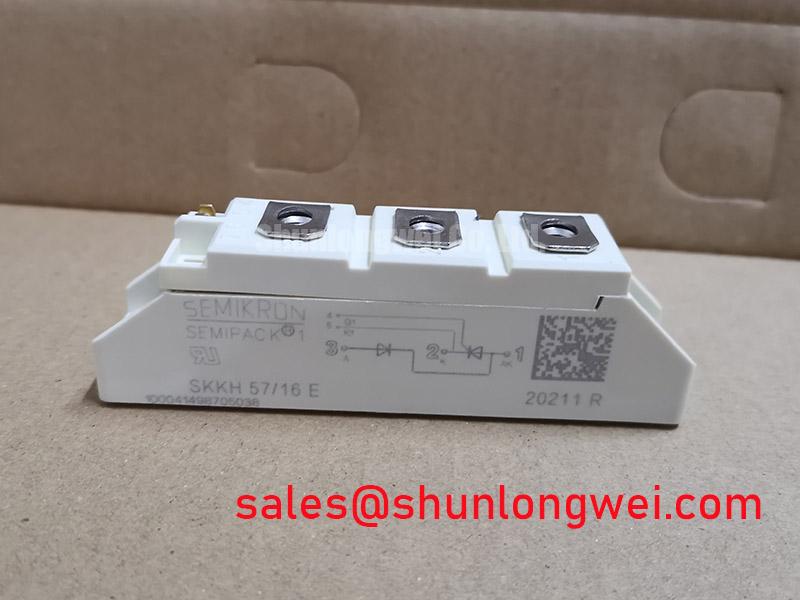
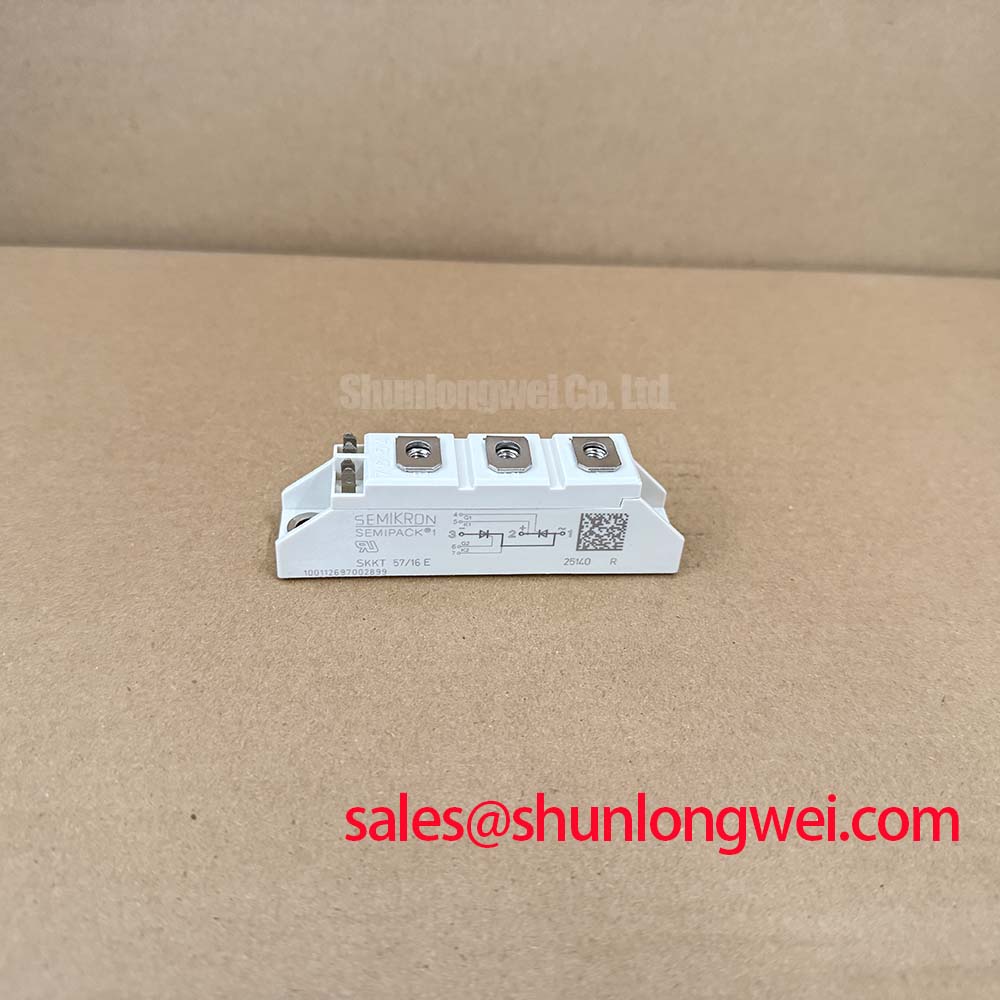
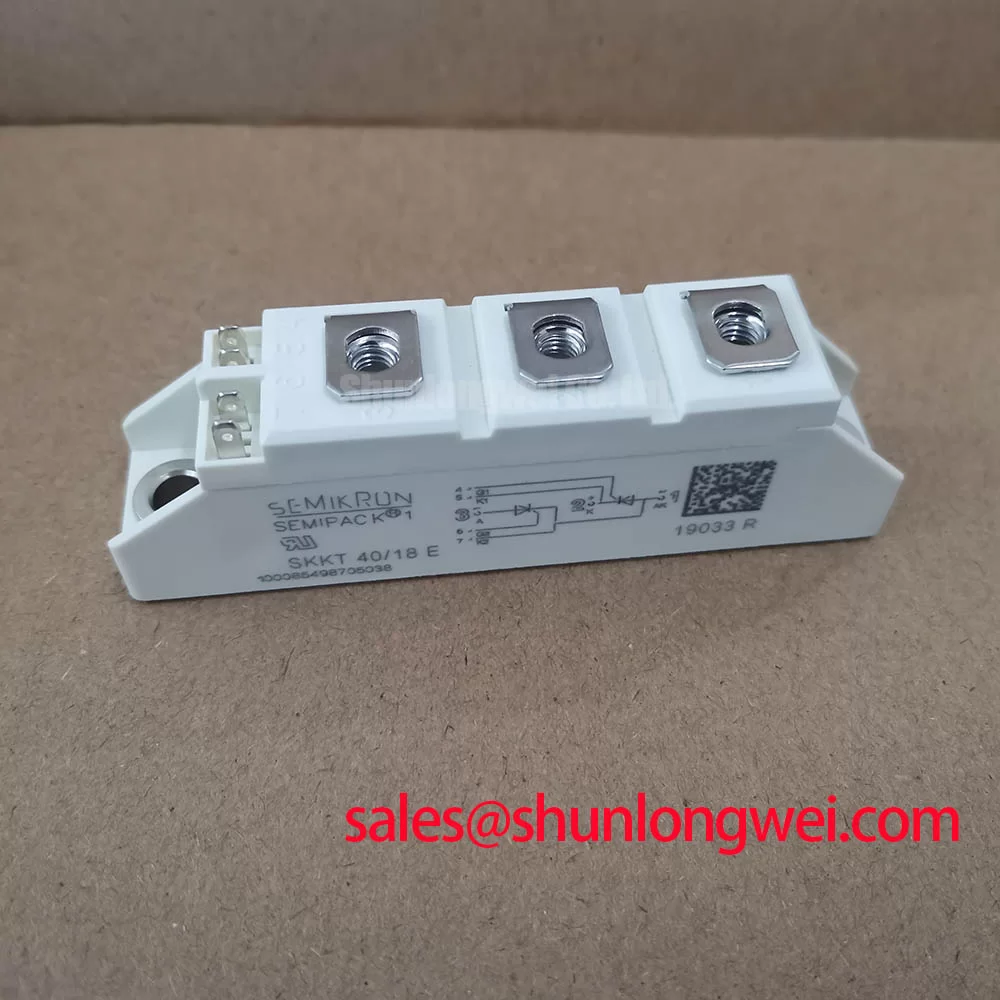
The SKKT58/16E represents a cornerstone in power electronic design, offering a robust solution for medium-power applications requiring precise phase control and rectification. As a prominent member of the Semikron SEMIPACK 1 family, this Thyristor/Diode Module is specifically engineered to bridge the gap between high-current industrial requirements and the need for compact, thermally efficient footprints. By utilizing advanced pressure contact technology, the module effectively addresses the common engineering challenge of solder fatigue in high-cycling environments, ensuring a lifespan that withstands the rigors of industrial automation and power regulation.
The SKKT58/16E features critical specifications: 1600V repetitive peak reverse voltage, a nominal mean on-state current (I_TAV) of 50A (at Tc=85°C), and a SEMIPACK 1 package with 3000V AC isolation. For industrial power controllers prioritizing long-term thermal margin and mechanical ruggedness, this 1600V module is the optimal choice.
Key Parameter Overview
Decoding the Specs for Enhanced Thermal Reliability
The SKKT58/16E is built on an alumina ceramic isolated metal baseplate, which is the primary factor in its superior heat transfer capabilities. Engineers must look beyond the nominal current rating to understand how the 1600V blocking capability provides essential safety margins in 400V or 480V AC line applications where voltage transients are frequent.
| Functional Group | Technical Parameter | Value / Specification |
|---|---|---|
| Voltage Ratings | Repetitive Peak Off-state/Reverse Voltage (V_DRM/V_RRM) | 1600V |
| Current Ratings | Mean On-state Current (I_TAV) @ Tc=85°C | 50A |
| Current Ratings | RMS On-state Current (I_TRMS) | 95A |
| Surge Capability | Peak Forward Surge Current (I_TSM) @ 10ms | 700A |
| Thermal Dynamics | Thermal Resistance Junction to Case (Rth(j-c)) | 0.55 K/W |
| Package & Safety | Isolation Voltage (Visol) 1 min / 1 s | 3000V / 3600V |
Download the SKKT58/16E datasheet for detailed specifications and performance curves.
Application Scenarios & Value
Achieving System-Level Benefits in High-Reliability Power Regulation
One of the primary challenges engineers face in industrial motor soft starters is the intense thermal stress during the startup phase, where the module must handle current surges significantly higher than its continuous rating. The SKKT58/16E addresses this with a high surge current rating of 700A, allowing for frequent start-stop operations without compromising the internal semiconductor structure. In welding power supply applications, where the environment is characterized by high electromagnetic interference and fluctuating loads, the pressure contact design acts as a mechanical buffer, absorbing the micro-expansions and contractions caused by rapid temperature changes.
For applications such as large-scale temperature control in kilns or plastic extrusion, the module's 3000V isolation voltage ensures that high-power circuits remain electrically separated from sensitive control electronics, reducing the risk of ground loops. For systems requiring even higher current handling, the related SKKT250/16E offers similar 1600V protection with a significantly higher amperage capacity. Designers can also find relevant strategies for managing these modules in our guide on why Rth matters in thermal performance.
Technical Deep Dive
A Closer Look at the Pressure-Contact Design for Long-Term Reliability
A distinctive feature of the SKKT58/16E is its pressure contact technology, which differentiates it from standard solder-based modules. Think of a solder joint as a rigid glue that can crack under the constant expansion and contraction of heavy industrial use; in contrast, pressure contact is like a high-tension spring-loaded mechanism that maintains consistent electrical and thermal conductivity regardless of physical stress. This eliminates "solder fatigue," a leading cause of failure in power semiconductors.
Furthermore, the Rth(j-c) of 0.55 K/W is achieved through the use of high-purity alumina ceramics. In power electronics, Thermal Resistance is the bottleneck of performance. The SKKT58/16E's internal architecture is optimized to minimize the thermal path from the silicon die to the heat sink, allowing for higher power density. By integrating this module with a robust Gate Drive, designers can achieve high-efficiency switching with minimal loss. This physical ruggedness makes it a preferred choice in the industrial application landscape, where downtime is not an option.
FAQ
How does the pressure-contact technology in the SKKT58/16E specifically improve MTBF (Mean Time Between Failures)?
Pressure-contact technology eliminates the rigid solder layer between the chip and the substrate. This prevents the formation of micro-cracks caused by mismatched coefficients of thermal expansion (CTE) during power cycling, which is the primary failure mode in standard power modules. By maintaining constant mechanical pressure, the electrical and thermal paths remain stable over millions of cycles.
What is the engineering significance of the 1600V rating in a 400V industrial system?
In 400V AC systems, peak voltages are approximately 565V. However, inductive kickbacks from motors and line surges can easily double or triple this. A 1600V rating provides a nearly 3x safety buffer, preventing catastrophic avalanche breakdown during transient events, which is critical for maintaining system uptime in unstable electrical grids.
For engineering teams integrating the SKKT58/16E into next-generation industrial drives or power supplies, the focus should remain on precise thermal dissipation and gate control. To further enhance your system design, consider exploring our comprehensive guide on power modules or contact Semikron for specific technical documentation regarding their SEMIPACK series.