Content last revised on September 10, 2026
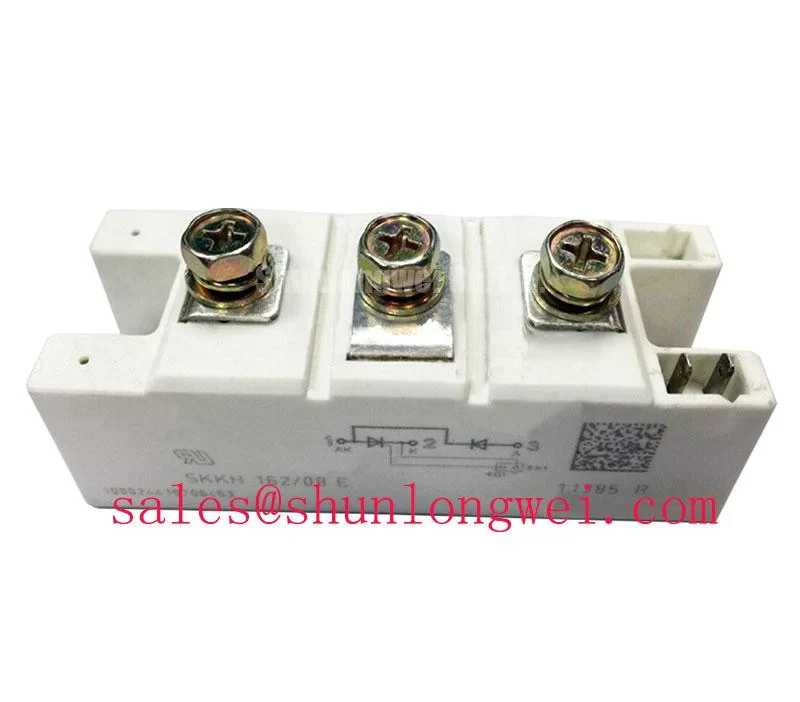
SKKH162/18E Semikron Danfoss Thyristor/Diode Module
The SKKH162/18E is a high-reliability dual-chip thyristor/diode module housed in an industry-standard SEMIPACK 2 package. Developed by Semikron Danfoss, it is built to deliver high electrical and thermal cycling performance in demanding power control environments. The module features a repetitive peak reverse voltage (VRRM) of 1800V and handles an average on-state current (IT(AV)) of 156A at a case temperature of 85°C. With its integrated aluminum oxide ceramic insulated metal baseplate and hard-soldered joints, it provides robust thermal cycling performance. What is the primary benefit of its ceramic insulation? It ensures high dielectric strength and efficient thermal transfer to the heatsink. How does the hard-soldered joint enhance reliability? It prevents bond-wire fatigue under extreme cyclic thermal stresses. For industrial soft starters requiring 1800V transient headroom and high thermal cycling endurance, this thyristor-diode module is the optimal choice.
Key Parameter Overview
Decoding the Specs for Enhanced Thermal Reliability
| Parameter Symbol | Technical Specification | Value / Condition |
|---|---|---|
| VRRM / VDRM | Repetitive Peak Reverse / Off-State Voltage | 1800V |
| IT(AV) | Average On-State Current (sin. 180; Tc = 85°C) | 156A |
| ITSM | Peak Non-Repetitive Surge Current (10 ms; Tvj = 25°C) | 5000A |
| I²t | Surge Current Rating (10 ms; Tvj = 125°C) | 125 kA²s |
| VT(TO) | Threshold Voltage (Tvj = 125°C) | 0.85V |
| rT | On-State Slope Resistance (Tvj = 125°C) | 1.5 mΩ |
| Rth(j-c) | Thermal Resistance Junction-to-Case (per module) | 0.18 °C/W |
| Visol | RMS Isolation Voltage (1 min / 1 s) | 3600V / 4800V |
| Package | Housing Dimensions & Type | SEMIPACK 2 (94 x 34 x 30 mm) |
Download the SKKH162/18E datasheet for detailed specifications and performance curves.
Application Scenarios & Value
System-Level Protection Under Extreme Inductive Loads
Engineers designing heavy-duty industrial soft starters face high thermal stress during starting. When startup current surges occur, the module's 5000A surge rating (ITSM) prevents junction overtemperature. In a phase control rectifier circuit, the 1800V rating blocks voltage transients from line fluctuations. This ruggedness protects upstream systems, minimizing downtime in continuous industrial applications like chemical process control and professional dimming.
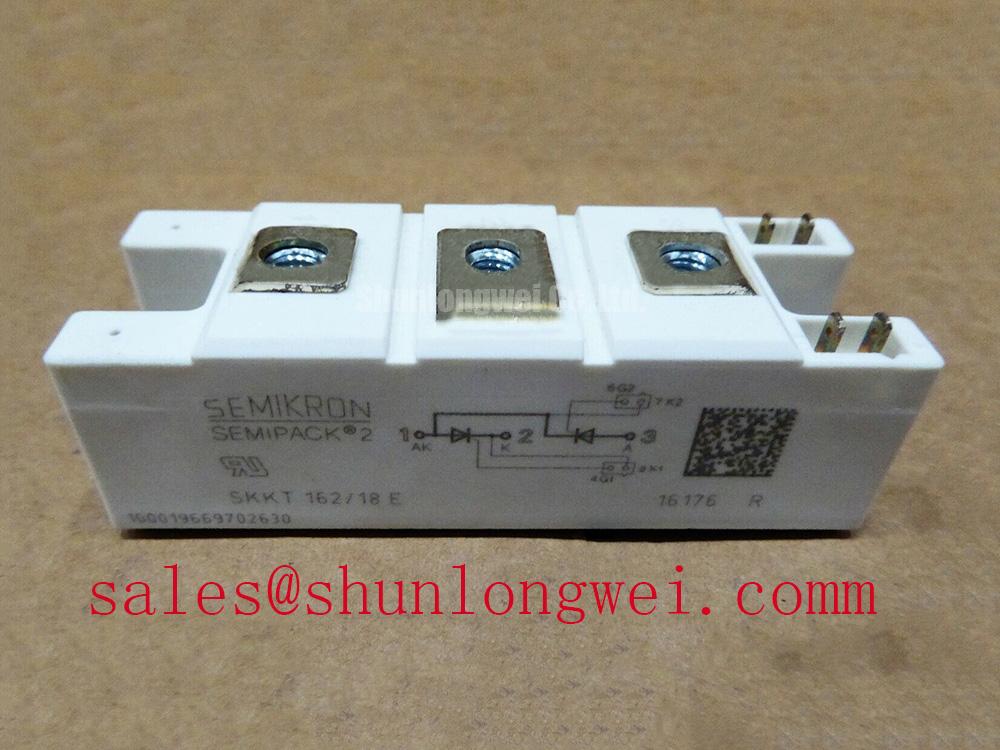
For applications requiring lower current ratings, the SKKH106/16E module is also available. If your topology demands a dual-thyristor configuration instead of a diode-thyristor series pair, look at the SKKT162/18E as a system alternative.
Technical & Design Deep Dive
Hard-Soldered Interconnections and Ceramic Insulation for Extended Thermal Cycling
In high-power thyristor design, keeping internal junctions cool is the key to preventing thermal runaway. The thermal resistance of 0.18 °C/W (Rth(j-c)) acts like an open thermal highway. This low resistance allows heat to flow rapidly from the silicon chip to the heatsink, preventing a thermal bottleneck.
To ensure safety, the 3600V electrical isolation acts like a solid firewall. It prevents dangerous high-voltage spikes from jumping to the grounded chassis or control boards. Using a power semiconductor selection guide helps engineers balance these thermal and electrical isolation parameters. For more on testing, consult our Field Engineer's Handbook to prevent common module failures.
Frequently Asked Questions
Addressing Critical Engineering Design Queries
Question 1: How does the Rth(j-c) of 0.18 °C/W impact the system heatsink design?
Answer: The low thermal resistance allows smaller heatsinks to be used while keeping the junction below 125°C under nominal load.
Question 2: What are the main benefits of using a hard-soldered module compared to solder-free pressure contact designs?
Answer: Hard-soldered connections provide reliable contact stability for steady load profiles, making them highly cost-effective in standard industrial drives.
Question 3: Is a gate driver required for the gate terminal in the diode-thyristor configuration?
Answer: Yes, a proper pulse trigger circuit is required for gate turn-on. See the gate drive and thermal management section for triggering recommendations.
For bulk pricing, inventory inquiries, or technical support, contact our sales department today.