

Content last revised on September 10, 2026
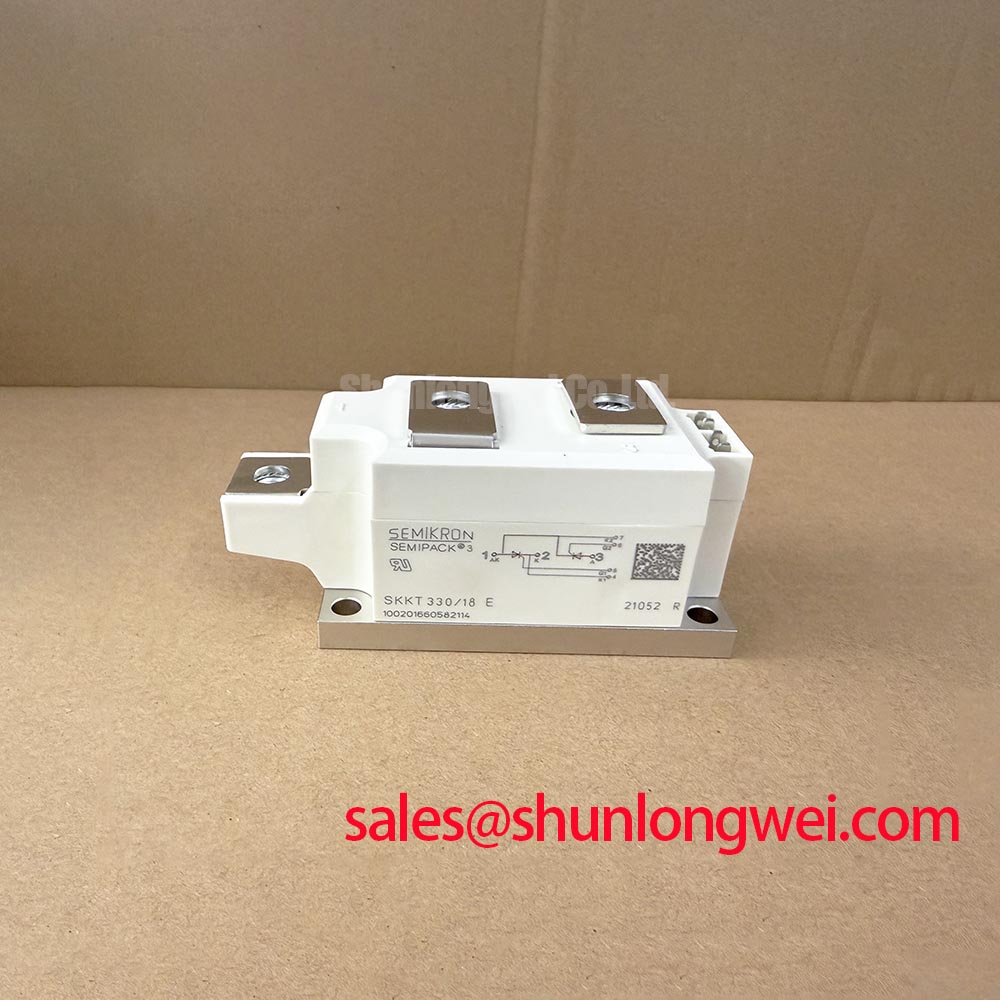
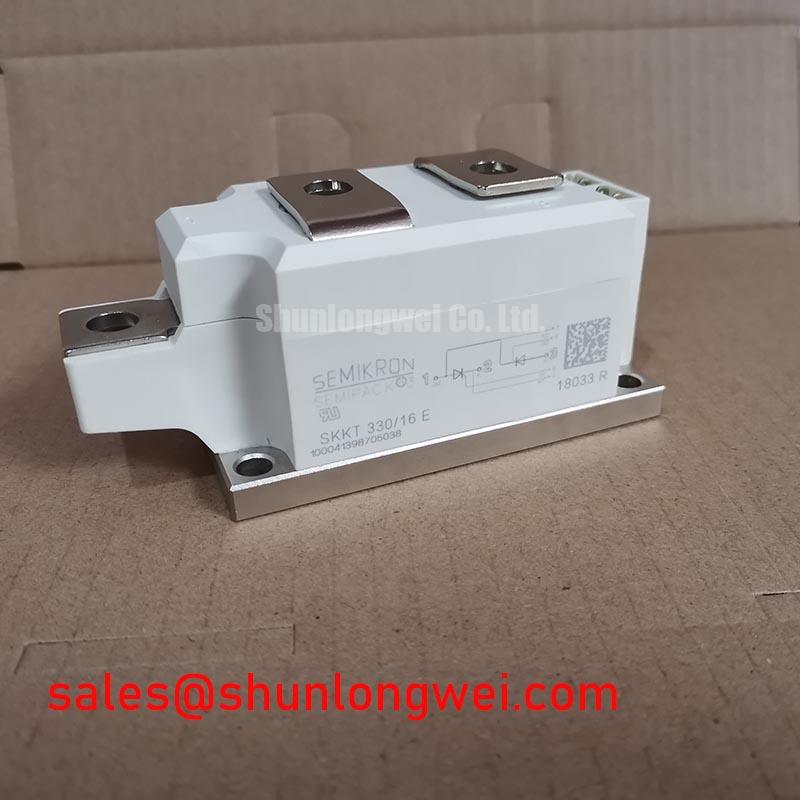
SKKT 330/16 E: High-Reliability 1600V, 309A Dual Thyristor Module
Engineered for Endurance in High-Stress Power Control
The Semikron SKKT 330/16 E is a high-performance dual thyristor module designed for exceptional long-term reliability in demanding industrial power control systems. It combines a high voltage and current rating with a mechanically robust architecture to ensure stable operation and extended service life. For high-power industrial rectifiers and motor controllers requiring maximum operational lifespan under severe thermal cycling, the SKKT 330/16 E is a definitive engineering choice.
- Core Specifications: 1600V | 309A (ITAV) | 8000A (ITSM)
- Key Engineering Benefits: Superior thermal cycling endurance and robust fault current survivability.
- Primary Design Advantage: Its pressure-contact system eliminates solder-related failure modes, ensuring consistent performance over years of operation.
Application Scenarios & Value
System-Level Benefits in Demanding Industrial Power Conversion
The SKKT 330/16 E is engineered for applications where operational uptime and resilience are paramount. Its robust design makes it an ideal component for core industrial equipment.
A prime application is in high-power Soft Starters for large AC induction motors. During motor ramp-up, the thyristor module must handle significant inrush currents and repeated thermal stress. The SKKT 330/16 E's impressive 8000A peak surge current (ITSM) rating provides the necessary margin to withstand these events without degradation. Furthermore, its pressure-contact design prevents the solder fatigue that commonly leads to premature failure in modules subjected to frequent on/off cycles, a critical factor in extending the reliability of the entire motor drive system. This module is also highly effective in DC motor controls, temperature control systems for industrial ovens, and high-capacity UPS (Uninterruptible Power Supply) installations.
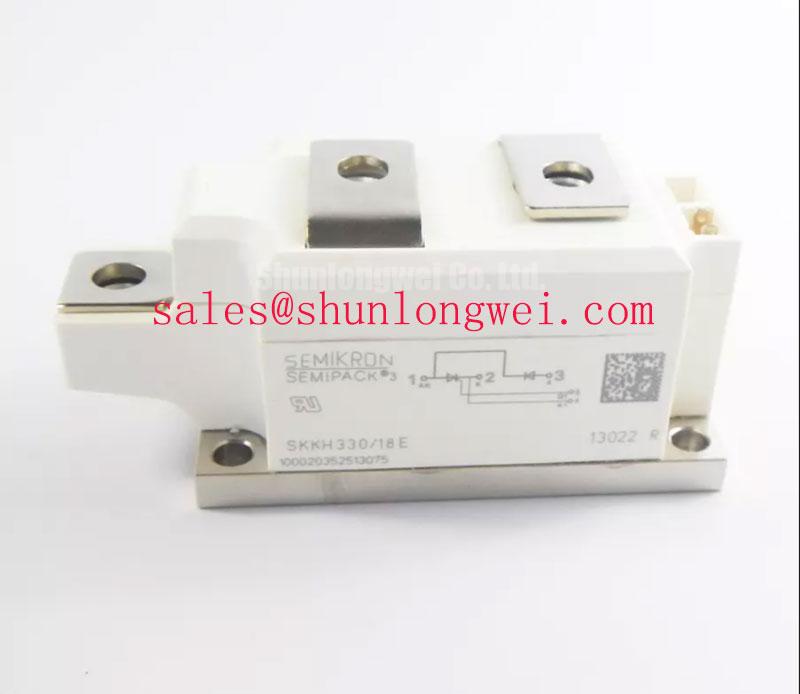
For systems that require a combination of controlled (thyristor) and uncontrolled (diode) rectification, the related SKKH330/16E offers a thyristor/diode configuration with similar power handling capabilities, providing design flexibility within the same physical footprint.
Key Parameter Overview
Key Specifications and Their Engineering Significance
The technical specifications of the SKKT 330/16 E are tailored for robust, high-power applications. Below is a breakdown of the key parameters that directly influence system design and performance.
| Characteristic | Symbol | Value | Engineering Significance |
|---|---|---|---|
| Repetitive Peak Off-State Voltage | VDRM, VRRM | 1600 V | Provides a safe operating margin for direct connection to 480V to 690V AC lines, accommodating voltage transients. |
| Average On-State Current (Tc=100°C) | ITAV | 309 A | Defines the continuous current handling capability, suitable for high-power phase-angle control and rectification. |
| RMS On-State Current | ITRMS | 510 A | Indicates the maximum RMS current the terminals can handle, critical for calculating losses in AC phase control applications. |
| Surge Non-Repetitive On-State Current (10ms) | ITSM | 8000 A | Demonstrates exceptional robustness against fault conditions like motor stalls or short circuits, crucial for fuse coordination. |
| Thermal Resistance, Junction to Case | Rth(j-c) | 0.07 °C/W | A very low value indicating highly efficient heat transfer from the silicon to the heatsink, enabling higher power density or smaller cooling solutions. |
| Maximum Junction Temperature | Tjmax | 125 °C | Defines the upper thermal limit for reliable operation, providing a solid thermal design margin for industrial environments. |
Download the SKKT 330/16 E datasheet for detailed specifications and performance curves.
Engineer's Frequently Asked Questions
Clarifying Design and Performance Advantages
How does the pressure-contact design of the SKKT 330/16 E improve reliability compared to soldered modules?
Pressure-contact technology eliminates solder layers between the silicon die and the baseplate. Solder is prone to fatigue and cracking after thousands of thermal cycles, which is a primary failure mechanism in power modules. By using a high-force pressure system, the SKKT 330/16 E maintains a consistent, low-resistance thermal and electrical path, dramatically increasing its power cycling capability and operational lifetime, especially in applications like induction heating or motor control.
What is the significance of the 338 000 A²s I²t value for system protection design?
The I²t rating represents the thermal energy the device can withstand during a short, non-repetitive fault. A high value of 338,000 A²s allows for easier coordination with protective devices like fuses or circuit breakers. It ensures that the protective device will open the circuit before the thyristor module is damaged during a fault condition, enhancing the overall ruggedness of the power stage.
How does the Rth(j-c) of 0.07 °C/W influence heatsink selection and thermal management?
Thermal resistance (Rth) is like the inverse of a pipe's diameter for heat flow; a lower number means heat escapes more easily. The extremely low Rth(j-c) of 0.07 °C/W signifies very efficient heat transfer from the active silicon to the module's baseplate. For a design engineer, this means that for a given power dissipation, the junction temperature will be lower, providing a greater safety margin. Alternatively, it allows for the use of a smaller, more cost-effective heatsink while maintaining the same junction temperature, which is crucial for designing compact and power-dense systems.
Can the SKKT 330/16 E be used for controlled three-phase bridge rectifier applications?
Yes, absolutely. The SKKT 330/16 E contains two series-connected thyristors (a "half-bridge" leg). Three of these modules can be configured to create a fully-controlled three-phase bridge rectifier (B6C circuit). This configuration is standard for high-power DC motor drives, battery chargers, and front-end converters for industrial inverters.
What mounting torque is recommended to ensure optimal thermal and electrical contact for the SKKT 330/16 E?
According to the official datasheet, the mounting torque for the main M6 terminals is 4.5 Nm ± 15%, and for the M10 mounting bolts to the heatsink, it is 20 Nm ± 15%. Applying the correct torque is critical. Insufficient torque leads to high thermal resistance and potential overheating, while excessive torque can warp the baseplate and cause mechanical stress on the internal components.
Technical Deep Dive
A Deeper Look: The Engineering Behind Pressure-Contact Technology
At the core of the SKKT 330/16 E's superior reliability is its pressure-contact design, a technology developed by Semikron to overcome the inherent wear-out mechanisms of traditional power modules. In conventional modules, the silicon chip is soldered to a direct bonded copper (DBC) substrate, which is then soldered to a metal baseplate. The different coefficients of thermal expansion (CTE) of these materials cause immense mechanical stress on the solder joints during temperature changes. Over time, this leads to solder fatigue, crack formation, and eventual device failure.
The SKKT 330/16 E bypasses this fundamental limitation. Instead of solder, it employs an internal, high-force spring and pressure system to press the silicon die and other components directly against the baseplate and electrical contacts. This is analogous to using a high-tension, pre-loaded bolt to join two steel beams instead of welding them; the constant pressure ensures a reliable connection that is resilient to expansion and contraction. This design results in a dramatic improvement in power cycling capability, making the module exceptionally durable in applications with frequent load changes and ensuring a longer, more predictable service life in critical Industrial Automation systems.
From an engineering standpoint, the SKKT 330/16 E is more than a component; it is a foundational element for building power systems where long-term reliability is non-negotiable. Its robust construction provides the necessary design margin to handle real-world overload and fault conditions, simplifying thermal management and ultimately lowering the total cost of ownership for high-power industrial equipment.