
Content last revised on September 10, 2026
Active Miller Clamp Implementation & Parasitic Capacitive Turn-On Prevention
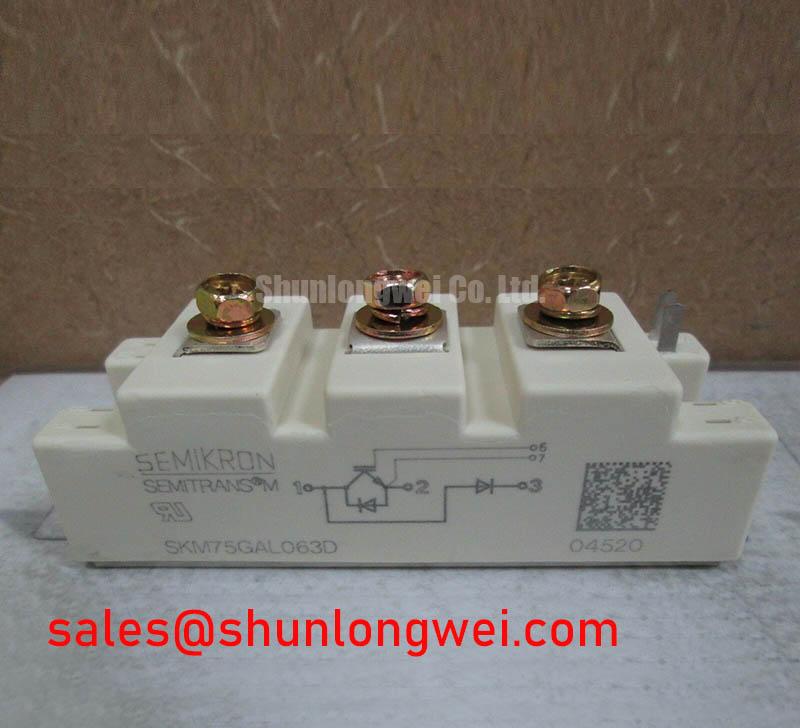
In high-altitude wind turbine pitch and yaw converter subsystems, hard-switching transients generate severe collector-emitter voltage gradients (dv/dt). The Semikron SKM75GAL063D chopper module features a low-side IGBT switch paired with a freewheeling diode. During high dv/dt commutations of complementary switches or adjacent phase legs, displacement current flows through the parasitic gate-collector Miller capacitance (Cgc), described by:
Igc = Cgc × (dv/dt)
If this displacement current traverses the internal gate resistance and driver pull-down impedance, it generates a parasitic voltage drop across the gate-emitter terminals. When this induced voltage exceeds the gate-emitter threshold voltage VGE(th), spurious cross-conduction (shoot-through) occurs, leading to localized thermal stress and potential catastrophic breakdown across the DC bus.
To suppress parasitic turn-on without introducing excessive turn-off gate resistance delays, implementation of an Active Miller Clamp (AMC) circuit is essential. The AMC circuit monitors the gate-emitter voltage during turn-off; once VGE drops below a defined threshold (typically around +2V relative to emitter potential), a low-impedance internal MOSFET shorts the gate directly to the negative rail or driver ground. Supplementing AMC with an asymmetric negative gate bias of -5V to -15V provides enhanced safety margins against high dv/dt transients exceeding 10 kV/µs. Minimizing parasitic loop inductance (Lsigma) within the gate drive path ensures that the module total gate charge Qg is rapidly extracted without excessive ringing.
For systems operating under different topologies or requiring alternative switching configurations, the MG20G6EL1 serves as a baseline comparison for legacy discrete and dual-pack evaluations.
Thermal Paste Degradation Prevention and Mechanical Clamping Torque Calibration
Operating power modules in elevated wind turbine nacelles (>3000m altitude) subjects thermal management assemblies to wide thermal cycles and lower ambient atmospheric pressures. These conditions accelerate thermal interface material (TIM) degradation through pump-out and dry-out mechanisms. Maintaining a stable junction-to-heatsink thermal path for the SKM75GAL063D requires precise control of paste thickness, voiding, and mechanical mounting torque.
Thermal paste application must maintain a calibrated thickness between 50 µm and 100 µm. Excessive layer thickness increases conductive thermal resistance, whereas insufficient thickness fails to compensate for baseplate convexity and heatsink surface irregularities (recommended heatsink flatness: ≤ 20 µm per 100 mm). When mounting the module to the heatsink, a multi-step sequential torque sequence prevents asymmetric mechanical stress and localized substrate cracking:
- Step 1 (Pre-fastening): Hand-tighten or apply a crosswise pre-torque of 0.5 N·m to 1.0 N·m across all mounting screws to allow uniform paste dispersion.
- Step 2 (Dwell Time): Allow a 15-minute settling period for high-viscosity thermal pastes to wet the metallic surfaces and eliminate micro-voids.
- Step 3 (Final Fastening): Apply the final rated torque of 3.0 N·m to 5.0 N·m (using standard M5 hardware) to ensure uniform baseplate contact pressure.
While non-baseplate pressure-contact architectures, such as Semikron MiniSKiiP® Power Modules, eliminate solder layers entirely through direct spring mounting, copper-baseplate modules like the SKM75GAL063D require strict adherence to these mechanical fastening protocols to preserve long-term thermal conductance.
DC-Bus Operating Voltage Headroom Derating for Single Event Burnout (SEB) Immunity
At high altitudes (>3000m), cosmic ray-induced terrestrial neutron flux increases significantly compared to sea-level environments. High-energy atmospheric neutrons colliding with the silicon lattice inside the reverse-biased depletion region of power semiconductors can trigger localized avalanche generation. In the presence of high electric fields, this localized current filamentation initiates Single Event Burnout (SEB), causing instantaneous device destruction without prior thermal warning.
The Failure-in-Time (FIT) rate due to cosmic radiation is strongly dependent on the applied DC-bus voltage (VDC) and operating junction temperature. For the 600V rated Semikron SKM75GAL063D, operating with nominal sea-level voltage margins at high altitudes increases susceptibility to neutron-induced SEB. To achieve target system reliability (