Content last revised on September 10, 2026
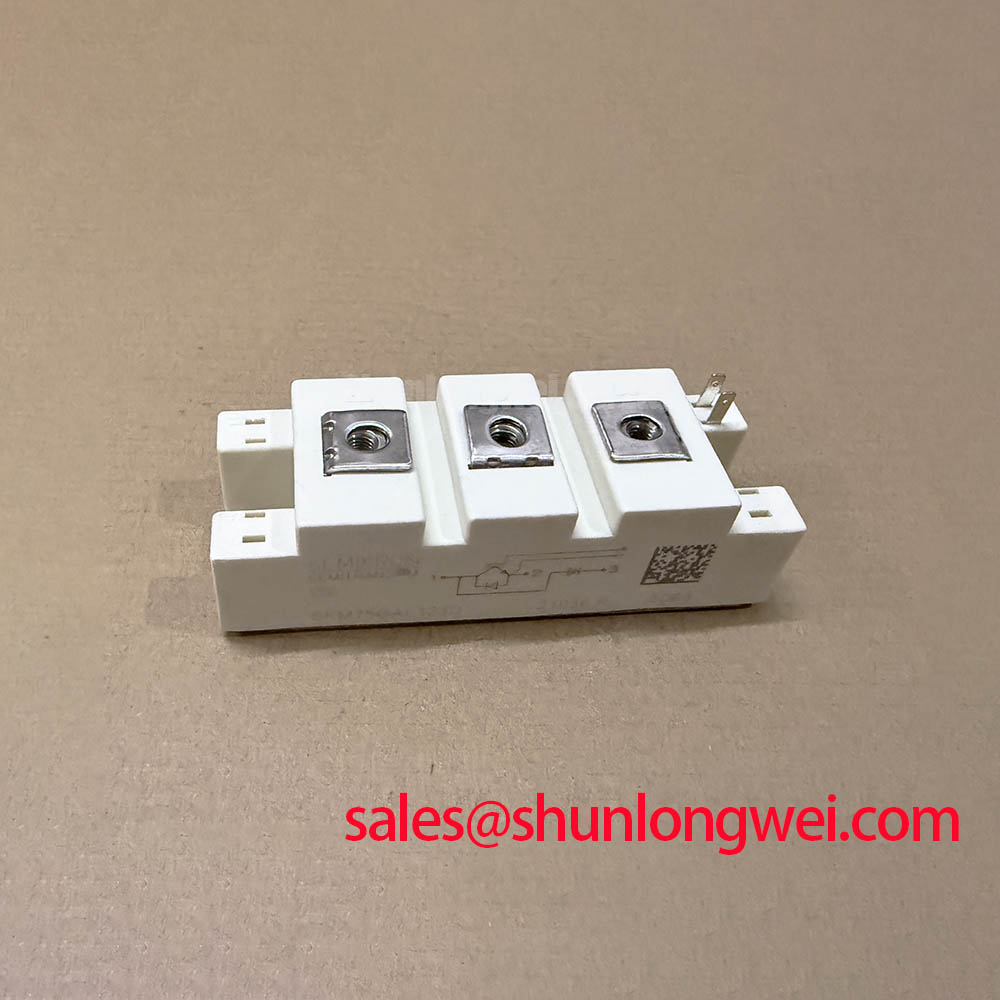
Semikron SKM75GB176D 1700V Half-Bridge IGBT Module
The Semikron SKM75GB176D provides an optimized 1700V blocking capability and high short-circuit ruggedness for 690V AC industrial systems. Key specifications include VCES = 1700V, IC = 75A (at Tcase = 25°C), and a low thermal resistance Rth(j-c) = 0.28 K/W per IGBT switch. It delivers low switching losses and seamless current sharing. For engineers managing high DC-bus ripple in demanding line-voltage drives, this module eliminates the breakdown risks common to standard 1200V alternatives.
Application Scenarios & Value
Robust Power Conversion for Medium-Voltage Industrial Grids
For 575V to 750V AC industrial systems requiring high ruggedness, this 1700V module provides the optimal balance of blocking voltage and thermal margin. Engineers often face severe transient overvoltages and DC-link voltage fluctuations when designing inverters directly connected to 575V AC, 660V AC, or 690V AC utility grids.
In standard motor drive topologies, a 690V line creates a rectified DC bus of approximately 930V to 1050V under steady-state conditions, easily spiking above 1300V during regenerative braking. The 1700V collector-emitter voltage rating of the SKM75GB176D acts like a reinforced surge barrier, absorbing transient spikes without requiring oversized, complex snubber networks. What makes the SKM75GB176D ideal for 690V lines? Its 1700V blocking voltage ensures robust insulation margin against transient overvoltages.
This module also addresses the demanding thermal cycling in auxiliary power supplies for public transit and industrial traction converters. The isolated copper baseplate inside the standard SEMITRANS® 2 package ensures high insulation strength of 4000V AC, allowing compact multi-axis inverter packaging.
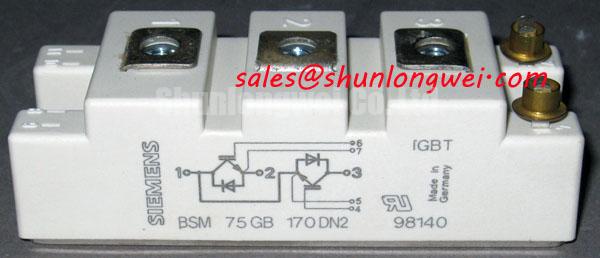
For designs requiring higher current capacity within the same voltage class, the related SKM200GB176D provides a continuous rating of 200A, while the brake chopper topology is supported by the SKM400GAL176D. If your system operates on standard 400V AC mains, consider the 1200V rated SKM75GB128D.
Technical Deep Dive
Trenchgate Dynamics and Short-Circuit Ruggedness
The Semikron SKM75GB176D integrates homogeneous silicon Trenchgate technology with CAL (Controlled Axial Lifetime) freewheeling diodes. This architecture produces a positive temperature coefficient of VCE(sat) (typically 2.0V at 25°C and 2.4V at 125°C). How does positive VCE(sat) temperature coefficient help? It enables natural current balancing during parallel IGBT operation.
Under heavy electrical stress, the device offers self-limiting short-circuit capability up to 6 × IC with a certified withstand time tpsc = 10 µs at Tj = 125°C. This 10 µs window serves as a built-in electronic crumple zone, granting desaturation detection circuits ample response time to initiate soft turn-off without destructive avalanche failure. To master gate protection strategies, explore our guide on IGBT gate drive layout and design.
Understanding internal heat flow is vital for sizing heatsinks; review our analysis on why thermal resistance dictates module reliability. Refer to standard Safe Operating Area guidelines when calculating switching trajectories under maximum DC-link voltages.
Key Parameter Overview
Essential Engineering Ratings and Thermal Limits
| Parameter / Specification | Symbol | Test Conditions | Characteristic Value |
|---|---|---|---|
| Collector-Emitter Voltage | VCES | Tvj = 25°C | 1700 V |
| Continuous Collector Current | IC | Tcase = 25°C / Tcase = 80°C | 75 A / 50 A |
| Pulsed Collector Current | ICRM | tp = 1 ms | 150 A |
| Collector-Emitter Saturation Voltage | VCE(sat) | IC = 50 A, VGE = 15 V, Tj = 25°C | 2.0 V (typ.) / 2.45 V (max.) |
| Gate Threshold Voltage | VGE(th) | VGE = VCE, IC = 2 mA | 5.2 V – 6.4 V |
| Short-Circuit Withstand Time | tpsc | VCC = 1000 V, VGE ≤ 15 V, Tj = 125°C | 10 µs |
| Thermal Resistance (Junction-to-Case) | Rth(j-c) | Per IGBT element | 0.28 K/W |
| Isolation Test Voltage | Visol | AC sinusoidal, 50 Hz, 1 min | 4000 V |
Download the SKM75GB176D datasheet for detailed specifications and performance curves.
FAQ
Clarifying Critical Implementation Queries
What is the maximum continuous current rating of the SKM75GB176D at elevated operating temperatures?
The module delivers 75A at a baseplate case temperature of 25°C, derating to 50A continuous collector current at Tcase = 80°C to keep internal junction temperatures safely below the maximum 150°C rating.
Why is a 1700V IGBT required instead of a 1200V module for 690V line inverters?
A 690V AC mains input generates nominal DC link levels around 950V–1000V. Adding turn-off inductive overvoltage spikes makes 1200V switches vulnerable to breakdown, whereas 1700V devices provide critical safety margin.
How does the positive temperature coefficient of VCE(sat) simplify paralleling?
Because the saturation voltage increases with temperature (from 2.0V at 25°C to 2.4V at 125°C), any IGBT carrying more current naturally heats up, increasing its resistance and shifting current to cooler parallel branches to prevent thermal runaway.
What gate drive voltage range is recommended for optimal operation?
Standard operation requires a turn-on voltage of +15V and a turn-off bias between -8V and -15V. This negative bias prevents parasitic turn-on caused by high dv/dt transients through the Miller capacitance.
What package type does the SKM75GB176D utilize?
It utilizes the industry-standard SEMITRANS® 2 package (D61 outline) featuring screw power terminals (M5) and FASTON signal control terminals, backed by a 4000V AC isolation barrier.
Long-Term Deployment and Supply Integration
Modern industrial drives and utility converters demand continuous component availability without redesign risk. The SKM75GB176D provides an established footprint that stabilizes power architectures across medium-voltage grid deployments. Aligning rugged 1700V silicon with standard thermal interfaces ensures low life-cycle maintenance costs and streamlined power stack upgrades across global industrial operations.