Content last revised on September 10, 2026
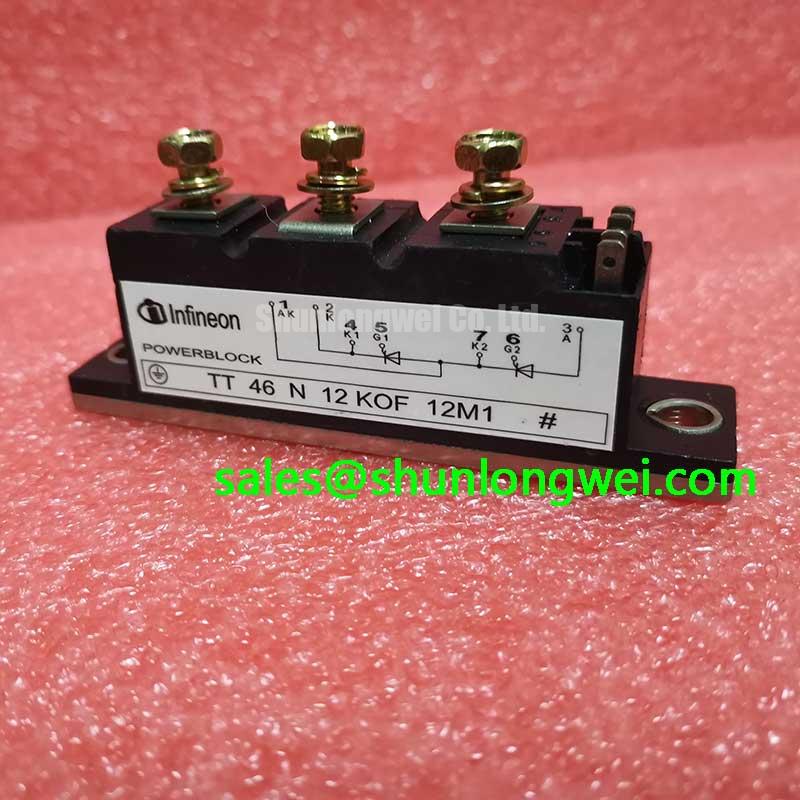
TT46N12LOF Thyristor/Diode Module, 1200V 46A Datasheet
Technical Introduction to the TT46N12LOF Module
The Infineon TT46N12LOF is a Thyristor/Diode Module engineered for exceptional long-term reliability in high-stress power conversion systems. At the core of its design is Pressure Contact Technology, a solder-free construction that mitigates the primary failure mechanism of thermal-mechanical stress in conventional soldered modules. This approach is fundamental for engineers seeking to enhance the operational lifetime of equipment subject to frequent temperature fluctuations. What is the primary benefit of its pressure-contact design? Enhanced long-term reliability by eliminating solder fatigue failures. This module provides a robust foundation for systems where uptime and minimal maintenance are critical operational goals.
Top Specs: 1200V | 46A (ITAVM) | Al2O3 Insulated Baseplate
Key Benefits:
- Superior thermal cycling endurance
- Simplified system assembly
Strategic Advantages in Demanding Power Conversion Environments
In industries such as manufacturing automation and renewable energy, the total cost of ownership (TCO) is a decisive factor in component selection. Downtime and maintenance events directly impact profitability. The TT46N12LOF addresses this by prioritizing operational robustness. Its pressure contact design, a technology proven in the most demanding applications like traction and industrial drives, directly contributes to a longer service life. This focus on durability aligns with the broader industry trend towards creating more resilient and efficient power infrastructure, ensuring that systems like Variable Frequency Drives (VFDs) and uninterruptible power supplies operate dependably for years, even under challenging electrical and thermal conditions. By integrating this module, designers can build systems with a lower lifecycle cost and a higher degree of operational certainty.
Deploying Long-Term Reliability: Key Application Fields
The specific features of the TT46N12LOF make it highly suitable for a range of controlled and uncontrolled rectification applications where system longevity is a primary engineering concern. The combination of a high blocking voltage and reliable thermal performance facilitates its use in demanding industrial environments.
- Industrial Motor Drives: Serves as a dependable input rectifier for AC motor drives and soft starters, providing controlled power and withstanding the electrical stresses common in factory settings.
- Power Supplies and UPS: Forms the core of reliable rectifier stages in uninterruptible power supplies (UPS) and industrial SMPS, ensuring consistent DC power delivery.
- Welding Equipment: The module's robust surge current handling capability makes it an excellent choice for the power rectification stages in professional welding power sources.
- Battery Charging Systems: Ideal for building high-power, controlled rectifiers for industrial battery charging infrastructure.
For controlled rectifier circuits in the 20-30 kW range where operational lifetime is the primary design driver, the TT46N12LOF's pressure contact construction offers a distinct advantage over conventional soldered alternatives.
A Deeper Look at Pressure Contact and Passivation Technology
Two key technological pillars define the performance of the TT46N12LOF: its connection method and chip-level protection. How does the module achieve reliable isolation? Through its high-performance Aluminium Oxide ceramic baseplate. This design choice not only provides excellent electrical insulation but also ensures efficient thermal transfer to a heatsink.
Pressure Contact Technology
Unlike standard modules that rely on soldered connections between the semiconductor die and the substrate, the TT46N12LOF utilizes a pressure-based system. This eliminates solder layers, which are often the weakest point in a power module's construction. During thermal cycling, mismatched expansion and contraction rates between materials can cause solder fatigue and eventual failure. The pressure contact design is inherently immune to this degradation mechanism, leading to a significantly higher power cycling capability and a more predictable operational life. For more information on thermal performance, consult our guide on unlocking IGBT thermal performance.
Glass Passivated Chips
What is the benefit of glass passivated chips? They ensure stable high-voltage blocking performance over the component's lifespan. The semiconductor junctions are protected by a layer of hard glass, which hermetically seals and shields them from environmental contaminants. This passivation technique is crucial for maintaining low leakage currents and stable blocking voltage characteristics over decades of operation, a key factor in long-term system reliability.
Core Technical Specifications for System Integration
The following table outlines the critical parameters of the TT46N12LOF, based on the official datasheet. These values are essential for accurate system design, thermal modeling, and performance simulation. For a comprehensive list of all parameters, including characteristic curves and mechanical drawings, please refer to the official product documentation.
| Electrical Characteristics (per thyristor/diode at Tj=25°C unless otherwise specified) | ||
|---|---|---|
| Parameter | Symbol | Value |
| Repetitive Peak Off-State Voltage | VDRM / VRRM | 1200 V |
| On-State Current (Avg) | ITAVM | 46 A (TC = 85°C) |
| Surge Forward Current | ITSM | 550 A (t=10ms, Tvj=25°C) |
| On-State Voltage (Thyristor) | VT | max. 1.55 V (IT = 150A) |
| Forward Voltage (Diode) | VF | max. 1.5 V (IF = 150A) |
| Thermal and Mechanical Characteristics | ||
| Operating Junction Temperature | Tvj op | -40 to +125 °C |
| Thermal Resistance, Junction to Case (per thyristor) | RthJC | max. 0.5 K/W |
| Isolation Test Voltage | VISOL | 2500 V (RMS, 50 Hz, 1 min) |
Interpreting Thermal Resistance (RthJC)
The Thermal Resistance from junction to case (RthJC) is a critical parameter for thermal design. It acts like the narrowness of a pipe, restricting the flow of heat. A lower RthJC value signifies a wider, more efficient "pipe," allowing heat generated at the semiconductor junction to be evacuated more effectively to the heatsink. The low RthJC of the TT46N12LOF, enabled by its direct-bonded copper (DBC) and insulated baseplate construction, is key to maintaining a lower operating junction temperature, which directly translates to higher efficiency and enhanced reliability.
Data for an Informed Component Selection Process
When evaluating power modules for a new design or as a replacement part, it is crucial to look beyond primary voltage and current ratings. The underlying construction technology plays a significant role in long-term performance. For systems with high power cycling demands or where service access is difficult and costly, a module with pressure contact technology like the TT46N12LOF presents a compelling engineering case compared to traditional soldered modules. Engineers should assess the expected thermal cycling profile of their application to determine if the enhanced mechanical endurance of a pressure-contact design offers a superior total cost of ownership. For rectifier applications requiring different topologies, the TDB6HK95N16LOF provides a three-phase bridge configuration in a similar module format.
Frequently Asked Questions (FAQ)
1. What is the primary advantage of the pressure contact technology in the TT46N12LOF compared to soldered modules?
The main advantage is significantly improved reliability and operational lifetime, especially in applications with frequent and wide temperature changes. By eliminating solder layers, it completely avoids solder fatigue, which is a common cause of failure in conventional power modules. This results in superior power cycling capability and mechanical robustness.
2. How does the electrically insulated baseplate simplify thermal design and assembly?
The integrated Aluminium Oxide (Al2O3) ceramic baseplate provides high dielectric strength, eliminating the need for external insulating materials like thermal pads or foils between the module and the heatsink. This reduces assembly complexity, lowers material costs, and improves the consistency and efficiency of the thermal interface, leading to more reliable heat dissipation.
Your Next Step in High-Reliability Power Design
To fully assess the TT46N12LOF for your next design, review the detailed parameter table and download the official datasheet to run your thermal simulations. The data provided will enable a thorough evaluation of its performance within your specific application constraints, ensuring you can leverage its unique reliability features to their full potential. For further insights into component selection, explore our guide on decoding power module datasheets.