Content last revised on September 25, 2026
1MBI400NN-120 Circuit Protection and Reliability: Heatsink Contact and Interface Control
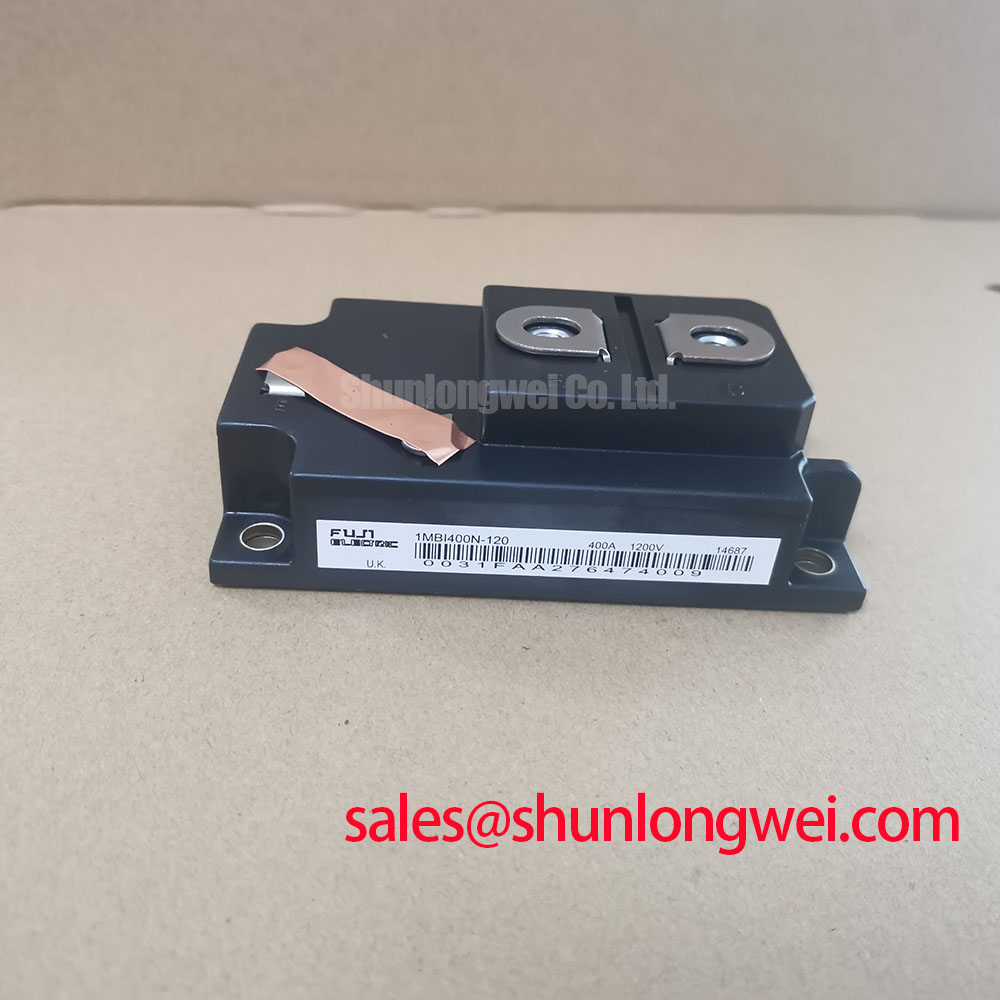
Begin a replacement inspection by confirming the nameplate and procurement record identify Fuji Electric 1MBI400NN-120, then verify the module's cold state terminal condition before connecting it to a powered converter. The supplied official specification identifies this device as an IGBT Module with a rated voltage of 1200 V and a rated current of 400.0 A. These values establish the product identity and electrical rating reference; they do not replace the system designer's voltage transient, current waveform, insulation, and thermal verification.
For a field replacement, inspect the baseplate, terminals, mounting surface, and surrounding heatsink for contamination, scoring, oxidation, or evidence of uneven contact. A flat, clean interface is important because local gaps in the thermal interface material can increase thermal resistance and create a temperature distribution that is difficult to detect from an average heatsink measurement. The interface material should be applied as a controlled, continuous layer according to the selected compound's process instructions. Excess material can migrate toward nearby surfaces, while insufficient coverage can leave air pockets beneath the baseplate.
Baseplate curvature should be considered during assembly. Place the module on the prepared heatsink without forcing it into position, confirm that the mounting holes align naturally, and tighten the screws progressively in a cross pattern. The exact fastener type, screw sequence, and torque must follow the module documentation and the equipment manufacturer's assembly procedure. A system engineer should validate contact pressure after assembly through thermal testing under the intended switching profile rather than treating a general workshop torque value as an official parameter for this model.
Maintenance Note: During preventive maintenance, clean the heatsink and confirm that airflow remains unobstructed while comparing contact temperature at equivalent operating load and ambient conditions.
Protection work should also include the gate drive and turn-off path. Where the converter uses desaturation monitoring, the protection threshold, blanking interval, soft turn-off behavior, and fault latch sequence must be verified against the actual gate driver and module circuit. The 1MBI400NN-120 page does not establish those system-level settings. A short-circuit test should therefore be performed with controlled energy, suitable probes, and a known-good reference waveform, checking whether the driver reduces gate command cleanly without creating an excessive collector-emitter transient.
For engineers comparing related power stages, 2MBI150UC-120 may be reviewed as a separate Fuji Electric reference device. It should not be treated as a drop-in substitute without confirming electrical topology, terminal arrangement, gate characteristics, thermal construction, protection behavior, and mechanical compatibility.
1MBI400NN-120 Operational Boundaries: Static and Dynamic Current Distribution
When several IGBT paths operate in parallel, static current sharing and dynamic current sharing must be evaluated separately. The positive temperature coefficient commonly associated with the on-state voltage of an IGBT can support improved steady-state current distribution: as one device warms, its on-state voltage behavior may reduce the tendency for it to continue taking disproportionate current. This is a design consideration, not a guarantee that parallel devices will share current evenly under every pulse condition.
Dynamic imbalance is strongly affected by gate loop geometry, driver propagation delay, emitter reference layout, stray inductance, and the relationship between the commutation loop and the DC link. Gate wiring for parallel devices should be arranged symmetrically, with comparable conductor length and impedance. The system integrator should verify individual gate-emitter waveforms and collector current distribution using appropriately rated differential and current probes. A single gate signal measured at the driver output cannot confirm that every module terminal receives the same switching command.
Phase-angle conduction and line-frequency ripple also influence the thermal and electrical loading of the module. Before approving a traction inverter or industrial converter application, evaluate the actual duty pattern, modulation method, regeneration events, and low-speed operating conditions. A line-frequency smoothing network may reduce ripple seen by the power stage, but its inductance, capacitance, control interaction, and stored energy remain system characteristics that require separate validation.
RC snubber selection should be based on measured switching behavior and the energy associated with the specific commutation loop. A snubber can reduce ringing when placed across the correct electrical nodes, yet an unsuitable network can add loss, alter turn-off behavior, or mask a layout problem. Measure the collector-emitter waveform at the module terminals and compare it with the DC-link condition during turn-on, turn-off, and fault interruption. The system engineer should confirm peak voltage and thermal margins through switching tests before adopting a production value.
Bootstrap-assisted gate supplies require similar discipline. The high-frequency charge and discharge balance depends on gate charge, switching frequency, duty cycle, driver quiescent current, bootstrap diode recovery, capacitor ESR, and the available replenishment interval. Because these values are not supplied here as official specifications for the 1MBI400NN-120, the capacitor and diode cannot be selected from a generic module rule. Verify the gate supply at the driver pins during the most demanding duty pattern, including startup, low-frequency operation, rapid load changes, and fault recovery.
For the upstream or complementary power stage, engineers may consult 2MBI400TB-060-01 as a separate topology reference. Its role, voltage class, terminal arrangement, and switching behavior must be checked independently before it is placed in the same converter architecture.
1MBI400NN-120 Thermal-Electrical Optimization: Transient Heating and Peak Junction Evaluation
Thermal approval should begin with the real load profile rather than a single nominal current value. The official supplied rating is 400.0 A, but the temperature response of an installed module depends on conduction loss, switching loss, pulse duration, repetition rate, cooling conditions, interface quality, and the thermal impedance of the complete assembly. A short overload and a sustained overload can produce very different junction temperature responses even when their average current appears similar.
A practical test sequence uses synchronized measurements of collector-emitter voltage, current, gate voltage, case temperature, heatsink temperature, and ambient condition. Use the measured switching waveform to estimate the electrical loss during each operating interval, then apply the equipment's validated thermal network to determine the transient case-to-junction response. Multi-stage RC thermal models can be useful for this purpose, but their parameters must come from an applicable manufacturer data source or a properly characterized assembly. They should not be presented as official 1MBI400NN-120 values when the source data has not been supplied.
During pulsed overload testing, allow sufficient time for the case and heatsink to reach the intended thermal state before comparing results. Inspect whether the temperature rise follows the expected load pattern and whether repeated pulses create cumulative heating. If the measured case temperature is stable while electrical waveforms show increasing loss, investigate gate drive timing, switching overlap, current commutation, and probe placement. If temperatures differ between parallel paths, inspect the interface pressure and current path symmetry before assigning the result to the silicon alone.
Thermal cycling is also relevant to maintenance. Repeated heating and cooling can affect interface material condition, mounting pressure, busbar joints, and terminal connections. At service intervals, review thermal images alongside historical load records and check for a change in temperature distribution at comparable operating points. This trend-based approach is more defensible than assigning an unsupported operating lifetime or failure-rate figure.
For broader device physics and switching-test reference material, the The Ultimate IGBT Knowledge Base can be used alongside the applicable Fuji Electric documentation. Fuji Electric's information on Brake Chopper IGBT Modules and RC IGBT Modules should likewise be read as manufacturer information for their respective product families, not as a substitute for the exact 1MBI400NN-120 specification.
1MBI400NN-120 Assembly Integrity and Layout Architecture: Symmetrical Busbar Geometry
Busbar geometry should minimize the commutation loop area and keep the forward and return current paths physically close. This reduces parasitic inductance and helps limit turn-off overshoot, but the acceptable result is determined by the measured DC-link voltage, current slew rate, switching condition, and module terminal waveform. The system engineer should verify the peak margin directly at the module terminals during switching tests rather than relying on a calculated layout target alone.
In practical terms, keep the DC-link connection, module terminals, snubber connection, and return path arranged as a compact, symmetrical current loop. Avoid routing high di/dt conductors beside sensitive gate-drive or protection wiring for extended distances. Where a laminated or planar busbar is used, confirm that the physical stack-up remains consistent across parallel paths and that fasteners do not introduce unintended contact resistance or mechanical distortion.
Snubber capacitors should be connected to the nodes they are intended to control, with the shortest practical connection compatible with insulation and service requirements. Their capacitance, voltage rating, pulse current capability, damping resistance, and thermal loss must be selected from measured ringing and the system's switching energy. A larger capacitor is not automatically a better solution because it can increase circulating current and switching loss.
During troubleshooting, compare the voltage waveform at the module terminals with the waveform measured farther away on the busbar. A meaningful difference may indicate probe inductance, connection inductance, or an unbalanced current path, so use a controlled measurement setup and repeat the test with the known-good phase or converter leg. Layout clearance, creepage, insulation coordination, and enclosure conditions must be confirmed against the applicable equipment standard and operating environment, particularly where condensation or contamination may occur.
For a high-speed rail or heavy freight locomotive traction inverter evaluation, this module should be assessed as part of the complete power stage, including the gate driver, cooling assembly, busbar, protection circuit, control timing, and service environment. The supplied product data confirms the 1200 V rated voltage, 400.0 A rated current, and Module package classification; final application approval remains dependent on documented system verification.