
Content last revised on September 10, 2026
Reverse Recovery Charge (Qrr) & Commutation Turn-Off Snubber Loss Optimization
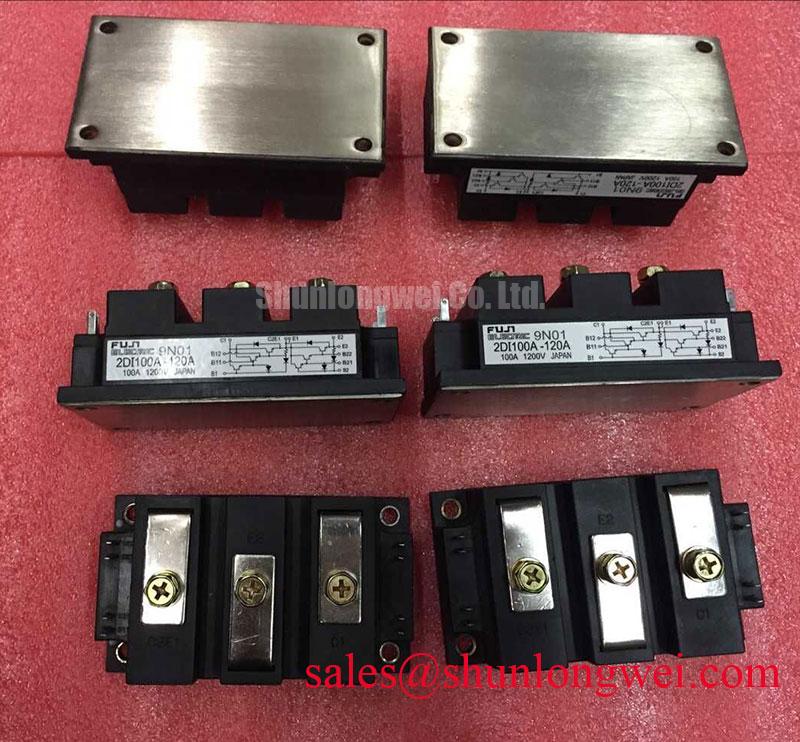
In high-voltage three-phase motor solid-state soft starters, power diodes manage severe commutation transients during each line cycle. The 2DI100A-120 dual diode module from Fuji Electric Global Power Semiconductor Technologies provides a repetitive peak reverse voltage of 1200.0V (Official Datasheet Specification) and an average forward current rating of 100.0A (Official Datasheet Specification). During phase-angle firing control, rapid current fall rates (di/dt) extract stored charge across the P-N junction, producing a peak reverse recovery current (IRRM) that induces overvoltage spikes across parasitic circuit inductances.
Without adequate snubber damping, sudden snap-off during the reverse recovery time (trr) creates high dv/dt transients that stress adjacent power switches. Plant engineers routinely size RC snubber circuits across the module terminals to absorb the inductive energy released during diode turn-off. Placing non-inductive resistors paired with low-inductance polypropylene capacitors directly across the AC input terminals reduces localized switching dissipation, protecting the internal silicon dies against transient punch-through without producing excessive auxiliary snubber losses.
Short-Circuit Withstand Limits: Coordinating Semiconductor Fuses with Diode/Thyristor I2t
Solid-state soft starters operating on industrial motor lines are exposed to direct line-to-line faults, jammed impellers, and severe locked-rotor overcurrents. Protecting the 2DI100A-120 against catastrophic case rupture requires strict coordination between the semiconductor fuse clearing energy and the module surge current withstand capability. The diode internal silicon die and wire bonds tolerate a finite maximum I2t energy during sub-cycle short circuits before bond-wire fusion or silicon fracture occurs.
To avoid explosive module destruction during a dead-short condition, the total clearing I2t of the upstream high-speed semiconductor fuse must remain well below the rated melting energy of the diode module. Plant maintenance teams evaluating damaged power assemblies can cross-reference diagnostic procedures outlined in the Field Engineer’s Handbook when assessing semiconductor failure modes and fuse-clearing integrity.
| Protection Parameter | Engineering Function | Field Inspection Criteria |
|---|---|---|
| Semiconductor Fuse I2t | Clears line short-circuit energy within <10 ms | Must not exceed module limit at 125°C junction |
| Non-Repetitive Surge Current (IFSM) | Withstands single-cycle peak fault current | Verified post-trip via milliohm meter check |
| Terminal Clamping Torque | Prevents high-resistance micro-arcing | Calibrated with M5 torque wrench (2.5–3.5 N·m) |
Dynamic Voltage Sharing and RC Damping in Series-Connected Rectifier Diodes
Medium-voltage soft starter topologies frequently employ series-connected diode pairs to support bus voltages exceeding single-module ratings. Because leakage currents (IR) and junction capacitances vary across manufacturing lots, unassisted series strings risk severe steady-state and dynamic voltage imbalances. Static sharing resistors equalize off-state DC blocking voltages, while parallel dynamic capacitors force uniform voltage division during high-speed turn-off transitions.
When selecting compatible bridge components across low-to-medium voltage drive retrofits, engineers often compare the 1200V module against alternate ratings such as the 2DI100MA-050 for systems requiring lower blocking thresholds. In all installations, thermal interface maintenance directly governs device lifespan. High-voltage switching modules listed among Fuji Electric Power Semiconductor & IPM Modules require planar heatsink mounting tolerances with an evenly spread 50–100 μm thermal grease film to keep thermal resistance (Rth(j-c)) within design limits.
⚠️ Maintenance Note: Thermal compound dries and oxidizes in hot industrial enclosures over extended operational intervals. Inspect the baseplate contact zones every 12 to 18 months, recalibrate heatsink mounting bolts to 2.5–3.5 N·m (General Industry Design Consideration for M5 fasteners), and check for localized discoloration indicating terminal overheating.
Mechanical Torque Shock Elimination in Heavy Pumps and Compressors via Soft Ramping
Direct-on-line starting of heavy centrifugal compressors and slurry pumps draws locked-rotor inrush currents reaching 600% to 800% of nominal motor ratings. This inrush produces steep mechanical torque spikes that shear drive couplings, strip gearboxes, and cause hydraulic water hammer in long pipe runs. Utilizing the 2DI100A-120 in a controlled phase-angle soft-starter circuit clamps starting current draw to less than 250% of the motor rated current.
By smoothly ramping the RMS voltage applied to the motor stator over an adjustable 5 to 30 second window, electromagnetic torque rises linearly. This smooth ramp eliminates mechanical backlash across shaft assemblies and minimizes voltage sags on the plant distribution feeder. Once the motor reaches full synchronous operating speed, an internal or external bypass contactor engages to route line current around the power module, reducing continuous operational heat generation inside the starter cabinet.