Content last revised on September 10, 2026
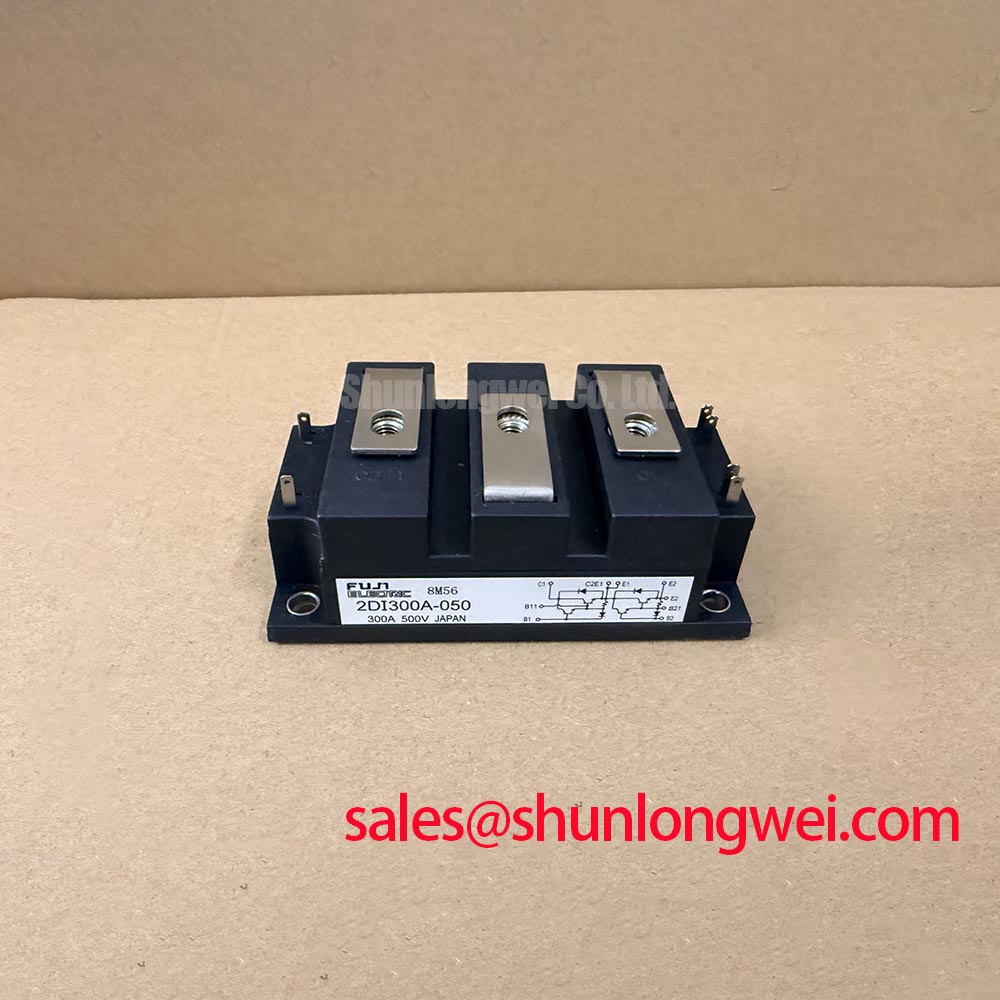
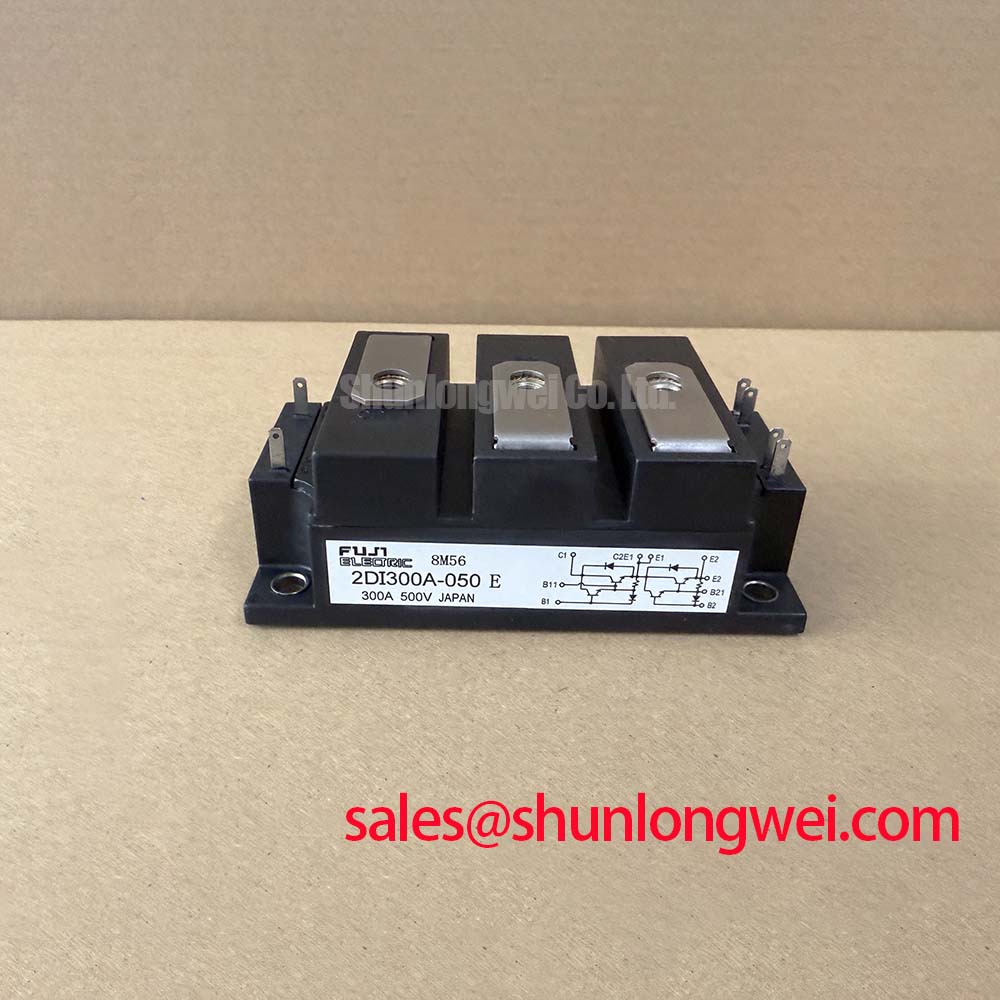
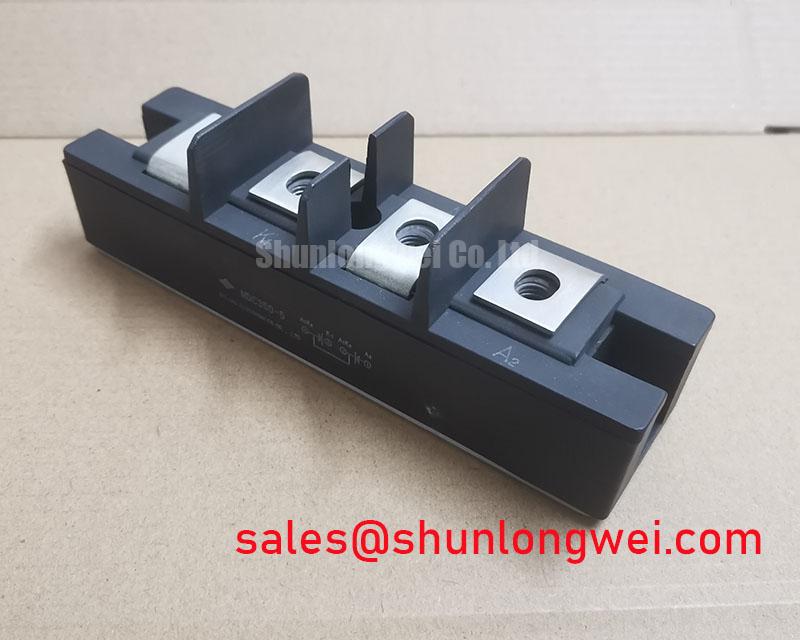
2DI300A-050-03 | 500V 300A Dual IGBT Module for High-Frequency Power Conversion
Product Overview: Technical Specifications and Engineering Insights for the 2DI300A-050-03 IGBT Module
Engineered for high-frequency power conversion, the 2DI300A-050-03 minimizes total power loss through a combination of low VCE(sat) and fast switching characteristics. This dual IGBT module delivers robust performance with key specifications of 500V | 300A | VCE(sat) 2.5V (typ.). Its design provides two primary engineering benefits: significantly reduced thermal load and the capability to operate at higher switching frequencies. This module directly addresses the challenge of balancing efficiency and power density in demanding applications by minimizing both conduction and switching losses. For high-frequency welding and induction heating systems up to 75kW, the 2DI300A-050-03's balance of low switching loss and 300A capability makes it a compelling choice.
Key Parameter Overview
Decoding the Specs for Efficient Power Switching
The technical specifications for the 2DI300A-050-03 are grouped by function to facilitate engineering evaluation. The values presented below are critical for performing thermal analysis, calculating power losses, and ensuring reliable operation within the device's safe operating area.
Table 1: Key Operational Parameters
| Parameter | Symbol | Condition | Value | Unit |
|---|---|---|---|---|
| Absolute Maximum Ratings (Tc=25°C) | ||||
| Collector-Emitter Voltage | VCES | - | 500 | V |
| Gate-Emitter Voltage | VGES | - | ±20 | V |
| Collector Current (DC) | IC | - | 300 | A |
| Collector Current (Pulsed) | ICP | 1ms pulse | 600 | A |
| Max Power Dissipation | PC | Per IGBT | 960 | W |
| IGBT Electrical Characteristics (Tj=25°C) | ||||
| Collector-Emitter Saturation Voltage | VCE(sat) | IC = 300A, VGE = 15V | 2.5 (Typ) / 3.0 (Max) | V |
| Turn-On Time | ton | VCC=300V, IC=300A, VGE=±15V, RG=5.1Ω | 0.5 (Typ) | µs |
| Turn-Off Time | toff | 1.0 (Typ) | µs | |
| Reverse Recovery Time (FWD) | trr | 0.25 (Typ) | µs | |
| Thermal Characteristics | ||||
| Thermal Resistance (Junction to Case) | Rth(j-c) | Per IGBT | 0.13 | °C/W |
| Operating Junction Temperature | Tj | - | +150 | °C |
Application Scenarios & Value
Achieving System-Level Benefits in High-Frequency Power Topologies
The 2DI300A-050-03 IGBT module is optimized for power conversion systems where operational efficiency and physical compactness are paramount. Its primary value is realized in applications that leverage high switching frequencies to reduce the size of magnetic components like transformers and inductors.
Consider the design of a high-frequency (20-50 kHz) power supply for industrial welding. The primary engineering challenge is managing the substantial heat generated by switching losses. The fast turn-on (0.5 µs) and turn-off (1.0 µs) times of the 2DI300A-050-03 directly translate to lower switching energy loss (Eon, Eoff) during each cycle. This reduction in wasted energy means less heat must be dissipated, allowing the design engineer to specify a smaller, more cost-effective heatsink or fan assembly, ultimately enabling a more compact and competitive final product. This focus on efficiency is a core principle in modern Variable Frequency Drive (VFD) and UPS designs.
This module's electrical characteristics make it a strong candidate for:
- High-Frequency Welding Power Supplies
- Industrial Motor Drives
- Uninterruptible Power Supplies (UPS)
- Induction Heating Systems
- Switching Mode Power Supplies (SMPS)
While the 2DI300A-050-03 is well-suited for 500V systems, for applications requiring a higher blocking voltage, the related 2MBI200VA-060 offers a 600V rating.
Frequently Asked Questions (FAQ)
How does the VCE(sat) of 2.5V (typ) impact thermal design in a motor drive application?
A lower VCE(sat) directly reduces conduction losses, which is the power dissipated as heat while the IGBT is conducting current (P_loss = VCE(sat) * Ic). With a typical VCE(sat) of 2.5V at its rated 300A, the module generates less heat than a device with a higher saturation voltage. This simplifies thermal management, potentially allowing for a smaller heatsink, reduced cooling requirements, and improved overall system reliability by keeping the junction temperature lower.
What is the significance of the 0.25 µs reverse recovery time (trr) for the free-wheeling diode?
The reverse recovery time (trr) of the integrated free-wheeling diode (FWD) is critical in half-bridge topologies like those found in inverters. A shorter trr, like the 0.25 µs typical for this module, means the diode stops conducting reverse current more quickly. This results in lower reverse recovery losses (Erec), reduces voltage stress on the opposing IGBT, and minimizes electromagnetic interference (EMI), which is particularly important in high-frequency designs.
Can the 2DI300A-050-03's isolated baseplate simplify manufacturing assembly?
Yes. The module features an electrically isolated baseplate rated for 2500V (AC, 1 minute). This integral isolation eliminates the need for separate, thermally resistive insulating pads (e.g., mica or silicone) between the module and the heatsink. This simplifies the mechanical design, reduces parts count, streamlines the assembly process, and ensures a more consistent and efficient thermal path from the module case to the heatsink.
Technical Deep Dive
Balancing Conduction and Switching Losses for Optimal Performance
In power electronics design, managing power loss is a fundamental challenge. The total loss in an IGBT module is primarily a sum of conduction losses and switching losses. The 2DI300A-050-03 is engineered to provide a balanced solution that minimizes this total loss, particularly in systems operating above 10 kHz.
Think of power loss like friction for a vehicle. Conduction loss, dictated by VCE(sat), is like the constant aerodynamic drag when cruising at a steady speed. Switching loss, determined by parameters like ton and toff, is analogous to the extra energy burned every time you brake and re-accelerate. In applications with frequent start-stop cycles (high-frequency switching), this 'acceleration' cost can become the dominant form of energy waste. The 2DI300A-050-03's low VCE(sat) reduces the 'constant drag,' while its fast switching speeds minimize the 'acceleration cost,' leading to higher overall fuel efficiency for your power system.
Industry Insights & Strategic Advantage
Meeting the Demands for Higher Power Density and Efficiency
The industrial sector is continuously driven by mandates for greater energy efficiency and a reduction in equipment footprint. The performance of the 2DI300A-050-03 directly supports these strategic goals. By minimizing total power losses, systems built with this module consume less electricity and generate less waste heat. This is not merely an operational benefit; it allows engineers to design more power-dense solutions. For example, a more efficient Uninterruptible Power Supply (UPS) can be housed in a smaller enclosure, saving valuable floor space in data centers.
Furthermore, reliability is directly linked to thermal performance. A component's operational lifetime is often dictated by its operating temperature. A key parameter, thermal resistance (Rth(j-c)), defines how effectively heat can be removed from the active silicon. A low Rth(j-c), like the 0.13 °C/W of this module, is like having a wider, shorter pipe to drain heat away from the chip. The faster the heat is removed, the cooler the chip operates, which is fundamental to achieving long-term reliability and preventing premature system failure, a critical consideration in any high-power industrial design.
Technical Support and Inquiries
Our team of technical specialists is available to support your design process. For detailed application notes, thermal modeling assistance, or to discuss the specific requirements of your power conversion project, please contact us for engineering support.