

Content last revised on September 10, 2026
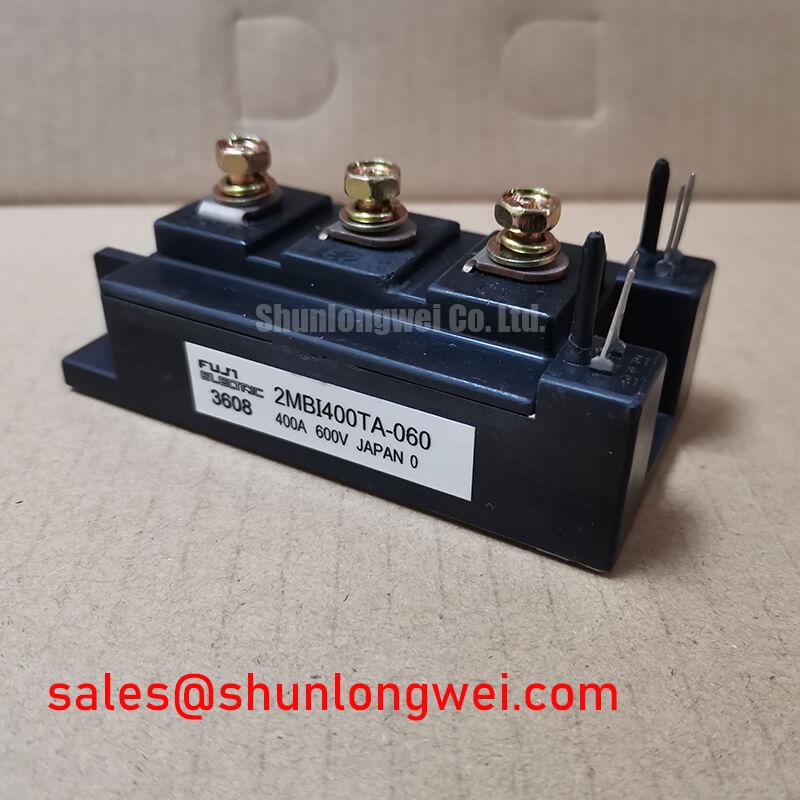
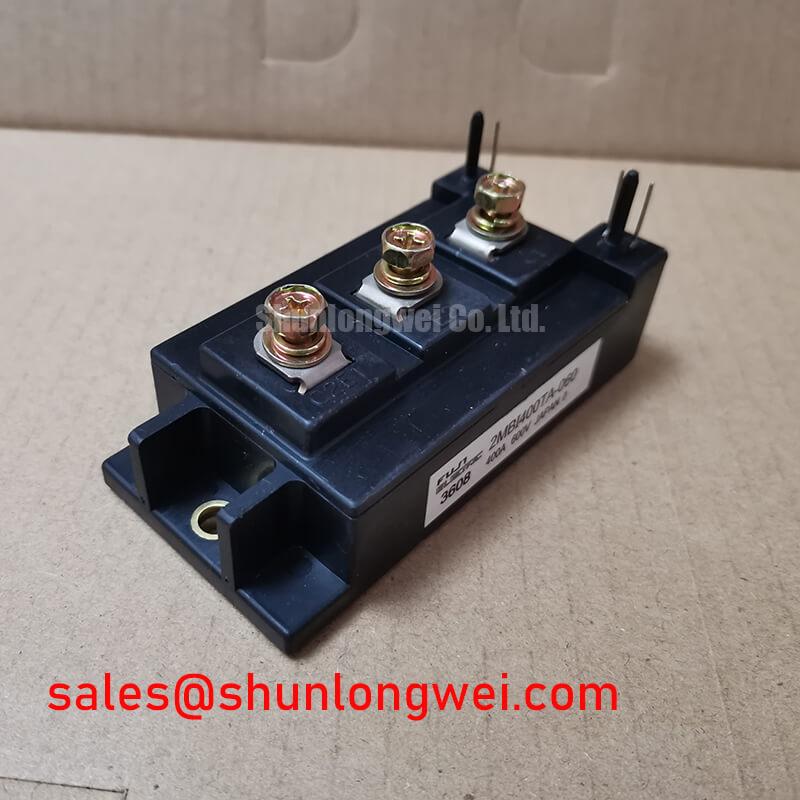
2MBI400TA-060 Fuji Electric IGBT Module: Technical Product Analysis
An In-Depth Review of the 400A, 600V Half-Bridge Module
Engineered for high-current power conversion, the Fuji Electric 2MBI400TA-060 is a 2-in-1 IGBT module that delivers a robust balance of efficiency and thermal performance. This T-Series module integrates two IGBTs in a half-bridge configuration, featuring key specifications of 600V | 400A | V_CE(sat) 2.2V (typ). Its primary engineering benefits include significantly reduced conduction losses and simplified thermal management. The design directly addresses the need for high efficiency in demanding applications by minimizing energy wasted as heat during operation. Best Fit Scenario: For industrial motor drives and UPS systems operating up to 400V AC lines where minimizing conduction losses is a primary design driver for achieving higher efficiency and power density.
Key Parameter Overview
Decoding the Specs for Enhanced Switching Performance
The technical specifications of the 2MBI400TA-060 are foundational to its performance in high-power applications. The following table highlights the critical parameters that directly influence system efficiency, thermal design, and reliability.
| Parameter | Symbol | Test Condition | Value | Engineering Implication |
|---|---|---|---|---|
| Collector-Emitter Voltage | V_CES | 600V | Provides a safe operating margin for applications on 200V and 400V AC lines. | |
| Continuous Collector Current | I_C | Tc = 80°C | 400A | Enables high power output, suitable for industrial inverters and servo drives. |
| Collector-Emitter Saturation Voltage | V_CE(sat) | I_C = 400A, V_GE = 15V | 2.2V (Typ), 2.7V (Max) | A low V_CE(sat) is critical for minimizing conduction losses. Think of it as the 'friction' the current experiences; a lower value means less energy is wasted as heat, directly improving system efficiency. |
| Forward Voltage (FWD) | V_F | I_F = 400A | 2.1V (Typ), 2.6V (Max) | Defines the efficiency of the integrated freewheeling diode, crucial for handling inductive load commutation in motor drives. |
| Turn-on Switching Loss | E_on | V_CC = 300V, I_C = 400A | 140 mJ/pulse | Quantifies the energy lost during the turn-on transition. A key factor in calculating total losses, especially in high-frequency PWM schemes. |
| Turn-off Switching Loss | E_off | V_CC = 300V, I_C = 400A | 180 mJ/pulse | Represents the energy lost during the turn-off event. Along with E_on, it dictates the thermal load at higher switching frequencies. |
| Thermal Resistance (IGBT) | R_th(j-c) | Junction to Case | 0.05 °C/W | This value measures how effectively heat can be transferred from the IGBT chip to the module's baseplate. A lower number signifies superior thermal performance, simplifying heatsink selection and allowing for higher power density. |
| Short Circuit Withstand Time | t_sc | V_CC < 400V, V_GE = 15V | >= 10 µs | Defines the module's ruggedness against fault conditions, a vital parameter for ensuring system reliability. |
Application Scenarios & Value
Achieving System-Level Benefits in High-Power Motor Drives
The Fuji Electric 2MBI400TA-060 is optimized for high-power, medium-frequency applications where efficiency is paramount. What is the primary benefit of its low saturation voltage? Enhanced system efficiency by minimizing heat generation under heavy loads.
A primary application is in industrial Variable Frequency Drives (VFDs). In a VFD for a 150 kW motor, the IGBT module is subjected to continuous high currents. The 2MBI400TA-060's low typical V_CE(sat) of 2.2V at 400A directly translates to lower conduction losses compared to modules with higher saturation voltages. This reduction in wasted power means less heat is generated within the drive's enclosure, easing the demands on the cooling system, potentially allowing for a smaller heatsink, and improving the overall reliability and operational lifespan of the VFD. The integrated fast and soft recovery Free Wheeling Diode (FWD) is purpose-built to handle the inductive currents from the motor windings during PWM switching cycles, ensuring smooth and efficient operation.
Other key applications include:
- Uninterruptible Power Supplies (UPS): The module's high current capability and efficiency are essential for the inverter stage of large-scale UPS systems, ensuring minimal energy loss during battery operation.
- Welding Power Supplies: Its ability to handle high-current pulses makes it a suitable choice for the power switching stage in advanced industrial welders.
- Solar Inverters: In large commercial or utility-scale solar installations, multiple modules can be used in the inverter stage to efficiently convert DC power from solar arrays into grid-compliant AC power.
While the 2MBI400TA-060 is well-suited for these roles, systems requiring lower power may find a component like the 2MBI300N-060, with its 300A rating, to be a more cost-effective fit. For applications demanding higher blocking voltage, such as those on a 690V line, a 1200V-class module like the 2MBI600VE-120-50 would be required.
Frequently Asked Questions (FAQ)
How does the V_CE(sat) of 2.2V directly impact thermal design in a motor drive?
A lower V_CE(sat) directly reduces power dissipation (P_loss = V_CE(sat) * I_C). With less power being converted into heat under load, the required heatsink size can be reduced, or a greater thermal margin can be achieved with the existing cooling solution. This leads to a more compact, reliable, and potentially lower-cost system design.
What is the role of the integrated Free Wheeling Diode (FWD) in this module?
The FWD provides a safe path for inductive current to flow when the IGBT turns off. In a motor drive, the motor windings are an inductive load. The FWD prevents a large voltage spike across the IGBT, which would otherwise destroy it. The characteristics of this diode, such as its forward voltage (V_F) and reverse recovery time, are critical for overall inverter efficiency.
Is the gate-emitter voltage rating of ±20V standard, and what does it imply for gate drive design?
Yes, a ±20V V_GES rating is a common industry standard for this class of IGBT. It provides sufficient margin for a typical +15V turn-on voltage and allows for a negative turn-off voltage (e.g., -5V to -15V). Utilizing a negative gate voltage during the off-state is a best practice for improving noise immunity and preventing parasitic turn-on, which is crucial in electrically noisy environments. For more information, refer to our guide on robust IGBT gate drive design.
What is the maximum operating junction temperature (Tj) for this module?
The datasheet specifies a maximum operating junction temperature of 150°C. Designing the thermal management system to keep the junction temperature well below this limit, especially under worst-case load conditions, is essential for ensuring long-term operational reliability.
Can the 2MBI400TA-060 be used in parallel to achieve higher current ratings?
While paralleling IGBT modules is a common engineering practice, it requires careful design considerations. Key factors include ensuring symmetrical PCB layout for balanced current sharing, using gate resistors with tight tolerances, and providing uniform thermal management across all paralleled modules. Consulting the manufacturer's application notes, such as those from Fuji Electric, for guidance on paralleling is highly recommended to avoid imbalances that could lead to premature failure.
An Engineer's Perspective
From a design engineer's standpoint, the 2MBI400TA-060 presents a straightforward and effective solution for power conversion in the sub-250kW range. Its value lies not in a single groundbreaking feature, but in its execution of fundamental requirements: low conduction losses and robust thermal characteristics within a standard, easy-to-integrate package. The detailed specifications for switching energies (Eon, Eoff) allow for precise loss calculations, which is critical for optimizing PWM strategies and predicting thermal performance early in the design cycle. This module is a workhorse component, built to provide a reliable and efficient foundation for a wide array of industrial power electronics.