Content last revised on September 10, 2026
Field Diagnostics & Commissioning: Dynamic Power Loss Dissipation in 7MBI75SA-120B Topologies
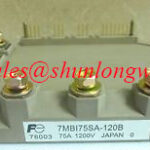
The 7MBI75SA-120B is a Fuji Electric IGBT Module rated at 1200 V and 75 A according to the Official Specification provided for this model. Before fitting a replacement module into a low voltage traction inverter, verify that the installed DC bus, gate driver board, current feedback circuit, busbar arrangement, and connector orientation remain consistent with the original equipment design. The module rating is an electrical identity boundary, not a substitute for checking system transient conditions.
Incoming bench work should start with a cold, unpowered comparison. Inspect the module housing, mounting surface, terminal hardware, and terminals for handling damage, contamination, or deformation that could affect electrical contact or thermal transfer. Use a multimeter diode function only as a qualitative screening method. A conduction path inconsistent with the expected anti parallel diode orientation, a near short path between major power terminals, or a marked difference from a known good circuit path warrants further controlled investigation before connecting a gate driver.
💡 Bench Tip: Keep gate terminals protected from static charge during handling and record cold diode mode observations before removal of the original module so the replacement check is based on the actual equipment topology.
Under pulsed load, semiconductor junction temperature cannot be judged from heatsink temperature alone. Dynamic power dissipation is influenced by conduction current, switching frequency, duty cycle, gate drive behaviour, DC bus ripple, and the thermal path from the module to its cooling assembly. A multi resistance thermal model can be useful when the equipment designer has the applicable thermal impedance data, switching loss data, measured case temperature, and actual pulse profile. In that case, the system engineer can calculate a predicted junction rise through the relevant transient thermal network and compare the resulting peak junction estimate against the manufacturer specified operating limits.
No junction temperature margin should be inferred from the 1200 V and 75 A nameplate ratings alone. A current reading below the nominal rating may still coincide with elevated switching loss if gate waveforms, freewheel current commutation, cooling flow, or busbar geometry have changed. During recommissioning, measure phase current and DC link voltage with suitable isolated instruments, then examine the collector emitter waveform and gate emitter waveform at the module connection points. Ringing or unexpected turn on behaviour may indicate a layout, driver reference, or load path issue that needs investigation against the original design.
For electric material handling and forklift low voltage traction equipment, technicians should also inspect contactors, battery connectors, precharge parts, motor cable terminations, and current sensor connections. A traction inverter may show intermittent torque, overcurrent trips, or irregular regeneration for several possible reasons. The IGBT module should be assessed as one element in the complete power path rather than assigned as the sole cause without evidence.
Where a repair bill of materials identifies a higher current Fuji Electric module, 6MBI300U-120 can be reviewed as a separate model for documented electrical, mechanical, gate drive, cooling, and circuit compatibility assessment. It should not be treated as a direct replacement solely because it belongs to a related power module family.
7MBI75SA-120B Circuit Protection & Reliability: Negative Gate Bias vs Active Miller Clamp
High rate DC bus transitions can couple energy into an off state gate loop through parasitic capacitance and shared inductance. If the induced gate voltage approaches the turn on region, cross conduction can occur in a bridge leg. Negative gate bias and active Miller clamp arrangements are common driver level countermeasures, but neither function is identified as an internal feature of the 7MBI75SA-120B by the supplied Official Specification. Their suitability, voltage level, timing, and driver capability must therefore be verified from the original gate driver documentation and validated on the complete inverter.
A Design Consideration is to keep the gate drive return path controlled and separate sensitive gate sensing from high current commutation paths where the equipment architecture permits. The objective is to reduce voltage disturbance at the gate emitter reference during switching. Designers should evaluate gate waveforms under the intended load and temperature conditions, paying attention to both commanded switching events and the opposite device transition. A gate driver that appears correct during a no load test can behave differently during regenerative braking, battery current reversal, or abrupt motor torque changes.
Protection coordination should include the driver supply, desaturation or overcurrent sensing method where present, short circuit response strategy, DC link protection, and controller fault handling. The correct protection thresholds are system determined and should not be transferred from another inverter without measurement. If a protection event is recurring, capture the gate command, power device voltage, phase current, and DC bus condition together. Reviewing one signal alone can conceal the event sequence that initiated the trip.
Thermal interface quality also affects protection performance because repeated heating can alter electrical operating conditions. A thin, uniform thermal interface material layer is commonly used to support heat transfer between a module base and a prepared heatsink surface. A 50 to 80 μm target layer is a General Industry Design Consideration, not an Official Specification for this Fuji Electric model. The actual material, thickness control method, surface flatness requirement, and mounting procedure must follow the equipment manufacturer’s service information.
⚠️ Field Alert: Tighten mounting hardware in a cross pattern and use the torque specified by the equipment manufacturer, because uneven clamp force can compromise the thermal interface or mechanically stress the module.
The Fuji Electric brake chopper IGBT module information provides useful context when assessing controlled energy dissipation functions in industrial DC link systems. It does not establish the exact gate drive, switching, or protection requirements for this specific module installation.
7MBI75SA-120B Thermal and Electrical Optimization: DC Bus Operating Voltage Headroom and Derating
The Official Specification identifies the 7MBI75SA-120B at 1200 V. During service evaluation, technicians should verify the measured DC bus voltage at the inverter, including battery charging conditions, regenerative events, contactor transitions, and any energy returned from the motor. The peak voltage at the module during turn off can exceed the steady DC link reading because commutation loop inductance and current change interact. The system engineering objective is to minimise parasitic loop inductance to suppress turn off overshoot, then verify peak margins against the DC link voltage through switching tests.
A laminated or closely coupled bus arrangement can reduce the loop area between the DC link capacitor and the switching stage where the original design uses that approach. Avoid extending high current paths or relocating DC link capacitors without reassessing measured switching waveforms. Long motor cables can also create reflected voltage behaviour at the motor terminals. Cable type, length, motor insulation condition, output filtering, and inverter switching behaviour should be assessed together when abnormal noise, motor insulation concerns, or unexplained inverter trips occur.
In battery powered traction equipment, the operating voltage can vary with state of charge, charger operation, regenerative braking, battery temperature, and battery management behaviour. Engineers should use the equipment’s specified battery voltage limits and capture actual operating data rather than relying on a nominal battery label. The 1200 V module rating must remain an explicit reference point during that review.
Altitude, terrestrial neutron exposure, single event burnout, failure in time estimates, and operating lifetime require qualified device and system data before numerical claims can be made. No FIT rate, altitude derating factor, cosmic ray failure prediction, or service life figure is stated here because no applicable source has been provided for this exact installation. As a Design Consideration, equipment used outside its documented environmental envelope should be reviewed by the responsible system engineer with the relevant manufacturer documentation and measured electrical stresses.
For broader context on changing power semiconductor technologies, the technical guide Wide Bandgap Revolution discusses GaN and SiC design considerations. That material should be used as background reading rather than as evidence that a different semiconductor technology is electrically or mechanically interchangeable with the 7MBI75SA-120B.
In converters that include a rectifier, auxiliary bridge, or upstream power stage, the condition of related components can influence DC bus ripple and commutation stress. The 2MBI150UC-120 is a separate Fuji Electric module that can be evaluated against the documented requirements of an associated stage. Its use requires independent verification of topology, ratings, terminal arrangement, cooling, and gate drive compatibility.
7MBI75SA-120B Circuit Protection & Reliability: Thermal Paste Degradation Prevention
Before mounting the 7MBI75SA-120B, clean the heatsink interface using a method approved for the equipment and inspect the contact area for embedded debris, raised damage, corrosion, or residue. These conditions can prevent even thermal contact and can produce local hot regions that are not obvious from an external visual inspection. Do not attempt to compensate for a damaged heatsink surface by applying excessive thermal paste. Material thickness is only one part of the thermal interface; flatness, cleanliness, mounting pressure distribution, and cooling system condition also affect the result.
A General Industry Design Consideration is to apply thermal interface material as a controlled, continuous layer with minimal trapped air. During installation, follow the original hardware sequence so the module settles progressively against the cooling surface. If the module baseplate or heatsink shows suspected distortion, compare it with the equipment manufacturer’s permitted mechanical condition rather than assuming that extra fastening force will correct it.
After installation, inspect every high current joint and gate connector before restoring power. Loose power hardware can add resistance and heating, while disturbed control connectors can alter gate command integrity or protection feedback. Where the inverter permits controlled startup, begin with the manufacturer approved commissioning sequence and monitor the DC bus, fault indication, cooling operation, and phase current response. If abnormal switching traces appear, de energise the equipment and compare the measurements with the known good signal path and original design documentation.
The Fuji Electric 7th Generation X Series IGBT module information is useful for reviewing the manufacturer’s wider IGBT module portfolio. It should not be used to infer unlisted electrical characteristics, internal construction details, or qualification status for the 7MBI75SA-120B.