
Content last revised on September 25, 2026
BSM50GD170DL Product Identification and Application Considerations
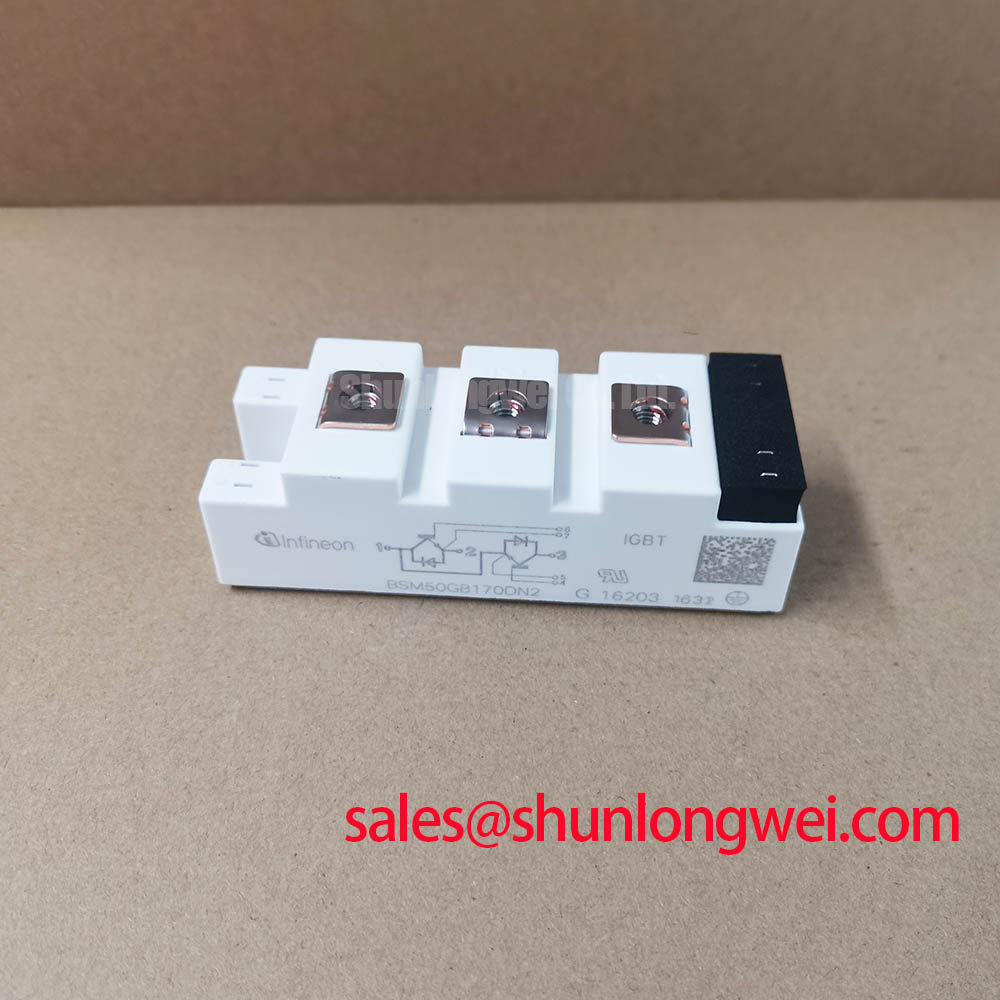
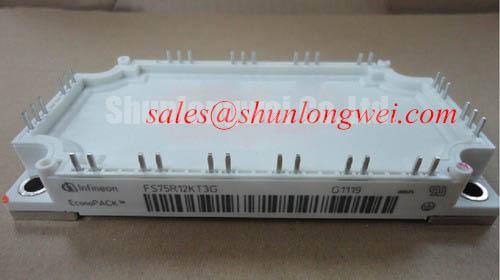
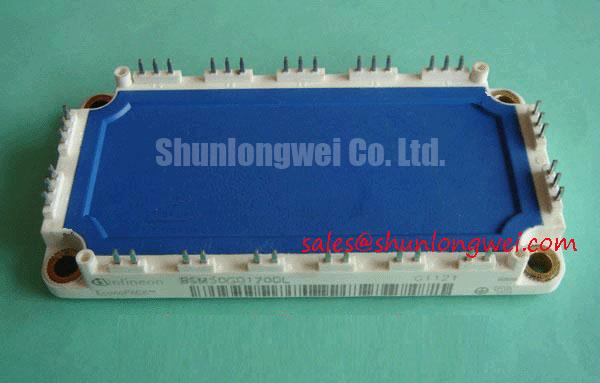
Before applying any test voltage, verify the module marking, inspect the case and terminals for mechanical damage, and confirm that the equipment documentation calls for an Infineon BSM50GD170DL rated at 1700.0 V and 50.0 A. The published product category is an IGBT Module with a module package. These nameplate values establish the starting point for replacement screening, but they do not by themselves define the allowable switching frequency, thermal operating point, short circuit capability, or complete inverter duty cycle.
For a repair engineer, the useful question is whether the replacement matches the original electrical role, mechanical interface, gate-drive arrangement, cooling path, and protection strategy. For a procurement engineer, the same checks help prevent a visually similar power module from being installed without confirming its electrical and mechanical compatibility.
| Parameter | BSM50GD170DL Information | Classification |
|---|---|---|
| Manufacturer | Infineon | Product identification |
| Device category | IGBT Module | Official product category |
| Rated voltage | 1700.0 V | Official specification supplied for this product page |
| Rated current | 50.0 A | Official specification supplied for this product page |
| Package | Module | Official package classification |
The 1700.0 V voltage rating should be evaluated against the actual DC link, switching overshoot, regenerative events, and isolation coordination of the host converter. The 50.0 A current rating should not be treated as a universal continuous-load guarantee because conduction loss, switching loss, case temperature, cooling performance, pulse duration, and duty cycle determine the usable current in a complete system. The applicable Infineon portfolio context can be reviewed through the manufacturer’s official IGBT Modules and Discretes portfolio.
BSM50GD170DL Thermal Electrical Optimization: High dv/dt Cross Conduction Shoot Through Practical Tuning
When this module is evaluated in a high-voltage converter, begin with a gate-drive review rather than immediately changing gate resistance. Confirm the driver reference, gate loop routing, isolation arrangement, gate-emitter return path, and the timing relationship between the upper and lower switching devices. A high dv/dt transition can couple displacement current into an inactive gate circuit. The resulting gate disturbance may reduce the effective turn-off margin and create a risk of cross-conduction, especially when the power loop and gate loop share an uncontrolled return path.
A dedicated active Miller clamp is a Design Consideration where the driver architecture supports it. Its purpose is to hold the inactive gate at a defined low impedance during the opposing device transition. The clamp should be connected and referenced according to the driver manufacturer’s instructions, with the shortest practical connection between the driver return and the relevant emitter reference. A negative gate bias can also be considered by the system designer when the selected gate driver, insulation system, and module gate-emitter limits support that operating method. The exact bias value is system determined and must be verified against the approved device documentation rather than copied from a general inverter design.
For a multi-megawatt offshore or onshore wind turbine full-scale converter, the DC-link bus structure deserves the same attention as the gate circuit. A laminated bus arrangement can reduce the commutation loop area, but its effectiveness depends on the actual current path, connector geometry, capacitor placement, and mechanical stack-up. During a double-pulse or equivalent switching test, measure the collector-emitter waveform directly at the module terminals with a suitable high-voltage differential probe. Compare the measured peak and ringing with the converter’s DC-link operating boundary and the module’s documented switching conditions.
Unexpected gate movement should be investigated with a probe at the driver output and another measurement at the module gate-emitter terminals. A clean signal at the driver with distortion at the module often points toward common impedance, excessive loop area, connector inductance, or an unsuitable reference point. A distorted signal at both locations requires examination of driver supply decoupling, isolation behavior, gate resistor placement, and the turn-on and turn-off command relationship.
When the converter includes a phase-controlled rectifier or front-end arrangement, the conduction angle can influence DC-link ripple and low-frequency current distortion. That ripple changes the instantaneous switching stress seen by the IGBT bridge. Harmonic mitigation belongs to the complete converter, using the selected line reactor, filter, control strategy, and grid-code requirements. The BSM50GD170DL should therefore be assessed under the real DC-link waveform rather than only under a stable laboratory supply.
Pro Tip: Keep the high-current commutation path and gate-drive return physically separated wherever the verified module interface permits, then confirm the resulting gate margin with measured switching waveforms rather than relying on a schematic review alone.
Preventing Spurious Faults: PCB Symmetry Considerations for Dual IGBT Guidelines for BSM50GD170DL
In a dual-switch power arrangement, symmetry is an electrical requirement as well as a mechanical layout preference. The collector and emitter paths should be examined for unequal copper length, unequal via usage, different terminal transitions, and asymmetrical connections to the DC-link and AC output bus. Such differences can cause one switching path to experience a different stray inductive voltage than the other, even when both gate commands are nominally identical.
If the module documentation identifies an auxiliary emitter or driver reference terminal, use that terminal only for the gate-drive return function defined by the manufacturer. The high-current emitter path should remain separate from the sensitive gate reference until the intended reference point. This arrangement reduces mutual coupling from load current into the control loop. Do not assume that a nearby power-emitter connection is equivalent to an auxiliary emitter connection without checking the original terminal definition.
Freewheeling diode behavior can also influence false fault reports. Reverse recovery current may interact with bus inductance, device output capacitance, and the opposing IGBT’s turn-on speed. The resulting voltage and current ringing can appear as an overvoltage event, a desaturation warning, or a gate disturbance. A fault indication should therefore be correlated with an oscilloscope capture of gate-emitter voltage, collector-emitter voltage, phase current, and the driver’s fault signal. A single control-board alarm is not sufficient to identify the physical source.
Snubber selection is a Design Consideration governed by the measured ringing frequency, damping requirement, capacitor pulse capability, resistor energy, thermal environment, and physical placement. A snubber located far from the switching loop may have limited effect because the connecting conductors add their own inductance. The system engineer should select and validate the network using the actual busbar and module geometry, with attention to both conducted and radiated electromagnetic interference.
Long motor cables introduce another system-level condition. Their distributed capacitance and inductance can produce reflected-wave behavior, and the motor-terminal voltage may exceed the inverter-terminal waveform during fast transitions. A cable filter or output reactor may be considered when the drive topology, motor insulation system, cable length, and measured waveform require it. The filter must be evaluated for resonance, common-mode current, thermal loading, and control-loop interaction. It is not appropriate to assign a universal filter value to the BSM50GD170DL without the cable and motor data.
In a wind turbine converter, the physical distance between the power stack, filter section, and control cabinet can make measurement discipline especially important. Use a repeatable probe reference and document the measurement bandwidth and probe location. If an apparent oscillation changes substantially when the probe ground arrangement changes, treat the result as a measurement integrity issue until it has been confirmed with a suitable differential measurement method.
For a field replacement assessment, the FF45017ME4 may be reviewed as a separate compatible-device candidate, but compatibility must be confirmed from its own electrical ratings, terminal layout, gate requirements, mechanical dimensions, and thermal interface documentation. It should not be treated as an automatic substitute for the BSM50GD170DL.
BSM50GD170DL Thermal Electrical Optimization: Baseplate Convexity Compensation and Screw Practical Tuning
Thermal evaluation should start with the complete heat-transfer chain: module baseplate, interface material, heatsink or cold plate, clamping hardware, airflow or coolant conditions, and temperature measurement location. The module’s official product information identifies the package as a module, but the available product data supplied here does not establish a universal baseplate flatness value, interface-material thickness, or mounting torque. Those items must be taken from the applicable mechanical drawing, assembly instructions, and TIM manufacturer’s process data.
A thin, continuous interface layer is generally preferred because excessive material increases thermal resistance, while insufficient coverage leaves dry areas. The correct thickness is process dependent and should be controlled by the selected TIM, surface finish, mounting method, and manufacturer instructions. Apply the material uniformly across the active contact area and inspect the assembly process for trapped air, contamination, uneven spreading, and edge displacement.
Baseplate convexity or local distortion can reduce contact over part of the mounting surface. Do not compensate by forcing the module down with arbitrary tightening force. Instead, inspect the heatsink surface, mounting-hole alignment, baseplate seating, and the mechanical drawing’s permitted conditions. A flatness or curvature issue should be addressed through approved mechanical correction or component replacement, not by adding an unverified spacer or changing the TIM into a thicker thermal cushion.
Use a cross-pattern or sequential tightening method when the manufacturer’s assembly instructions call for it. Bring the fasteners into contact progressively so that the baseplate is not tilted against the heatsink. The final torque is a Design Consideration determined by the module hardware, screw size, thread condition, heatsink material, washer arrangement, and official mounting instructions. It must not be inferred solely from the 50.0 A electrical rating.
After installation, verify that the power terminals remain free from mechanical stress caused by busbar misalignment. A rigid laminated busbar should be positioned so that it does not pull the module sideways or twist the terminal area during tightening. Check the gate and auxiliary connections separately, because a mechanically stable power bus can still impose force on a small control connector if the harness is routed without strain relief.
Thermal testing should use the actual switching waveform and load profile. A low-frequency resistance check or a steady DC current test may fail to reveal switching loss, diode recovery loss, or thermal cycling effects. Record case or baseplate temperature at a defined location and compare devices under the same airflow, coolant, ambient, and measurement conditions. If one position in a multi-module stack runs warmer, investigate busbar symmetry, cooling distribution, interface coverage, and switching timing before attributing the difference to the module alone.
For converters using long motor cables, output filtering can also change semiconductor losses. A filter may reduce motor-terminal reflected voltage while increasing circulating current or altering the switching transition. Thermal qualification must therefore include the selected cable and filter configuration rather than treating the BSM50GD170DL as an isolated heat source.
Benchtop Waveform Tuning: Mitigating Stress via High Speed Fault Management: VCE Desaturation on BSM50GD170DL
Desaturation protection is intended to identify a switching condition in which the collector-emitter voltage remains higher than expected while the device is commanded on. In practice, the desaturation circuit must distinguish a genuine short-circuit or severe overcurrent event from charging transients, diode recovery, measurement noise, and normal switching behavior. The blanking network, sensing path, fault latch, isolation channel, and gate shutdown sequence should be reviewed as one protection system.
Type I and Type II short-circuit behavior are commonly discussed as different operating circumstances, but the applicable short-circuit withstand information must come from the specific Infineon documentation for the device and test conditions. Do not transfer a short-circuit duration from another module family. The available product parameters for this page confirm the voltage, current, package, and manufacturer, but they do not establish an independent short-circuit safe operating area or a universal protection response time.
A two-stage soft turn-off strategy can be evaluated when abrupt gate removal would produce excessive inductive overvoltage. The first stage reduces the current transition rate, while the second stage completes turn-off after the fault path has been controlled. The timing, gate current, clamp behavior, and fault propagation delay are system determined. They should be tuned with a controlled short-circuit test fixture and verified against the measured collector-emitter peak, gate-emitter response, driver isolation limits, and DC-link condition.
During benchtop tuning, begin with a low-energy test condition that allows the protection signal to be observed without exposing the module to an uncontrolled event. Capture the desaturation input, gate command, gate-emitter voltage, collector-emitter voltage, current, and fault output on a common time base. If the fault signal appears without corresponding electrical stress, inspect the sensing diode, blanking capacitor, layout coupling, probe arrangement, and driver supply stability. If the protection does not respond during a confirmed overcurrent event, stop testing and review the sensing connection and threshold implementation before increasing energy.
The commutation bus should be kept compact to limit parasitic inductance, but the acceptable peak voltage must be established by measurement under the intended DC-link and current conditions. The physical principle is straightforward: reducing loop inductance and controlling the current transition reduces inductive overshoot, while the final margin remains the responsibility of the converter designer. A reference discussion of wide-bandgap switching behavior, parasitic effects, and design challenges is available in this Wide Bandgap Revolution technical resource; its concepts should be applied as general engineering guidance rather than as BSM50GD170DL-specific ratings.
When a full-scale wind turbine converter is connected to a variable grid and a long generator or motor-side cable, protection validation should include DC-link ripple, regeneration, filter interaction, cable reflection, and abnormal control commands. A protection circuit that behaves correctly on a short laboratory bus may respond differently after the real busbar, filter, cable, and machine are connected. Final acceptance should be based on documented waveform evidence and the applicable Infineon device documentation, not on a nominal gate signal alone.