Content last revised on September 10, 2026
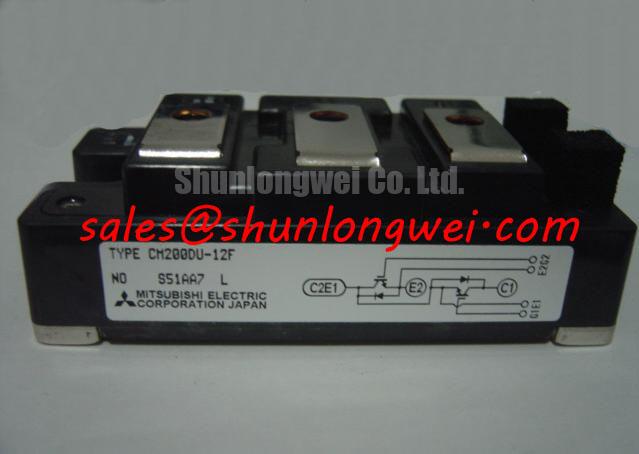
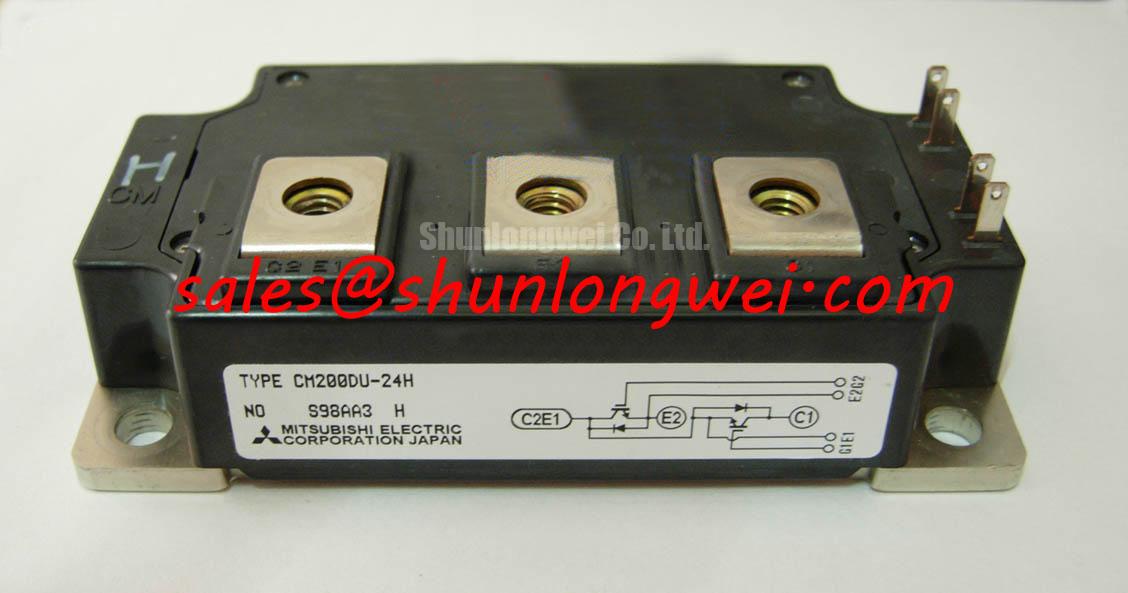
CM200DU-24H-203 Mitsubishi 1200V 200A Dual IGBT Module for Industrial Power Conversion
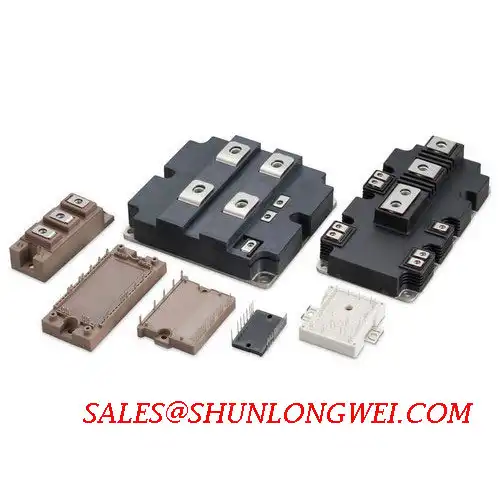
The CM200DU-24H-203 is a high-performance Dual IGBT Module designed by Mitsubishi Electric for high-power switching applications. Featuring a 1200V collector-emitter voltage and a 200A collector current rating, this module is engineered for the rigorous demands of industrial automation and renewable energy systems. By integrating two IGBTs in a half-bridge configuration, it provides a compact, low-inductance solution for engineers seeking to optimize power density without compromising on thermal ruggedness.
Top Specs: 1200V | 200A | $V_{CE(sat)}$ 2.4V (Typical)
Key Benefits: Superior thermal cycling for long-term field reliability; Optimized for 480V AC motor drive efficiency.
What is the primary benefit of the CM200DU-24H-203? It provides exceptional thermal cycling endurance and low switching losses in high-frequency industrial environments. For 480V AC industrial systems requiring compact 200A half-bridge switching, the CM200DU-24H-203 stands as a benchmark for reliability.
Key Parameter Overview
Decoding the Specs for Enhanced Thermal Reliability
To support engineering assessment, the following table summarizes the absolute maximum ratings and electrical characteristics of the CM200DU-24H-203 based on its technical documentation. For high-current handling, understanding the relationship between collector current and junction temperature is vital for Thermal Management.
| Characteristic | Symbol | Rating / Condition | Unit |
|---|---|---|---|
| Collector-Emitter Voltage | $V_{CES}$ | 1200 | V |
| Collector Current (DC) | $I_C$ | 200 | A |
| Collector-Emitter Saturation Voltage | $V_{CE(sat)}$ | 2.4 ($T_j = 25°C$) | V |
| Gate-Emitter Voltage | $V_{GES}$ | ±20 | V |
| Isolation Voltage | $V_{iso}$ | 2500 | Vrms |
| Thermal Resistance (Junction to Case) | $R_{th(j-c)}$ | 0.11 (Typical) | K/W |
Application Scenarios & Value
Achieving System-Level Benefits in High-Frequency Power Conversion
The CM200DU-24H-203 is primarily utilized in Variable Frequency Drives (VFD) and Uninterruptible Power Supplies (UPS). A common engineering challenge in industrial conveyor systems is managing the massive motor-start surge currents. The robust SOA (Safe Operating Area) of this module ensures that peak transients do not lead to IGBT Failure.
In Solar Inverter applications, the low $V_{CE(sat)}$ directly correlates to reduced conduction losses. Consider a 50kW central inverter operating at an 8kHz switching frequency; the efficiency gains from the H-series trench gate technology allow for smaller heatsinks, thereby reducing the total system footprint. For designs requiring higher current density, the CM300DU-24H offers an expanded 300A capability within a similar architecture.
Furthermore, the CM200DU-24H-203 is a preferred choice for Welding Power Supply units, where rapid thermal cycling is the norm. The internal bond-wire layout is optimized to distribute current evenly, mitigating the risk of localized hotspots. For engineers unfamiliar with these structures, deconstructing the IGBT internal layout reveals how Mitsubishi manages these stresses at the silicon level.
Technical & Design Deep Dive
Analyzing the H-Series Trench Technology for Optimized Switching
The CM200DU-24H-203 utilizes Mitsubishi’s H-series trench gate structure. In power electronics, a trench gate acts like a vertical highway for electrons. Traditional planar IGBTs have a "bottleneck" (the JFET region) that increases resistance. By "digging" a trench into the silicon, the CM200DU-24H-203 eliminates this bottleneck, allowing current to flow more freely. Think of this like upgrading a two-lane road with a traffic light into a multi-lane expressway; throughput increases while energy-wasting friction (heat) decreases.
This structural advantage is complemented by the module’s low Thermal Resistance. A $R_{th(j-c)}$ of 0.11 K/W ensures that heat generated at the junction is efficiently evacuated to the baseplate. For designers, this means more headroom when designing the Gate Drive and protection circuits, such as the Miller Clamp, which prevents parasitic turn-on during high dV/dt transitions.
Industry Insights & Strategic Advantage
Alignment with Industry 4.0 and Energy Efficiency Standards
As the global market shifts toward high-efficiency Electric Vehicle (EV) Inverter and green manufacturing, components like the CM200DU-24H-203 become strategic assets. Modern Industrial Automation standards like IEC 61800-3 place immense pressure on power modules to maintain low EMI and high reliability over a 10-15 year service life.
The CM200DU-24H-203 provides a mature, field-proven platform that balances performance with total cost of ownership. While SiC Module technology is emerging for ultra-high frequency applications, the IGBT Module remains the linchpin for mainstream 400V-600V industrial grids due to its short-circuit ruggedness and cost-to-performance ratio. Understanding how an IGBT works in these specific industrial contexts helps engineers bridge the gap between theoretical efficiency and practical, long-term durability.
FAQ
How does the "DU" package configuration in the CM200DU-24H-203 simplify system integration?
The "DU" designation refers to the dual-bridge (half-bridge) configuration. It integrates two IGBTs and two free-wheeling diodes into one housing. This significantly reduces stray inductance compared to discrete components and simplifies the busbar design, which is critical for suppressing voltage spikes during turn-off.
Is the CM200DU-24H-203 compatible with high-altitude operating conditions?
Standard modules are rated for sea-level insulation. For altitudes above 2000 meters, engineers must consider the derating of the clearance and creepage distances to prevent arcing. The 2500Vrms isolation rating provides a strong baseline, but dielectric stress must be recalculated for thin-air environments.
What is the engineering significance of the 0.11 K/W thermal resistance rating?
This low value indicates highly efficient heat transfer from the silicon chip to the module’s baseplate. Practically, it allows for a higher power-per-square-inch ratio, enabling designers to use smaller heatsinks or operate at higher ambient temperatures without exceeding the 150°C maximum junction temperature.
Does the "-203" suffix affect the electrical interchangeability of the module?
In the Mitsubishi nomenclature, the -203 suffix often denotes a specific terminal plating (like tin-lead vs. lead-free) or a customized internal diode characteristic for a specific OEM. While the core ratings (1200V/200A) remain the same, engineers should verify terminal dimensions and material compliance before drop-in replacement in legacy systems.
For procurement professionals and lead engineers, the CM200DU-24H-203 represents a stable, high-reliability choice for mid-range power conversion. Its balance of low switching losses and high thermal ruggedness makes it a strategic component for any 400V/480V industrial power stage. As system requirements evolve, staying informed on global IGBT market outlooks is essential for maintaining supply chain resilience and technical competitive advantage.