Content last revised on September 10, 2026
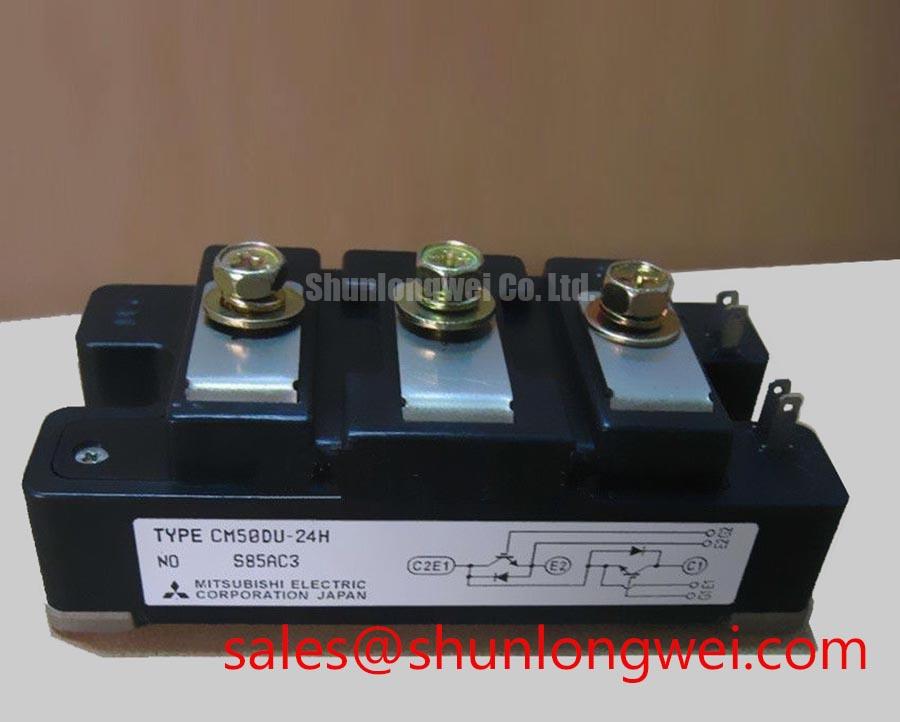
Mitsubishi CM50DU-24F 1200V 50A Dual IGBT Module
Introduction to High-Efficiency Power Conversion with CSTBT™ Technology
High-Efficiency Performance Through Carrier Stored Trench-Gate Architecture
The Mitsubishi CM50DU-24F is a high-performance 1200V / 50A dual IGBT module designed for engineers who prioritize the delicate balance between conduction losses and switching speed. Utilizing Mitsubishi's proprietary CSTBT™ (Carrier Stored Trench-Gate Bipolar Transistor) technology, this module offers a low Vce(sat) of typically 1.8V at rated current, directly translating to reduced power dissipation in industrial environments. Key benefits include superior thermal management via its insulated package and enhanced reliability for high-frequency switching. What is the primary benefit of CSTBT technology in the CM50DU-24F? It significantly reduces collector-emitter saturation voltage while maintaining high-speed switching. For industrial motor drives requiring high efficiency in 400V AC environments, the 50A CM50DU-24F with its CSTBT™ architecture is the optimal choice.
Application Scenarios & Value
Optimizing Motor Control Performance in Industrial Drives
Engineers often face the challenge of managing thermal overhead when designing Variable Frequency Drives (VFD) or servo drive systems. The CM50DU-24F addresses this by providing a robust 1200V Vces rating, which offers a critical safety margin against voltage spikes in 400V AC line systems. When a motor initiates a startup sequence, the 50A collector current (Ic) rating ensures the module handles transient inrush currents without entering the desaturation zone. This reliability is essential in automated factory floors where downtime is costly.
The integration of the CM50DU-24F extends beyond standard drives into UPS (Uninterruptible Power Supply) systems and solar inverter topologies. In these applications, the 1200V rating allows for efficient DC bus voltages, minimizing current requirements for the same power throughput. For systems requiring higher current handling, the related CM150DU-24F or CM300DU-24F offer similar voltage characteristics with expanded power ranges. By adopting this module, designers can adhere to IEC 61800-3 standards for EMC and efficiency while benefiting from a compact, dual-configuration footprint that simplifies the inverter stage layout.
Technical Deep Dive
The Engineering Impact of Low Vce(sat) on Thermal Budgets
A fundamental advantage of the CM50DU-24F lies in its CSTBT™ physics. Conventional trench IGBTs often struggle with carrier distribution, leading to higher on-state resistance. Mitsubishi's carrier storage layer acts like a reservoir, ensuring a uniform carrier concentration throughout the drift region. Analogously, this is like optimizing a highway's traffic flow; by ensuring the lanes are consistently filled, the "throughput" of current increases without a corresponding rise in "friction" or heat. This results in a Vce(sat) that remains stable even as junction temperatures rise, which is a critical factor for long-term reliability.
When deconstructing the IGBT performance, the thermal resistance Rth(j-c) of 0.35 K/W becomes the secondary hero. This low resistance allows for more efficient heat transfer to the cold plate, enabling higher switching frequencies without exceeding the 150°C maximum junction temperature. For those performing IGBT selection beyond Vcesat, the turn-off loss (Eoff) characteristics of the F-series chip represent a significant leap over previous generations, allowing for smaller passive components in the PFC stage or output filters.
Key Parameter Overview
Technical Specifications for System-Level Evaluation
| Parameter | Symbol | Typical Value / Rating |
|---|---|---|
| Collector-Emitter Voltage | Vces | 1200V |
| Collector Current (DC) | Ic | 50A |
| Collector-Emitter Saturation Voltage | Vce(sat) | 1.8V (at Tj=125°C) |
| Isolation Voltage | Viso | 2500V AC (1 min) |
| Thermal Resistance (Junction to Case) | Rth(j-c) | 0.35 K/W (max) |
Download the CM50DU-24F datasheet for detailed specifications and performance curves.
FAQ
Expert Insights into Integration and Reliability
How does the 1200V rating affect design safety in 480V systems?
The 1200V rating provides a substantial voltage buffer for 480V AC applications, where DC bus voltages typically sit around 650V-750V. This overhead is vital for absorbing the inductive flyback voltages generated during high-speed switching transitions.
What is the primary advantage of the CSTBT™ structure for thermal stability?
The Mitsubishi CSTBT™ structure maintains a lower and more linear Vce(sat) across the operating temperature range compared to standard trench designs, preventing thermal runaway during peak load conditions.
Does the CM50DU-24F require a negative gate voltage for turn-off?
While the CM50DU-24F has a robust Vge(th), applying a negative gate voltage (typically -5V to -15V) is recommended to prevent parasitic turn-on caused by Miller capacitance in high dV/dt environments.
How does the Rth(j-c) of 0.35 K/W directly impact heatsink selection?
This value determines the temperature rise of the junction for every watt of power dissipated. A lower Rth(j-c) allows designers to either use smaller heatsinks for a compact footprint or run the module at higher currents while maintaining a safe thermal margin.
What is the recommended switching frequency for this module?
The CM50DU-24F is optimized for frequencies in the 5 kHz to 20 kHz range. Beyond this, switching losses (Eon/Eoff) may become dominant, requiring careful analysis of the total power dissipation budget.
As industrial systems evolve toward higher power densities and stringent efficiency mandates, the CM50DU-24F remains a strategically sound choice for OEM engineers. Its combination of CSTBT™ technology and a thermally efficient dual package provides a factual basis for high-reliability power stage design in the 400V AC class.