Content last revised on September 10, 2026
CM75DU-24F IGBT Module: A Technical Review for Power System Design
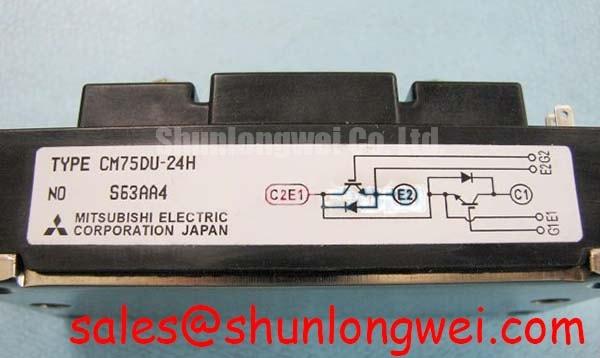
The Mitsubishi CM75DU-24F offers a robust foundation for medium-power converters, prioritizing thermal reliability and design simplification through its intelligent integration. With key specifications of 1200V, 75A, and a thermal resistance (Rth(j-c)Q) of 0.26°C/W, this module is engineered for performance. Its primary benefits include simplified thermal assembly and reduced conduction losses, which are critical for modern power systems. For engineers asking how to streamline heatsinking, the module's integrated isolated baseplate provides the answer by allowing direct mounting and enhancing heat transfer, eliminating the need for separate insulating layers.
Key Parameter Overview
Decoding the Specs for Thermal Performance and Efficiency
The technical specifications of the CM75DU-24F are pivotal for system designers aiming to balance efficiency, reliability, and power density. The parameters below, derived from the official datasheet, offer a snapshot of its capabilities in high-frequency switching applications. Understanding these values is the first step in leveraging this module for robust power stage design. For a comprehensive analysis, engineers should consult the official IGBT datasheets.
| Absolute Maximum Ratings (Tj = 25°C) | ||
| Parameter | Symbol | Value |
| Collector-Emitter Voltage | VCES | 1200V |
| Gate-Emitter Voltage | VGES | ±20V |
| Collector Current (DC) | IC | 75A |
| Collector Current (Pulse) | ICM | 150A |
| Maximum Collector Dissipation | PC | 480W |
| Junction Temperature | Tj | -40 to +150°C |
| Isolation Voltage | Viso | 2500Vrms |
| Electrical & Thermal Characteristics (Tj = 25°C) | ||
| Collector-Emitter Saturation Voltage | VCE(sat) | 2.7V (max) at IC=75A |
| Gate-Emitter Threshold Voltage | VGE(th) | 5.5V (typ) |
| Thermal Resistance (Junction to Case, IGBT) | Rth(j-c)Q | 0.26°C/W (max) |
| Thermal Resistance (Junction to Case, Diode) | Rth(j-c)R | 0.50°C/W (max) |
Download the CM75DU-24F datasheet for detailed specifications and performance curves.
Application Scenarios & Value
System-Level Benefits in Motor Drives and Power Supplies
For motor drives and UPS systems up to approximately 30kW requiring a balance of efficiency and thermal reliability, the CM75DU-24F is an optimal design choice. Its dual IGBT configuration in a half-bridge topology provides a compact building block for three-phase inverters, reducing both component count and assembly complexity.
Consider an engineer designing a Variable Frequency Drive (VFD) for industrial automation. A key challenge is managing heat generated by conduction losses during motor operation. The CM75DU-24F addresses this directly with its low collector-emitter saturation voltage (VCE(sat)) of 2.7V maximum at its rated 75A current. This specification ensures lower power dissipation compared to older generation IGBTs, contributing to higher overall system efficiency. This efficiency gain is crucial in applications where energy consumption is a primary concern. The integrated super-fast recovery free-wheel diode further enhances performance by minimizing switching losses, particularly in hard-switching topologies common in AC motor control. For systems demanding higher power output within a similar design framework, the related CM150DU-24F offers a 150A capability.
Technical Deep Dive
A Closer Look at the Isolated Baseplate and its Impact on Thermal Management
A defining feature of the CM75DU-24F is its electrically isolated baseplate, a design choice that provides significant value in both manufacturing and long-term operation. In conventional power module setups, a separate dielectric insulator, such as a thermal pad or mica sheet coated with thermal grease, must be placed between the module and the heatsink. This not only adds an extra component to the bill of materials but also introduces another interface that impedes heat flow.
The integrated isolation of the CM75DU-24F eliminates this external layer entirely. This design directly bonds the heat-spreading baseplate to an internal ceramic substrate (typically Alumina or Aluminum Nitride), which provides both excellent dielectric strength and thermal conductivity. The engineering value is twofold:
- Enhanced Thermal Performance: By removing an interface layer from the thermal stack, the overall Thermal Resistance from the semiconductor junction to the ambient air is reduced. This allows the IGBT to run cooler for a given load or handle higher power at the same junction temperature, a key aspect of unlocking IGBT thermal performance.
- Simplified Assembly and Increased Reliability: The simplified mounting process reduces assembly time and cost. It also removes the risk of assembly errors, such as a misaligned or torn insulating pad, which could lead to catastrophic failure from inadequate electrical isolation or poor thermal contact.
To put it in perspective, relying on an external thermal pad is like having a speed bump on the "highway" that heat uses to escape the device. The CM75DU-24F's design effectively removes that speed bump, creating a smoother, faster path for thermal energy dissipation, which is fundamental for building reliable, high-power-density systems.
Frequently Asked Questions
Engineering Inquiries on the CM75DU-24F's Implementation
How does the VCE(sat) of 2.7V at 75A impact the design of an AC motor drive?
A lower VCE(sat) directly translates to lower conduction losses (Power Loss = VCE(sat) x IC). For a motor drive, this means less heat is generated within the IGBT module, allowing for the use of a smaller, more cost-effective heatsink or enabling higher output power without exceeding the maximum junction temperature of 150°C. This is a critical factor in achieving higher system efficiency and power density.
What is the primary advantage of the discrete Super-Fast Recovery FWDi in the CM75DU-24F?
The discrete Super-Fast Recovery Free-Wheel Diode (FWDi) is optimized for low reverse recovery charge (Qrr) and fast reverse recovery time (trr). In half-bridge applications like motor drives and UPS systems, this reduces the turn-on losses in the complementary IGBT and minimizes voltage overshoots. This allows for more efficient operation at higher switching frequencies and improves the overall robustness and EMI performance of the inverter.
For design engineers and procurement specialists seeking a reliable and efficient power switching solution, the CM75DU-24F offers a well-documented and proven component. To evaluate this module for your specific application, please contact our technical sales team for further information or to request a quotation.