Content last revised on August 28, 2026
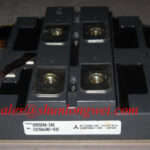
CM800HA-34H Power Module: Engineering Analysis for High-Voltage Applications
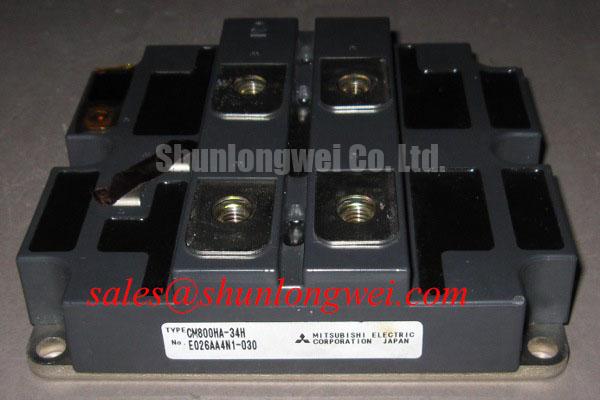
How do design engineers maintain switching reliability when scaling high-power industrial converters to 1700V operating thresholds? The CM800HA-34H high-voltage IGBT module from Mitsubishi Electric delivers high current capability and thermal robustness for heavy-duty power switching systems. Featuring a 1700V collector-emitter rating, an continuous collector current of 800A at TC = 95°C, and 9200W maximum power dissipation, this single-element IGBT package provides substantial thermal headroom. Key engineering benefits include low conduction loss via optimized VCE(sat) characteristics and an integrated fast recovery free-wheel diode for inductive load protection. For 1700V industrial inverters requiring high thermal headroom, the CM800HA-34H 800A single module is the optimal choice.
Frequently Asked Questions
Addressing Core Engineering Challenges in 1700V High-Power Conversion
How does the 4000V AC isolation voltage rating impact safety layout in high-voltage converters?
The 4000V AC (rms, 1 minute) isolation rating between the baseplate and internal conductors allows engineers to mount the module directly onto grounded heatsinks without external insulation sheets. This simplifies mechanical packaging while ensuring compliance with stringent high-voltage safety clearances.
What is the primary advantage of the CM800HA-34H single IGBT topology?
It maximizes current handling and power dissipation capacity.
How does the maximum collector dissipation of 9200W affect heatsink design?
With a maximum PC rating of 9200W at TC = 25°C, the module efficiently conducts heat away from the silicon junction. Designing cooling systems with thermal resistance Rth(c-f) around 0.018 K/W ensures the junction temperature remains safely below its 150°C absolute maximum during heavy pulse loads.
Why is gate drive voltage control critical for this 1700V module?
The module features a gate-emitter voltage rating of ±20V, with a recommended turn-on drive voltage of +15V. Applying an appropriate negative gate bias during turn-off prevents parasitic dv/dt turn-on caused by Miller capacitance feedback during high-voltage switching transients.
Key Parameter Overview
Decoding Specs for High-Voltage Isolation and Thermal Reliability
The technical parameters of the CM800HA-34H highlight its capabilities in demanding power conversion stages. Below is a structured summary of its core electrical and mechanical boundaries.
| Electrical Parameter | Datasheet Rating / Value | Engineering Significance |
|---|---|---|
| Collector-Emitter Voltage (VCES) | 1700V | High voltage margin for 690V AC line systems and DC bus rails. |
| Continuous Collector Current (IC) | 800A (DC, TC=95°C) | High current capacity for megawatt-class motor drives and converters. |
| Pulsed Collector Current (ICM) | 1600A | Accommodates short-duration surge and peak startup loads. |
| Maximum Power Dissipation (PC) | 9200W (TC=25°C) | High thermal energy transfer rate away from the IGBT die. |
| Isolation Voltage (Viso) | 4000V AC (rms, 1 min) | Ensures isolation between electrical terminals and cooling plates. |
| Gate-Emitter Voltage (VGES) | ±20V | Standard gate drive range for robust noise immunity. |
| Operating Junction Temp (Tj) | -40°C to +150°C | Wide thermal operating range for harsh industrial environments. |
Download the CM800HA-34H datasheet for detailed specifications and performance curves. Learn more about decoding IGBT datasheets to optimize your power stage layout.
Technical Deep Dive
Silicon Physics and Thermal Path Architecture
Understanding the switching dynamics of high-power semiconductors requires examining both electrical conduction paths and thermal impedance models. The CM800HA-34H utilizes Mitsubishi CSTBT™ technology to suppress carrier accumulation losses while maintaining a low forward saturation drop. Think of the internal silicon substrate as a high-capacity thermal highway: when high currents generate sudden energy peaks, a wider copper baseplate acts like an oversized thermal reservoir, absorbing instantaneous heat spikes before transferring energy into the liquid-cooled or forced-air heatsink.
Additionally, the integrated anti-parallel free-wheel diode (FWDi) exhibits fast reverse recovery characteristics, minimizing turn-on switching energy spikes across the main collector path. System engineers must carefully manage external busbar layout to limit stray inductance. Keeping parasitic loop inductance low prevents inductive voltage overshoot during 800A turn-off events, protecting the collector-emitter junction within its designated Safe Operating Area.
Application Scenarios & Value
Optimizing High-Power Motor Drives and Renewable Energy Converters
The single-element 800A 1700V configuration makes the CM800HA-34H well-suited for high-power industrial power conversion circuits. In large-scale motor drives, wind turbine power converters, and high-frequency induction heating power supplies, this module provides the required current throughput without complex multi-chip paralleling.
For industrial automation facilities operating heavy machinery, managing dynamic load spikes is a key design priority. When accelerating large inertia loads, motor drives experience high peak current surges. The module's 1600A pulse rating and robust thermal mass absorb these transient stress events without triggering thermal shutdown. For systems operating on lower DC voltage rails where a 1200V device is sufficient, the related CM400HA-24H provides a lower voltage alternative. Conversely, for higher voltage systems demanding even higher breakdown margins, the CM800HA-66H offers a 3300V rating in a similar single-unit topology.
Exploring IGBT module thermal management techniques and reviewing high-power industrial inverters guidelines helps system integrators maximize system uptime and operational longevity.
Integrating high-voltage power modules like the CM800HA-34H requires evaluating thermal limits, gate drive layout, and short-circuit protection schemes. By utilizing accurate datasheet parameters and solid thermal design, power engineers can build reliable inverter platforms capable of continuous high-power operation.
[