

Content last revised on October 25, 2026
FF300R17KE3 Application and Commissioning Considerations
- Confirm the cold state condition of the main terminals and compare readings with a known good assembly before applying the DC link.
- Inspect the module baseplate, heatsink contact area, thermal interface material, and clamping hardware for uneven contact or contamination.
- Check reinforced isolation in the isolated gate power supply and inspect gate loop routing for excessive common mode coupling.
- Verify protection coordination between desaturation detection, soft turn off, semiconductor fusing, and the inverter control interlock.
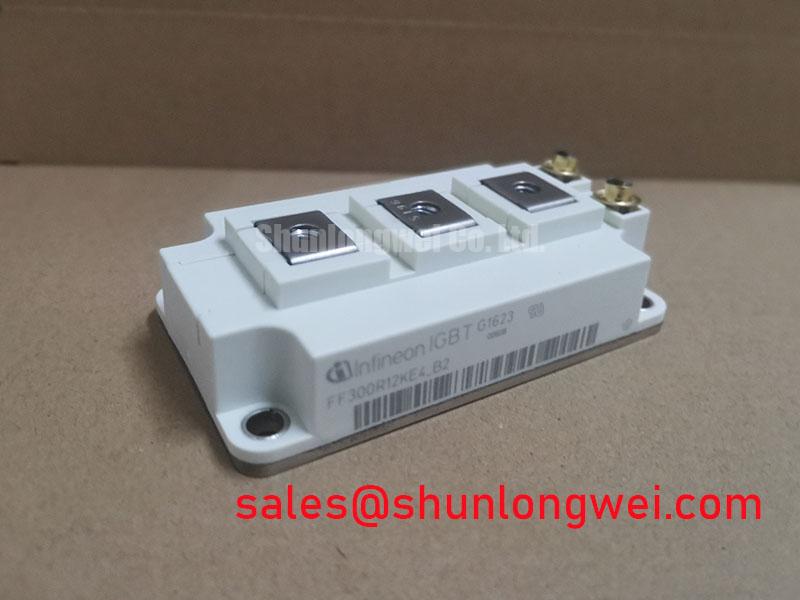
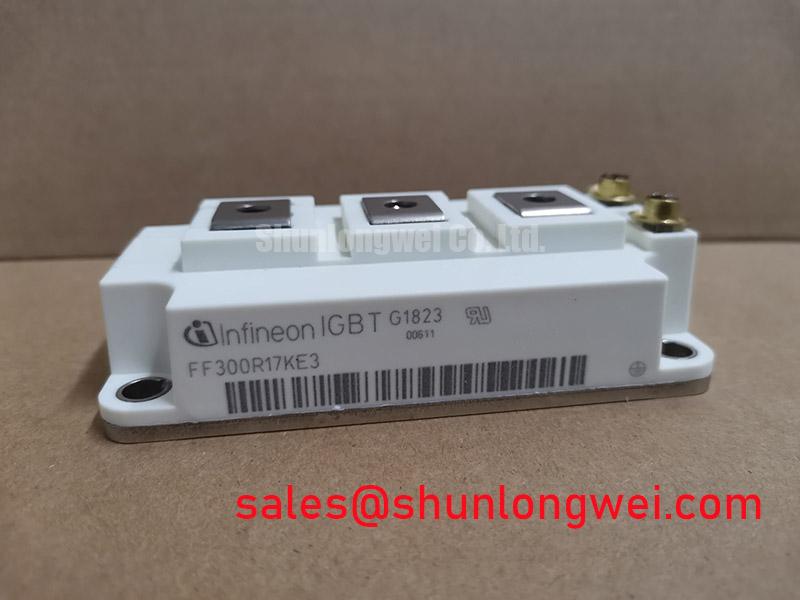
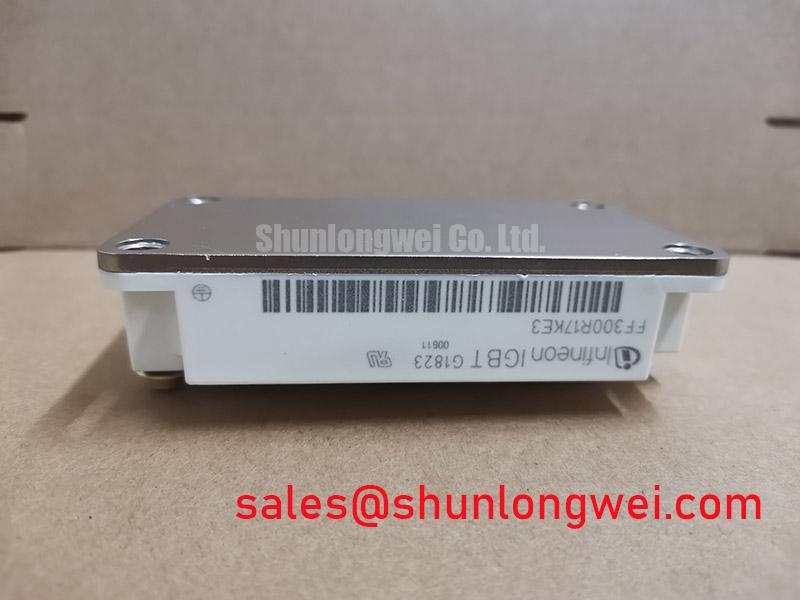
The Infineon FF300R17KE3 is an IGBT module rated at 1700.0 V and 300.0 A, with a module package format. These are the stated product parameters for identification and procurement. System voltage, switching frequency, thermal limits, short circuit withstand, gate drive conditions, and surge capability must be checked against the applicable manufacturer documentation before commissioning.
| Manufacturer | Infineon |
| Part number | FF300R17KE3 |
| Rated voltage | 1700.0 V |
| Rated current | 300.0 A |
| Package | IGBT Module |
For a utility scale 1500 V high power central solar photovoltaic inverter, the module should be assessed as part of the complete switching leg rather than as an isolated rating. The DC link, commutation path, gate driver, cooling assembly, protection board, and fuse coordination all influence the operating margin. Infineon’s IGBT Modules and Discretes portfolio and its IGBT Modules overview provide useful manufacturer context for evaluating the device family.
Benchtop Waveform Tuning: Isolated DC DC Supply Sizing for FF300R17KE3
Gate power isolation should be checked before waveform tuning because a switching node with high dv/dt can inject common mode current into the driver supply, signal return, and oscilloscope ground. The isolated DC DC converter must provide sufficient reinforced galvanic isolation for the system insulation plan, with creepage and clearance selected for the working voltage, pollution environment, altitude, and applicable safety standard. A requirement above 5 kV is a system insulation design condition, not an automatic FF300R17KE3 specification.
Common mode transient immunity should be treated as a driver and isolation barrier characteristic. Where the inverter switching environment requires a CMTI target above 100 kV per microsecond, the design team should verify the actual gate driver data, isolation technology, PCB spacing, and test waveform. A module rating of 1700.0 V does not itself establish the CMTI of the complete gate drive system.
During bench testing, use a differential probe across the gate and emitter reference, and keep the measurement loop physically compact. Compare the positive gate pulse, turn off transition, and any negative excursion at the same operating point used for the complementary switch. A narrow unwanted pulse can result from capacitive coupling, an unstable isolated supply, poor return routing, or probe connection error. Trace the signal from the controller output through the isolation barrier and driver stage instead of assigning the fault to the power module without evidence.
Gate supply decoupling should be placed according to the driver manufacturer’s layout requirements. The isolated converter must support the driver’s peak gate current and repetitive charge demand without excessive rail movement. Designers should also assess the high frequency charging and discharging demand of bootstrap capacitors where that topology is used, including the recovery behavior of the charging diode and the available voltage during the complete switching sequence.
FF300R17KE3 Circuit Protection and Reliability: Heatsink Flatness and Thermal Interface Control
Thermal contact begins with the relationship between the copper baseplate and heatsink surface. Remove oxide, particles, old interface compound, and burrs before checking flatness with calibrated workshop equipment. A baseplate that rocks on the heatsink can create local pressure concentration, while a distorted heatsink can leave parts of the active area with insufficient thermal contact.
Thermal interface material should spread into a continuous film without dry islands or heavy ridges. A nominal distribution range such as 50 to 80 micrometres may be used as a general design consideration when the selected material and surfaces support that process, but it is not an official FF300R17KE3 parameter. The interface supplier’s application method and the heatsink manufacturer’s flatness tolerance remain controlling conditions.
Use a calibrated torque tool and tighten the clamping hardware in a diagonal cross pattern. Bring the fasteners up progressively so the baseplate seats evenly rather than pulling one corner down first. After assembly, inspect for visible squeeze out, displaced hardware, or a torque change that may indicate thread damage. The final clamping method must follow the module and heatsink assembly documentation.
⚠️ Maintenance Note: Inspect fan filters, heatsink fins, thermal interface condition, and terminal tightness during planned service, while trending contact temperature under a repeatable load instead of relying only on visual inspection.
Electrical protection must prevent both shoot through and uncontrolled turn on. The complementary gate signals require an interlock path, a defined dead time selected from the switching delay and fault response of the actual driver, and a layout that keeps the high current commutation loop away from sensitive control traces. The correct dead time is system determined; excessive dead time increases diode conduction, while insufficient dead time can permit cross conduction.
Fast semiconductor fuses should be coordinated using the applicable I²t information for the fuse and the module’s documented short circuit and surge limits. The fuse cannot be selected from the 300.0 A rating alone. Review the prospective fault current, clearing time, DC link energy, wiring inductance, and enclosure fault containment before approving the protection scheme.
Benchtop Waveform Tuning: Derating and Mismatched Parameters on FF300R17KE3
When parallel paths or repeated inverter legs are evaluated, symmetrical gate loop construction is essential for dynamic balance. Keep conductor geometry, return routing, driver placement, and emitter reference paths consistent between the compared switches. A difference in stray inductance can alter the gate voltage during the Miller interval, producing unequal turn on or turn off behavior even when the controller commands are identical.
The positive temperature coefficient commonly associated with IGBT on state voltage can support static current sharing under suitable parallel operating conditions. It should not be treated as proof of safe dynamic current sharing. Designers should compare the temperature behavior, gate charge, switching energy, emitter path impedance, and transient waveforms of the actual devices and layout. The VCE(sat) measurement must be made at a controlled current and temperature so that readings are not confused with wiring drop or probe error.
Derating is determined by junction temperature, case temperature, cooling resistance, switching loss, conduction loss, overload duration, and the inverter duty profile. The 1700.0 V voltage rating and 300.0 A current rating identify the product class, but they do not prescribe a continuous operating point for a particular solar inverter. The thermal model should include seasonal ambient conditions, fan degradation, dust loading, and reduced airflow caused by cabinet filters.
For long motor or inverter cables, the cable behaves as a transmission path at fast switching edges. Reflected waves can increase the voltage seen at the remote load and return stress to the switching assembly. Cable length, characteristic impedance, termination, rise time, common mode path, and filter placement should be evaluated together. An observed peak that approaches twice the local step is a transmission line condition requiring measurement and mitigation, not a reason to apply an arbitrary filter value.
Use matched probe bandwidth and identical reference points when comparing legs. Check the gate emitter waveform close to the module terminals, then compare it with the driver output. If the two traces disagree, investigate the gate loop, isolation barrier, emitter reference, and measurement connection before changing gate resistance. A neutral evaluation of another high power module, such as FF650R17IE4P, should be based on electrical, mechanical, thermal, and protection compatibility rather than on current rating alone.
Preventing Spurious Faults: High Speed Desaturation Management for FF300R17KE3
Desaturation protection must distinguish a genuine overcurrent event from a false trip caused by switching noise, diode recovery, measurement delay, or an unsuitable blanking interval. The desaturation circuit monitors the collector emitter condition while the IGBT is commanded on and must communicate the fault to the driver with a controlled response. A sub 10 microsecond protection objective may be appropriate for some high energy switching designs, but the actual response must be established from the driver, comparator, isolation, and layout data.
Type I and Type II short circuit behavior should be treated according to the relevant manufacturer short circuit safe operating area and test conditions. Do not infer short circuit withstand from the 300.0 A nominal current. The test bench should control DC link voltage, gate command duration, case temperature, current path inductance, and turn off behavior, with the result compared against the applicable device data.
Two stage soft turn off can reduce the rate of current interruption during a fault. The first stage limits the immediate gate discharge disturbance, while the second stage completes turn off after the driver has controlled the fault current. The timing and gate impedance must be tuned with the commutation inductance and DC link condition because an overly aggressive turn off can create inductive overvoltage, while an excessively slow response increases short circuit energy.
Reverse recovery from the complementary diode can produce a current spike that appears at the desaturation input or gate loop. The diode recovery softness factor, often represented as an S factor in application analysis, should be considered alongside junction temperature, commutation rate, DC link impedance, and EMI filter behavior. It is not a standalone FF300R17KE3 rating. Use a high bandwidth differential measurement at the module terminals and inspect both the collector emitter voltage and the gate emitter signal during the same event.
Protection coordination also includes the fast fuse, DC link discharge path, contactor sequence, control interlock, and fault reset policy. A fault latch should prevent automatic repetitive restart until the cause has been evaluated. For long term gate drive development, the reference article Evolution of Negative Off Bias Gate Drive Circuits can be reviewed as a technical background resource when assessing off state noise immunity and gate control strategies.