
Content last revised on September 10, 2026
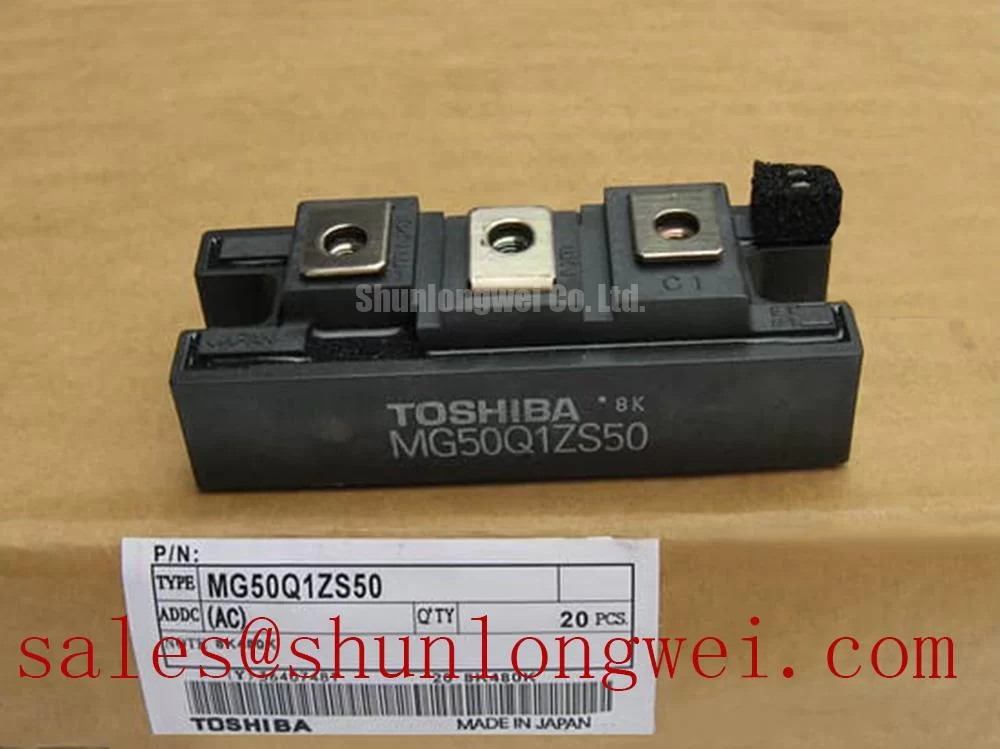
MG50Q1ZS50 Toshiba IGBT Module: 1200V 50A High-Speed Switching
The Toshiba MG50Q1ZS50 optimizes high-frequency power conversion by balancing conduction efficiency and robust isolation in 1200V industrial drives. Featuring a 50A current capacity and 2500VAC baseplate isolation, this N-channel switch minimizes steady-state losses while streamlining physical assembly. Design teams frequently question its application scope on volatile AC networks; the generous voltage threshold delivers indispensable headroom against back-EMF transients in harsh manufacturing environments. For 480V industrial motor drives prioritizing thermal stability and low conduction loss, this 1200V 50A module is the optimal choice.
Key Parameter Overview
Highlighting the Core Metrics for High-Power Designs
When selecting high-power IGBT modules, parsing the exact capabilities prevents over-engineering and safeguards reliability. The specifications below outline the foundational operating limits of the device.
| Parameter | Value | Engineering Impact |
|---|---|---|
| Collector-Emitter Voltage (VCES) | 1200V | Provides a massive safety margin for absorbing transients on a standard 480V AC industrial line. |
| Continuous Collector Current (IC) | 50A | Sustains continuous current delivery for mid-sized variable frequency drives. |
| Isolation Voltage | 2500VAC | Facilitates direct heatsink mounting, lowering the barrier for compliant safety architectures. |
Download the MG50Q1ZS50 datasheet for detailed specifications and performance curves.
Application Scenarios & Value
Achieving System-Level Benefits in High-Frequency Motor Control
Designers regularly face the complex challenge of managing thermal density when developing compact variable frequency drives (VFDs) for industrial machinery. Consider a high-fidelity scenario involving a heavy-duty packaging conveyor belt: during start-stop cycles, the motor startup draws significant inrush current. By leveraging the 50A current capacity of the MG50Q1ZS50, the drive handles these surges without entering thermal runaway.
Think of the 1200V rating as the clearance height of a physical bridge; a higher bridge guarantees that unexpected floodwaters—in this case, inductive voltage spikes—pass underneath harmlessly, preventing catastrophic silicon breakdown. This robust margin, coupled with fast turn-off characteristics, drastically reduces commutation losses across the inverter bridge. For systems requiring a dual-switch configuration, the BSM50GB120DN2 provides a half-bridge alternative, while the MG150Q2YS50 scales the current capacity to 150A for substantially larger mechanical loads.
Technical Deep Dive
Decoding the Thermal Interface and Conduction Dynamics
The internal N-channel architecture of the MG50Q1ZS50 is precisely calibrated to navigate the inherent trade-off between switching speed and forward voltage drop. Maintaining a low VCE(sat) minimizes the power dissipated as heat during the continuous ON state, directly influencing the baseline efficiency of the entire power stage.
Effectively managing this heat transfer is critical for long-term operational health. Managing thermal resistance is akin to widening a highway bottleneck; the internal structure and isolated baseplate act as a multi-lane express route for thermal energy. This pathway allows the heat generated during rigorous switching cycles to dissipate swiftly into the external heatsink without transferring any electrical current. Relying on advanced thermal management strategies, this 2500VAC isolated foundation eliminates the requirement for fragile external mica insulators, ultimately suppressing the total thermal impedance of the assembly.
Frequently Asked Questions
Answering Critical Engineering Queries on the MG50Q1ZS50
- What is the primary benefit of the isolated baseplate?
It reduces thermal impedance and assembly complexity by eliminating the need for external electrical insulators. - What makes the 1200V rating optimal for 480V industrial AC lines?
A standard 480V AC network produces peak voltages around 680V. The 1200V rating provides almost double the necessary margin, defending the semiconductor against grid fluctuations and regenerative braking spikes common in demanding circuit topologies. - How does the VCE(sat) influence switching efficiency in motor drives?
A minimized VCE(sat) lowers the voltage drop across the transistor while it conducts. This reduction directly limits steady-state power dissipation, conserving energy in high-current industrial cycles. - Can this N-Channel module support high-frequency welding applications?
Yes. The silicon is structured for rapid transition times, which effectively mitigates the dynamic switching losses that typically plague high-frequency inverter welding supplies.
As industrial automation networks demand denser integration and stricter energy compliance, the selection of fundamental active components dictates overall hardware longevity. Deploying reliable switching devices with substantial voltage margins and refined thermal pathways establishes a highly resilient power foundation for the next decade of intelligent manufacturing infrastructure.