Content last revised on September 20, 2026
Preventing Spurious Faults: DC Bus Low Inductance Laminated Busbar Design Guidelines for PM50B4LA060
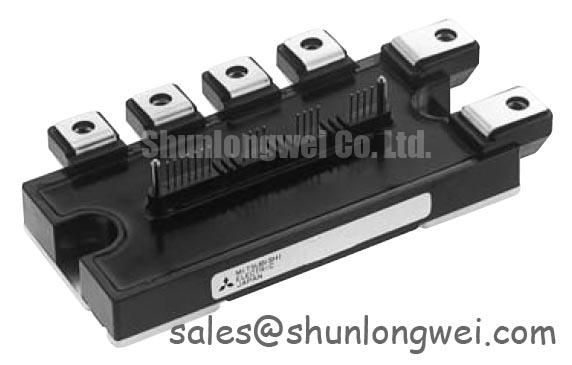
The PM50B4LA060 is rated at 600.0 V and 50.0 A as an Official Specification. In a traction inverter, the measured switching voltage can exceed the static DC bus voltage because the commutation loop contains parasitic inductance. In engineering terms, the peak device stress rises with DC bus voltage plus the inductive contribution created when current changes rapidly. This is an Engineering Calculation principle rather than a published module limit for this specific part.
Design Consideration: keep the positive and negative DC bus conductors physically close across the power stage so the outgoing and return currents follow a compact, symmetrical path. A laminated busbar can support this objective when its geometry, insulation system, creepage requirements, and mounting arrangement are validated for the actual inverter. Long cable loops between bulk capacitors and the IPM can increase overshoot, ringing, radiated noise, and nuisance protection activity.
During a repair investigation, inspect the DC link capacitor connections, busbar flatness, fastening condition, and evidence of thermal discoloration before replacing the power module. Compare the suspect inverter with a known functional unit where possible. Oscilloscope measurements should use an appropriate high voltage differential probe and a measurement method that does not introduce a large probe loop. A waveform that appears unstable may result from the measurement arrangement, the power loop, the driver loop, or an interaction between them.
Snubber capacitors are a system level Design Consideration, not a confirmed built in feature of this Mitsubishi Electric IPM. Their suitability depends on observed commutation ringing, capacitor current capability, switching frequency, physical placement, and thermal conditions. Designers should validate peak voltage margins during switching tests rather than selecting a snubber value from a generic rule.
In forklift traction equipment, regenerative braking can return energy to the DC bus. The braking chopper, brake resistor, battery acceptance capability, and bus voltage supervision are separate system functions that should be examined when repeated fault events occur during deceleration. A power module replacement cannot correct an incorrectly operating braking energy path.
⚠️ Field Alert: Disconnect and discharge the DC bus according to the equipment service procedure before touching busbars, capacitors, or the IPM terminals.
For broader context on switching speed, parasitics, and the different integration questions raised by newer power technologies, see Wide Bandgap Revolution. That reference is useful for test planning, while the PM50B4LA060 itself should be evaluated strictly against its original inverter requirements.
Benchtop Waveform Tuning: Mitigating Stress via Fault Clearing Dynamics and Desaturation Considerations on PM50B4LA060
Before attributing a shutdown event to the PM50B4LA060, capture the controller command, the gate related drive signal where safely accessible, the DC bus voltage, phase current, and fault indication in time relationship. An inverter can report a fault because of overcurrent detection, DC bus supervision, gate driver undervoltage, controller interlock logic, thermal monitoring, or a wiring issue. The observed waveform sequence is more useful than assigning a single cause from one symptom.
Desaturation detection and short circuit response are protection functions implemented by the original drive system or by circuitry associated with the module architecture. The available official data here does not establish a specific desaturation threshold, short circuit withstand duration, or soft turn off profile for PM50B4LA060. The system integrator should verify these values from the original Mitsubishi Electric documentation and the inverter schematic before modifying protection components.
Design Consideration: fault clearing must limit semiconductor stress while avoiding a rapid current interruption that creates excessive inductive overvoltage in the commutation loop. A controlled reduction of gate drive can be used in some inverter architectures, but its timing and behavior are system determined. Validation should include representative motor current, DC bus state, load direction, regenerative operation, and fault conditions permitted by the test procedure.
Gate resistor selection is also an Engineering Recommendation rather than an official parameter stated for this model. Gate resistance influences switching speed, ringing, driver peak current demand, and voltage overshoot. A resistor that suppresses ringing in one layout may create unacceptable switching loss or protection timing behavior in another. Engineers should begin from the original equipment value where available and verify switching behavior under controlled test conditions.
Isolation performance in the control path matters during high common mode transitions. Optocouplers and digital isolators should be evaluated as part of the complete driver board, including their supply decoupling, return path, signal routing, and controller grounding. Do not assume that a replacement IPM will resolve erratic gate commands caused by a degraded isolated supply or damaged signal path.
For manufacturer level information on power semiconductor technologies and module families, consult Mitsubishi Electric Power Semiconductors and High Power Modules. This external resource supports device family research but does not replace confirmation of the exact original equipment circuit implementation.
Benchtop Waveform Tuning: Mitigating Stress via Dynamic Gate Impedance Control for Robust Operation on PM50B4LA060
Cross conduction in a bridge can occur when a switching transition couples through parasitic capacitances and unintentionally raises the gate potential of the opposite device. In a traction inverter, this risk is influenced by power loop geometry, gate loop impedance, driver return routing, deadtime strategy, DC bus behavior, and the actual switching transition. It should not be diagnosed from a current spike alone.
Design Consideration: maintain a short, direct gate drive path and a return path that remains associated with the relevant switch reference. This reduces the opportunity for power current transients to modulate the gate control reference. Where the original driver design uses an active Miller clamp or an off state bias scheme, preserve the original intended circuit topology unless qualified engineering review confirms a change.
The available Official Specification identifies PM50B4LA060 as a 600.0 V, 50.0 A Mitsubishi IPM Module; it does not confirm a particular negative gate bias requirement, active clamp function, gate threshold, or allowable gate voltage range. The system integrator should verify those requirements from the original panel and drive documentation. Applying generic gate voltage values to an unknown IPM control interface can damage the module or prevent correct protection operation.
When a repaired inverter shows intermittent shoot through protection, compare its gate related waveforms to those of a verified operating drive under equivalent conditions. Check for unequal turn on and turn off behavior between phases, loose driver board connectors, damaged gate resistor networks, poor control supply decoupling, and noise entering logic level command paths. Each finding should be confirmed by measurement before component substitution.
In the wider power conversion chain, an upstream rectifier module can affect the DC bus delivered to an inverter. For neutral comparison during system level sourcing and maintenance planning, CM100DY-12E is a related power module reference that may be evaluated according to its own published ratings, topology, and mechanical requirements. It is not presented as a direct replacement for PM50B4LA060.
PM50B4LA060 Operational Boundaries: Evaluating PCB Gate Loop Layout Symmetry Limits
PCB layout inspection should start with the relationship between the gate drive traces, their return paths, isolated supply capacitors, controller ground, and high current power traces. A gate drive loop that shares too much impedance with the main power current path can develop unwanted voltage during switching. That voltage can distort the effective gate command seen by the IPM and may contribute to ringing, false protection indications, or inconsistent phase behavior.
Design Consideration: separate sensitive gate control returns from the high current emitter or phase current route wherever the original module connection scheme and documentation permit. The goal is to reduce common impedance coupling, not to impose a generic routing rule without knowledge of the module terminals and driver architecture. Any auxiliary or control reference terminal assignment must be confirmed from the exact PM50B4LA060 documentation before a board layout is altered.
A practical repair sequence is to inspect solder joints and connector seating, confirm continuity on low energy control paths with power removed, then evaluate waveform symmetry under controlled operation. If one phase differs from the others, investigate the driver channel, its isolated supply, its command path, its measurement reference, and the corresponding power connections. A difference may indicate layout sensitivity, a damaged peripheral component, control timing variation, or a mechanical connection issue.
Thermal integration also remains part of the operational boundary. Confirm that the heatsink mating surfaces are clean, flat, and compatible with the original assembly method. The fastening method, thermal interface material, clamping arrangement, and tightening specification should follow the original equipment documentation or applicable manufacturer data. Do not infer mounting torque or pressure requirements from the module’s current rating alone.
For comparison work where a higher current dual module is being assessed in a separate topology, CM300DXDX1-24A provides a neutral reference point for reviewing published package, rating, and connection differences. Any substitution decision requires full electrical, thermal, mechanical, and control interface verification; it should not be based only on a model family name or current figure.
Additional manufacturer technology information is available through Mitsubishi Electric Global Semiconductor Device Technologies. For PM50B4LA060 maintenance decisions, retain the original inverter schematic, module documentation, waveform evidence, and measured operating conditions with the service record.