Content last revised on September 10, 2026
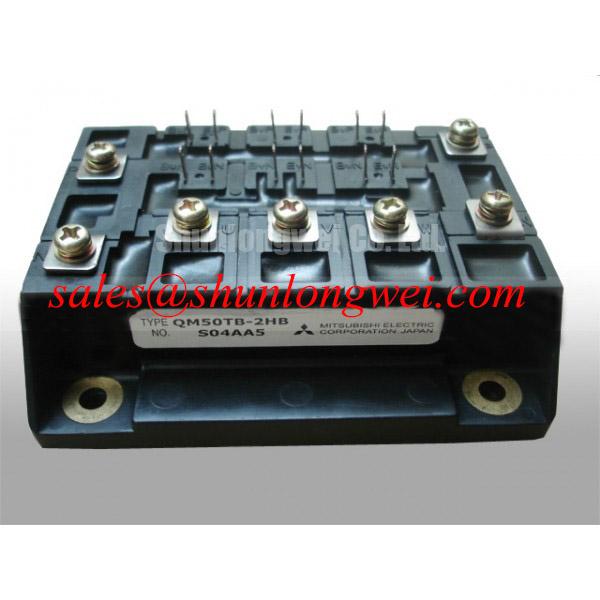
QM50TB-2HB Mitsubishi Electric 1000V 50A Transistor Power Module
The QM50TB-2HB GTR transistor power module delivers high-performance 1000V collector-emitter voltage handling and 50A continuous collector current rating in a compact six-pack bridge topology. Designed with an insulated copper baseplate and a high DC current gain Darlington structure, this power semiconductor simplifies drive circuitry while delivering robust thermal dissipation for demanding industrial switching applications.
Top Specifications: 1000V VCEX | 50A IC | 750 hFE min gain | Insulated Baseplate Package.
Key Engineering Benefits:
- Simplified Gate Drive: High current gain reduces external driver stage complexity and power consumption.
- Enhanced Thermal Reliability: Direct ceramic insulation base reduces junction-to-case thermal resistance.
What is the primary benefit of the QM50TB-2HB insulated baseplate? It ensures high thermal dissipation while maintaining electrical isolation from heatsinks. For industrial designers managing tight thermal budgets, understanding the interplay of voltage ratings, current capacity, and heat transfer is vital. For a broader framework, explore the core trio of power module selection.
Application Scenarios & Value
Achieving Thermal Reliability and High Gain in 480V Motor Inverters
For 480V industrial drive systems demanding robust 1000V insulation and 50A switching, the Mitsubishi QM50TB-2HB provides an ideal thermal and electrical baseline. Engineers often face severe thermal stress and parasitic switching losses when designing compact Variable Frequency Drives (VFD) and high-torque AC servo drives. In these environments, power semiconductors must withstand cyclic surge currents while preventing thermal runaway within enclosed IP65 control cabinets.
The QM50TB-2HB addresses these field challenges through its integrated 6-pack Darlington configuration. By providing a high DC current gain (hFE = 750), the module minimizes base drive power requirements, allowing control boards to interface efficiently without bulky driver stages. In heavy-duty conveyor drives and industrial pumps running under harsh duty cycles, the module's 1000V blocking voltage offers generous voltage margin against inductive kickback spikes caused by long motor cables and sudden load variations. This high breakdown voltage ensures compliance with rigorous noise and surge isolation standards such as IEC 61800-3.
For motor control designs requiring lower current capacity in standard line voltages, the related QM50DY-H provides 600V blocking capability, while systems demanding elevated power throughput benefit from evaluating higher current options like the QM100DY-2H.
Technical Deep Dive
Optimizing Thermal Dissipation and Safe Operating Area in Heavy-Duty Switching
Understanding internal device physics is key to maximizing operational lifespan under high electrical load. Think of a power semiconductor's internal chip layout like a high-speed highway intersection: if heat accumulates in centralized bottlenecks, traffic stalls and thermal damage occurs. The QM50TB-2HB utilizes an insulated copper substrate module package where electrical isolation is maintained directly beneath the silicon dies. This layout disperses heat uniformly across the entire heatsink interface, preventing localized hot spots.
When operating in continuous switching modes, managing internal heat transfer is critical to preserving the device's Safe Operating Area (SOA). Implementing a proper Snubber Circuit across the collector-emitter terminals suppresses transient voltage spikes during turn-off, guarding the internal Darlington junction against localized breakdown. To dive deeper into optimizing thermal dissipation paths and heatsink selection, refer to this guide on mastering power module thermal management.
Key Parameter Overview
Decoding 1000V/50A Specs for Functional Power Stage Design
The functional parameter table below outlines the electrical limits, amplification factors, and physical characteristics of the QM50TB-2HB module as defined in official documentation.
| Parameter Category | Specification Parameter | Technical Value |
|---|---|---|
| Voltage Ratings | Collector-Emitter Voltage (VCEX) | 1000V |
| Collector-Base Voltage (VCBO) | 1000V | |
| Current Ratings | Continuous Collector Current (IC) | 50A |
| Pulsed Collector Current (ICP) | 100A | |
| Amplification & Losses | DC Current Gain (hFE) | 750 (Min) |
| Collector-Emitter Saturation Voltage (VCE(sat)) | 2.5V (Max) | |
| Thermal & Mechanical | Circuit Topology | 6-Pack (3-Phase Bridge) |
| Isolation Status | Insulated Baseplate (UL E80276) |
Download the QM50TB-2HB datasheet for detailed specifications and performance curves.
Frequently Asked Questions
What makes the QM50TB-2HB suitable for 480V industrial line voltage applications?
The module features a collector-emitter breakdown rating of 1000V VCEX. In 480V AC line inverters, peak DC bus voltages routinely reach 680V to 750V under regenerative braking or line surge conditions. The 1000V rating provides a safety buffer against overvoltage failure.
How does the hFE gain rating of 750 simplify gate/base drive circuitry?
With a high current gain of 750, the QM50TB-2HB requires significantly lower base drive current to maintain saturated conduction at its full 50A collector rating. This enables drive boards to utilize lower-power optocouplers and driver stages, reducing overall power stage complexity.
What is the benefit of the insulated baseplate configuration in 3-phase bridge modules?
The internal ceramic insulator separates the electrically active collector circuits from the external metal baseplate. This allows all six internal switches to be mounted on a single shared heatsink without electrical shorting, simplifying assembly and lowering total system packaging cost.
What thermal management practices should be used when mounting this module?
Engineers should apply a uniform 0.5 to 1.0 mil layer of thermal grease across the nickel-plated copper baseplate and adhere strictly to specified mounting torque values. This minimizes interface thermal resistance and prevents mechanical warping of the internal substrate.
How does the QM50TB-2HB compare when replacing older non-insulated transistor modules?
Upgrading to an insulated module like the QM50TB-2HB eliminates external mica isolation pads, reducing heat transfer resistance to the heatsink and improving long-term vibration resistance in industrial servo and motor control platforms.
For engineers assessing power stage replacement or design validation, reviewing exact technical documentation and verified thermal curves is recommended to streamline thermal design and system commissioning.