Content last revised on September 10, 2026
SKKT107/22E Thyristor Module: 2200V Dual SCR Power Block for Industrial Line Control
How do design engineers guarantee dependable phase control when line transients and harsh thermal cycling threaten industrial rectifiers? The Semikron SKKT107/22E dual thyristor module addresses this challenge directly, delivering robust 2200V repetitive peak off-state voltage capability within the industry-standard SEMIPACK 1 footprint. Rated for an average on-state current (ITAV) of 107A with a junction-to-case thermal resistance (Rth(j-c)) of 0.19 K/W per thyristor, it secures ample voltage margin in 690V industrial grids. For line-fed systems demanding high transient withstand without costly snubber over-dimensioning, this 2200V dual SCR module serves as the premier choice.
Frequently Asked Questions
Addressing Key Implementation and Gate Drive Queries
What is the primary benefit of its 2200V VDRM/VRRM rating? It provides generous blocking margins against severe AC line transients in 400V to 690V industrial networks.
How does the aluminium oxide ceramic baseplate impact operational lifespan? It optimizes heat dissipation and minimizes mechanical shear stress across solder layers during repeated power cycles.
How does the low Rth(j-c) of 0.19 K/W per thyristor influence heatsink dimensioning? A lower thermal resistance allows power conversion systems to maintain safe junction temperatures under continuous 107A loads using smaller heatsinks or reduced forced-air cooling velocity.
What gate trigger characteristics are required for reliable firing? The SKKT107/22E requires a typical gate trigger current (IGT) of 100 mA and gate trigger voltage (VGT) of 2.5V at 25°C, ensuring noise immunity in electrically noisy industrial environments.
Can the module handle high inrush currents during motor starting? Yes, with a surge current (ITSM) rating of approximately 1900A (10 ms half-sine wave at maximum junction temperature), it withstands severe motor-starting surges and line short circuits before fuse clearance.
Key Parameter Overview
Decoding Electrical and Thermal Ratings for Power Control
Understanding critical ratings allows designers to effectively balance electrical ruggedness and voltage and thermal management:
| Parameter | Technical Specification | Engineering Value Interpretation |
|---|---|---|
| VDRM / VRRM | 2200V | Suppresses grid voltage spikes without requiring oversized surge arresters. |
| ITAV (sin. 180°) | 107A (Tc = 85°C) | Delivers continuous power density for medium-current rectification and soft starting. |
| ITRMS | 175A | Supports continuous high-current operation across full-wave bridge configurations. |
| ITSM (10 ms, 130°C) | 1900A | Provides high short-circuit survival capability during system-level overloads. |
| Visol (AC, 1 min) | 3600V~ | Guarantees electrical safety and isolation compliance according to UL standards. |
| Rth(j-c) (per chip) | 0.19 K/W | Ensures fast conductive heat removal from silicon junctions to the cold plate. |
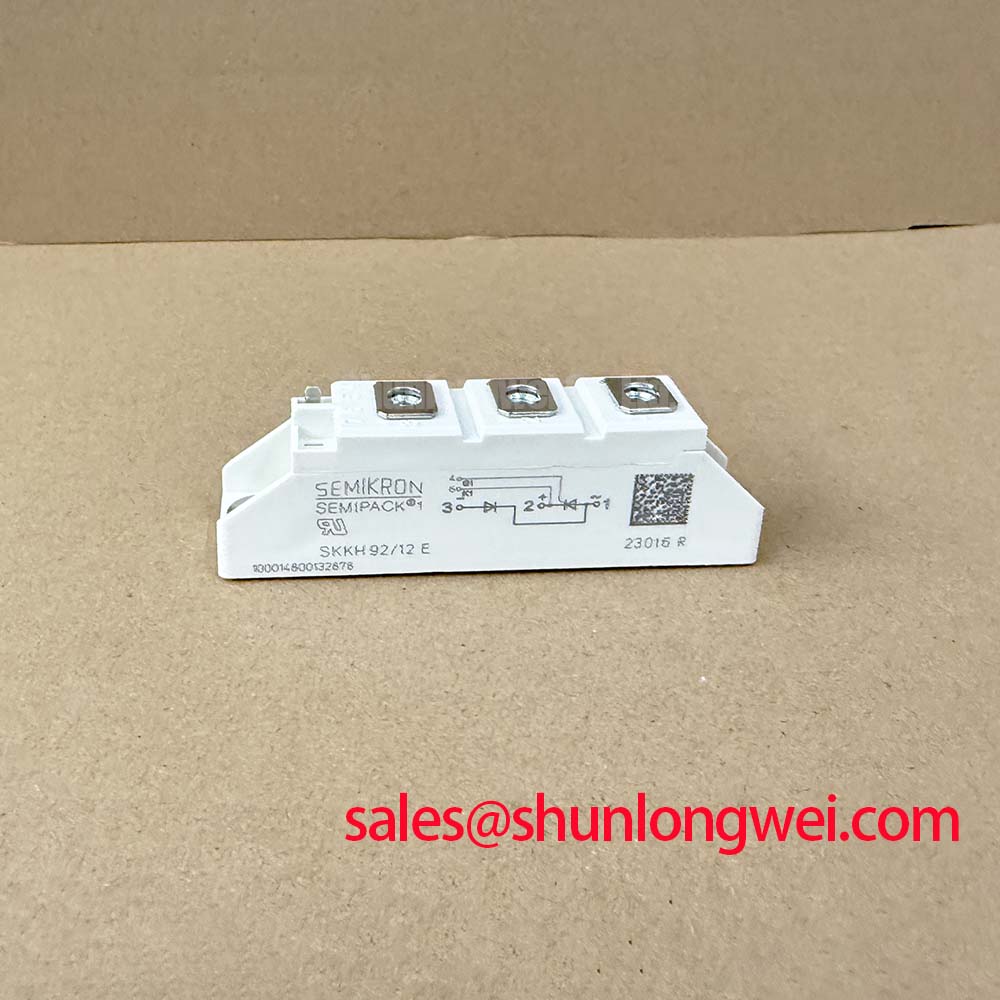
| Package Type | SEMIPACK 1 | Industry-standard screw-mount housing (93 x 20 x 30 mm) for drop-in field replacement. |
Technical & Design Deep Dive
Aluminium Oxide Baseplate Design and Thermal Heat Transfer
The SKKT107/22E utilizes an electrically isolated direct-bonded copper (DBC) substrate over an aluminium oxide (Al2O3) ceramic baseplate. In high-power phase-control topologies, thermal resistance behaves much like an electrical bottleneck: just as narrow wiring restricts current flow, high thermal impedance traps heat inside the silicon chip. By utilizing an optimized ceramic layer, the module establishes a wide thermal conduit, dissipating heat evenly into the baseplate and lowering thermo-mechanical fatigue under continuous load variations.
Internally, hard-soldered planar thyristor dies provide balanced forward voltage drops (VT typical 1.6V at 300A), minimizing conduction losses. Think of this balance like matching twin cylinders in an engine: balanced internal characteristics prevent localized hot spots and current crowding between paired SCRs, directly extending service life in demanding 24/7 industrial duties.
Application Scenarios & Value
Optimizing Heavy Industrial Soft Starters and Phase Angle Controllers
Consider an engineering team designing an AC motor soft starter for a heavy conveyor system in a mining facility. The motor startup sequence generates continuous inrush currents alongside substantial line harmonics and inductive kickback from utility fluctuations. Utilizing a standard 1600V module risks dielectric breakdown during utility capacitor bank switching. By integrating the SKKT107/22E, engineers leverage its 2200V blocking capability to safely absorb voltage spikes without triggering catastrophic punch-through.
The module is equally effective in temperature control units for industrial furnaces, fully controlled six-pulse bridge rectifiers, and high-power lighting regulators. For systems requiring lower voltage ratings in the same mechanical footprint, the related SKKT106/12E serves 400V grids, whereas designs requiring higher current capacity in 2200V classes benefit from the SKKT280/22E or the higher-amperage SKKH460/22EH4.
From an integration standpoint, verifying mounting torque (2.55 to 3.45 N·m on terminals and 4.25 to 5.75 N·m on the baseplate) alongside uniform thermal grease application (50 µm thickness) ensures that the module maintains rated thermal conductivity across extreme ambient operating conditions from -40°C to +130°C.