
Content last revised on September 10, 2026
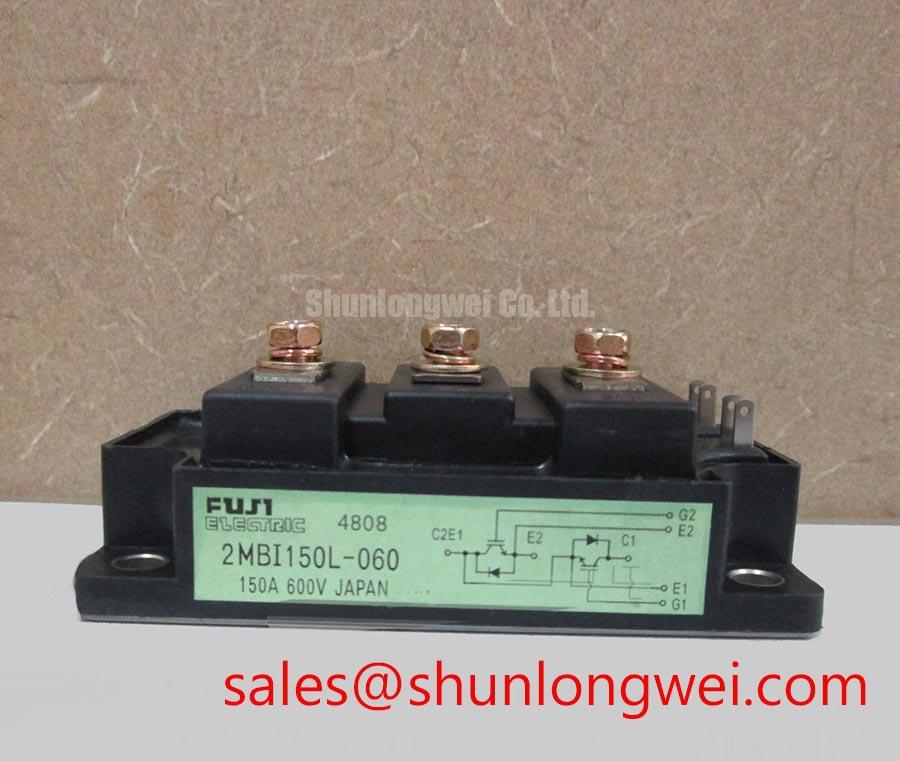
2MBI150L-060 Fuji Electric 600V 150A IGBT Module
| Manufacturer | Fuji Electric |
| Part number | 2MBI150L-060 |
| Category | IGBT Module |
| Rated voltage | 600.0 V, Official Specification |
| Rated current | 150.0 A, Official Specification |
| Package | Module, Official Specification |
Start the field inspection by isolating the DC link, checking the module marking against the approved maintenance record, and examining the power terminals, gate terminals, baseplate, and mounting surface for mechanical damage. The 2MBI150L-060 is a Fuji Electric IGBT Module specified at 600.0 V and 150.0 A. These are official product specifications; they do not by themselves define the allowable switching frequency, surge current, short circuit withstand time, thermal resistance, or safe operating area in a particular inverter.
For a commercial string inverter or micro-grid energy-storage converter, the replacement decision should begin with the original circuit documentation. Confirm the semiconductor topology, gate-driver arrangement, terminal assignment, DC-link voltage, cooling method, protection logic, and mechanical envelope before applying power. A module with the same headline voltage and current ratings still requires system-level verification of switching conditions and protection margins.
Assembly Integrity & Layout Architecture: Implementing Optocoupler vs Digital Coreless Transformer for 2MBI150L-060
When the gate-drive board is being repaired, identify whether the original isolation path uses an optocoupler, a digital isolator, or a coreless transformer before changing the driver circuit. The isolation rating, common-mode transient immunity, propagation delay, pulse-width distortion, and power-supply arrangement must be checked from the driver manufacturer’s documentation. Do not treat a requested isolation target above 5 kV or a CMTI target above 100 kV/µs as an official rating of this Fuji Electric module; those values belong to the complete driver and isolation design.
Keep the gate-drive loop compact and route the command return directly to the relevant emitter reference shown in the approved schematic. Separate high-current commutation paths from sensitive control traces, and maintain the creepage and clearance required by the system’s working voltage, pollution level, insulation class, and applicable safety standard. During commissioning, compare the gate waveform at the module terminals with the known-good phase. An unexpected pulse, excessive ringing, or unequal turn-on timing may indicate driver saturation, common-mode coupling, probing error, or a damaged interface, so verify each possibility with controlled oscilloscope measurements.
Fuji Electric’s information on brake chopper IGBT modules can provide useful context for high-power switching arrangements, but it should not be used as a substitute for the specific 2MBI150L-060 datasheet.
Preventing Spurious Faults: Auxiliary Emitter Return Trace Separation Guidelines for 2MBI150L-060
If the approved driver circuit provides a separate auxiliary emitter return, keep that control reference away from the main high-current emitter conductor. The purpose is to prevent load-current voltage drops and stray inductance from appearing in the gate signal. This is a Design Consideration for the surrounding power assembly, not a separately confirmed terminal specification for the product data supplied here.
Inspect the gate resistor, driver return, terminal fasteners, copper joints, and laminated bus connections when a converter reports intermittent overcurrent or gate fault events. A freewheeling diode’s reverse-recovery behavior can increase commutation overshoot and electromagnetic interference, particularly when cable inductance and busbar geometry are unfavorable. Snubber selection, gate resistance, dead time, and switching speed should therefore be established from double-pulse or equivalent switching tests on the complete assembly. The engineer should verify peak voltage and gate stability at the actual module terminals rather than relying only on control-board test points.
For a neutral comparison during replacement planning, engineers may also review the 2MBI150UC-120. It is a different Fuji Electric product and should be considered only after electrical, mechanical, thermal, and control-interface compatibility has been documented.
Transient Dynamics & Electrical Design: Mitigating Hard Switching Transients via Protection Coordination
The 600.0 V rating is an official voltage specification for the 2MBI150L-060, not permission to operate the DC link at that value without transient margin. During turn-off, stray inductance, reverse recovery, busbar layout, and motor or inverter cable reflections can raise the collector-emitter voltage above the steady-state bus voltage. Long motor cables can produce reflected-wave peaks that approach twice the incident voltage under certain transmission-line conditions, so the complete installation should be evaluated with suitable filtering, termination, and oscilloscope measurements.
Short-circuit protection must be coordinated with the actual gate driver, desaturation or current-sensing method, blanking interval, fault latch, and soft turn-off behavior. The supplied product data does not establish a universal response time below 10 µs, nor does it provide a guaranteed short-circuit withstand interval in this page specification. Treat SCSOA and surge-current limits as datasheet-controlled parameters that require confirmation before commissioning. Two-stage soft turn-off may reduce inductive stress, but its timing and gate-voltage profile remain system-design decisions.
When investigating a failed phase, record the DC-link voltage, gate-emitter waveform, collector-emitter transient, current rise, fault timing, and temperature condition. Fuji Electric’s RC-IGBT module information may help explain alternative switching topologies, but it does not establish interchangeability with this module.
Field Diagnostics & Commissioning: Baseplate Thermal Grease Layer Control in 2MBI150L-060 Topologies
Before mounting, clean the heatsink and module baseplate with a suitable process, check flatness and contamination, and confirm that the cooling interface matches the original equipment design. Thermal interface material should be applied as a uniform, continuous film. Follow the selected compound and heatsink manufacturer’s instructions for the application process and layer thickness; these are not official 2MBI150L-060 specifications.
Use the original mounting hardware where permitted, align the module without forcing the terminals, and tighten fasteners in a diagonal sequence so contact pressure develops evenly. For assemblies using a spring washer or disc spring, verify the spring specification and compression condition rather than assuming that a torque value alone proves correct pressure. Double-sided cooling arrangements require particular attention to parallel surfaces and sequential tightening because baseplate curvature or uneven pressure can leave air pockets in the thermal path.
⚠️ Field Alert: Disconnect all power before inserting or removing gate-drive connectors, and verify the specified fastener torque from the equipment service documentation.
After installation, inspect for displaced compound, loose terminals, and abnormal thermal gradients during a controlled load test. If the temperature rise differs from the known-good phase, verify clamping pressure, cooling flow, sensor placement, switching balance, and current sharing before attributing the result to the module itself. For gate-drive background, see Evolution of Negative Off-Bias Gate Drive Circuits.