
Content last revised on September 10, 2026
Optimized Switching Performance: The Fuji Electric 6MBI25S-120 IGBT Module
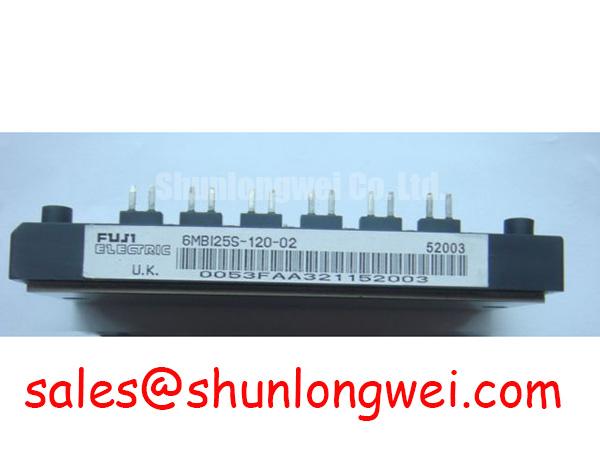
The 6MBI25S-120, manufactured by Fuji Electric, is a high-performance 1200V, 25A IGBT Module featuring a 6-pack (six-switch) inverter configuration. This module is developed to address the stringent requirements of small-to-medium power Variable Frequency Drive (VFD) systems and servo drives, where balancing switching speed with low thermal loss is critical for long-term system stability. By integrating six IGBT switches and their corresponding free-wheeling diodes into a single compact package, it simplifies the design of three-phase power conversion stages. For compact 400V motor drives prioritizing high switching efficiency and reduced footprint, the 6MBI25S-120 remains an industry-standard choice.
What is the primary benefit of the 6-pack configuration in the 6MBI25S-120? It significantly reduces parasitic inductance in the DC link compared to discrete component layouts. For systems requiring higher current handling, the related 6MBI100S-120 offers a Vces of 1200V with an increased current rating.
Key Parameter Overview
Decoding the Specs for Enhanced Thermal Reliability
Analyzing the electrical characteristics of the 6MBI25S-120 provides insight into its suitability for high-frequency switching environments. The Collector-Emitter saturation voltage, Vce(sat), serves as a primary indicator of conduction losses. Think of Vce(sat) as the internal friction within a valve; a lower value means less energy is converted into heat while the "valve" is open, allowing for higher power density without exceeding thermal limits.
| Parameter | Official Specification | Engineering Value |
|---|---|---|
| Collector-Emitter Voltage (Vces) | 1200V | Provides ample margin for 400-480V AC line transients. |
| Collector Current (Ic) | 25A at Tc=80°C | Ideal for 5.5kW to 7.5kW motor control applications. |
| Vce(sat) (Typical) | 2.1V | Low conduction loss optimizes inverter efficiency. |
| Configuration | 6-Pack Inverter | Simplifies 3-phase bridge design and PCB routing. |
| Mounting Torque | 3.5 N·m (Max) | Ensures consistent thermal contact with the heatsink. |
Download the 6MBI25S-120 datasheet for detailed specifications and performance curves.
Application Scenarios & Value
Achieving System-Level Benefits in High-Frequency Power Conversion
The 6MBI25S-120 is frequently deployed in industrial automation, specifically within the inverter stage of VFDs. One common challenge for engineers is managing the "inrush" or surge current when a motor starts under a heavy load. The robust Safe Operating Area (SOA) of this module ensures that it can withstand these transient events without triggering desaturation or catastrophic failure. In modern smart factories, where space in electrical cabinets is limited, the compact footprint of this module allows for more units to be installed in parallel, supporting the trend toward decentralized control architectures.
Beyond motor control, the 6MBI25S-120 is an excellent fit for Uninterruptible Power Supplies (UPS). In a UPS bypass or inverter circuit, the module’s low noise characteristics help in meeting IEC 61800-3 electromagnetic compatibility standards, reducing the need for bulky external filtering. Engineers evaluating power stages for renewable energy applications may also find this module useful in the PFC stage of small solar string inverters.
To deepen your understanding of these technologies, explore our engineers' guide to IGBT modules or our detailed breakdown of gate drive layout and thermal management.
Technical Deep Dive
A Closer Look at the Thermal Resistance and Switching Loss Dynamics
The thermal resistance from junction to case, Rth(j-c), is the most critical metric for determining the lifespan of an IGBT. In the 6MBI25S-120, the internal substrate is designed to move heat away from the silicon die as efficiently as possible. If the cooling system is not perfectly calibrated, heat can build up like water behind a dam, eventually overflowing and damaging the component. A lower Rth(j-c) ensures that even under high PWM inverter switching frequencies, the internal temperature remains within safe limits.
Furthermore, the Turn-off energy (Eoff) of the 6MBI25S-120 is optimized to minimize the "tail current" effect. This is essential for high-frequency operation because tail current causes significant power loss during every switching cycle. By reducing this energy loss, the module operates cooler, allowing engineers to potentially use smaller heatsinks or smaller cooling fans, which reduces the Total Cost of Ownership (TCO) of the final machine.
Industry Insights & Strategic Advantage
The Future Role of Reliable Power Switching in Industrial 4.0
As industry shifts toward higher levels of energy efficiency and the electrification of industrial processes, the demand for proven components like the 6MBI25S-120 remains high. While newer Wide Bandgap (WBG) materials like SiC are gaining traction, the established IGBT technology offers a predictable reliability profile and cost-effectiveness that is difficult to beat for standard industrial voltages. Its alignment with carbon neutrality goals is evident in its ability to minimize conversion losses in energy-intensive motor drives.
Strategically, adopting a standardized 6-pack module like the 6MBI25S-120 allows manufacturers to streamline their supply chains. Using a single, well-documented module across multiple product lines (from welding power supplies to AC drives) reduces the engineering overhead associated with testing and validation. For further technical comparison, see IGBT vs MOSFET vs BJT: The Ultimate Selection Guide.
FAQ
How does the Vce(sat) of 2.1V impact heat sink selection?
The 2.1V Vce(sat) directly determines the conduction loss (P = Vce * Ic). Higher conduction losses require a heatsink with a lower thermal resistance (K/W) to dissipate the resulting heat and keep the junction temperature below the 150°C limit.
What is the impact of the 6-pack configuration on PCB layout?
The 6-pack integration drastically simplifies PCB layout by consolidating the DC bus and three-phase output pins into a single area. This reduces the loop area for switching transients, which helps mitigate electromagnetic interference (EMI) and voltage spikes caused by stray inductance.
How does the 1200V rating address 400V-480V line fluctuations?
In 400V-480V industrial networks, the DC bus voltage often reaches 650V-780V. The 1200V Vces rating provides a safety margin of over 400V, protecting the silicon against transient voltage spikes and inductive back-EMF often found on noisy industrial grids.
For more technical documentation or to evaluate this module for your next power electronics project, please consult the official manufacturer resources via Fuji Electric.