



Content last revised on September 10, 2026
BSM25GD120DN2: 1200V IGBT for High-Efficiency Motor Drives
Technical deep-dive into the BSM25GD120DN2's switching characteristics and thermal design, focusing on its role in reducing system-level power loss and enhancing the reliability of industrial power conversion systems.
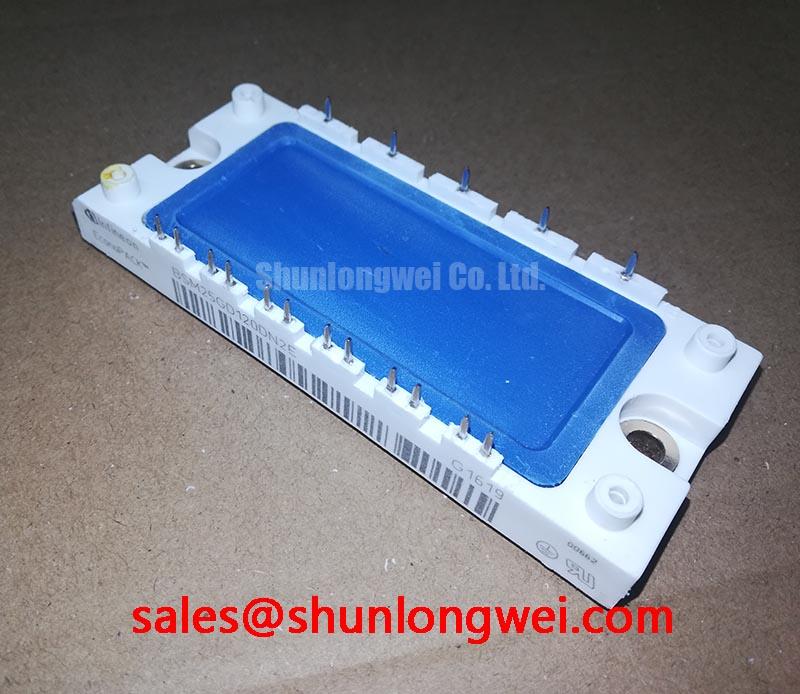
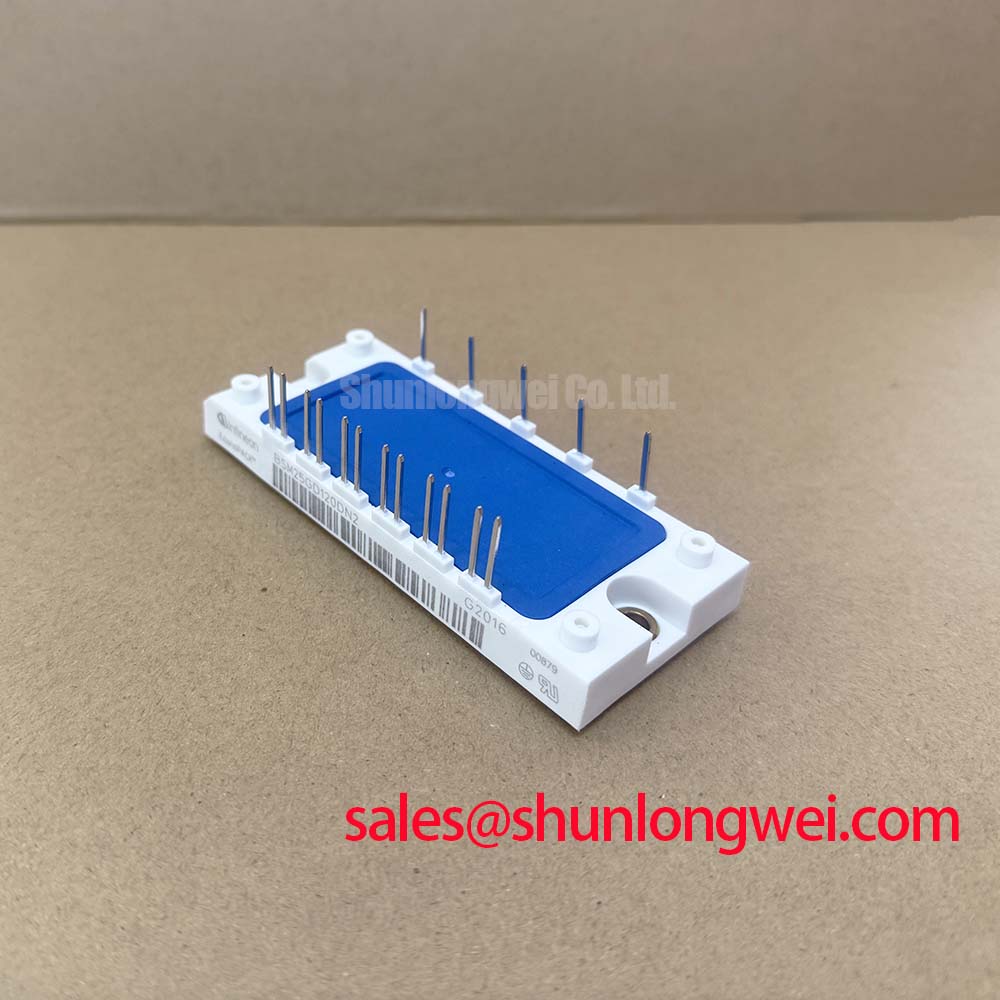
The Infineon BSM25GD120DN2 is a 1200V, 25A IGBT power module designed for three-phase full-bridge inverter applications. It offers a robust solution for motor drives and other power conversion systems where efficiency and reliability are paramount. With its integrated fast free-wheeling diodes and an insulated metal baseplate, this module simplifies thermal management and system assembly. What is the primary benefit of its low VCE(sat)? Reduced conduction losses, leading to higher system efficiency and lower operating temperatures. This module is engineered to provide a stable and efficient power stage, particularly in applications subject to demanding operational cycles.
Application Scenarios Forged in Demanding Environments
The BSM25GD120DN2 is engineered for applications where precise power control and long-term durability are critical. Its electrical and thermal characteristics make it an excellent component for a variety of industrial systems. The robust construction and 1200V rating provide significant design margin for systems operating on 380V to 480V AC lines, ensuring stable performance under transient voltage conditions.
- Variable Frequency Drives (VFDs): In VFDs, the module's fast and efficient switching directly contributes to lower motor energy consumption and more precise speed control, which is essential for industrial automation and HVAC systems.
- Servo Drives: For robotic and CNC applications, the BSM25GD120DN2 provides the rapid and accurate power modulation necessary for high-precision motion control, ensuring repeatability and operational accuracy.
- Uninterruptible Power Supplies (UPS): The module's reliability is crucial in UPS systems, where it ensures a seamless transition to battery power during outages, protecting critical infrastructure and data centers from power disruption.
- Solar Inverters: Its efficiency in converting DC to AC power is vital for maximizing the energy harvest from photovoltaic arrays, contributing to the overall performance of renewable energy systems.
For motor drive applications requiring higher current handling, the BSM50GB120DN2 offers a similar voltage rating with increased current capacity.
Deconstructing the BSM25GD120DN2's Technical Specifications
A component's performance is defined by its specifications. For the BSM25GD120DN2, several key parameters dictate its suitability for high-power applications. Understanding these values is essential for effective system design and thermal management.
Collector-Emitter Saturation Voltage (VCE(sat))
The VCE(sat) is a critical parameter that determines the power lost as heat during the on-state. The BSM25GD120DN2 features a typical VCE(sat) of 2.5V at its nominal current of 25A. This relatively low value directly translates to reduced conduction losses. Think of VCE(sat) as the "friction" the current encounters when the switch is closed; lower friction means less energy is wasted as heat, allowing for a cooler and more efficient system. This is a crucial aspect of IGBT selection for high-frequency designs.
Thermal Resistance (RthJC)
The thermal resistance from junction to case (RthJC) is specified at ≤ 0.6 K/W per IGBT. This parameter quantifies how effectively heat can be transferred from the active semiconductor chip to the module's baseplate. A lower RthJC value indicates superior thermal performance, enabling the device to run cooler under load or handle higher power levels without exceeding its maximum junction temperature. Effective thermal management is fundamental to ensuring the long-term reliability of power electronics.
Turn-On and Turn-Off Delay Times
With a turn-on delay time (td(on)) of 75 ns and a turn-off delay time (td(off)) of 400 ns, the BSM25GD120DN2 is optimized for moderate switching frequencies typical in motor drive applications. These parameters are crucial for calculating switching losses, which, along with conduction losses, determine the overall efficiency and thermal load of the inverter. For a deeper understanding of how these values impact system performance, explore this guide on decoding IGBT datasheets.
Comparative Data for Informed Decision-Making
Evaluating an IGBT module requires comparing its key performance indicators against other available options. This data is provided to support your technical assessment process.
Note: The following table presents factual data based on publicly available datasheets. It is intended to facilitate engineering analysis and does not constitute a direct recommendation. System performance is highly dependent on application-specific conditions such as gate drive design, thermal management, and operating frequency.
| Part Number | VCE (V) | IC @ 80°C (A) | VCE(sat) (Typ @ Nom. Current) (V) | Package |
|---|---|---|---|---|
| BSM25GD120DN2 | 1200 | 25 | 2.5 | EconoPACK™ 2 |
| FP25R12KE3 | 1200 | 25 | 1.7 | EconoPIM™ 2 |
| FS75R12KE3 | 1200 | 75 | 1.7 | EconoPIM™ 3 |
A Strategic View on Industrial Power Conversion
The push for greater energy efficiency and system uptime in industrial automation places significant demands on power semiconductor modules. The BSM25GD120DN2 addresses these trends by providing a well-balanced combination of voltage overhead, thermal efficiency, and proven package design. As automation becomes more complex, the reliability of core components like IGBTs becomes a strategic advantage, minimizing unplanned downtime and reducing the total cost of ownership. This module supports the move towards more compact and powerful inverter designs without compromising on the robustness required in industrial settings.
Key Parameters at a Glance
For engineers and procurement specialists, certain parameters are critical for initial evaluation. The table below highlights the most salient specifications for the BSM25GD120DN2, providing a quick reference for design and sourcing decisions.
| Parameter | Value |
|---|---|
| Collector-Emitter Voltage (VCE) | 1200 V |
| DC Collector Current (IC) @ TC = 80°C | 25 A |
| Collector-Emitter Saturation Voltage (VCE(sat)) @ 25A, 125°C | 3.1 V (typ) |
| Total Power Dissipation per IGBT (Ptot) @ TC = 25°C | 200 W |
| Junction Temperature (Tj) | -40 to +150 °C |
| Thermal Resistance, Junction-to-Case (RthJC) | ≤ 0.6 K/W |
Frequently Asked Questions
What are the primary considerations when designing a gate drive circuit for the BSM25GD120DN2?
A robust gate drive circuit for this module should provide a stable gate-emitter voltage (VGE) typically between +15V and -8V to ensure full enhancement and prevent spurious turn-on. It's also critical to minimize the inductance in the gate drive loop to avoid voltage overshoots and ringing, which can be achieved through careful PCB layout and the use of twisted-pair wiring for longer connections.
How does the insulated metal baseplate benefit the overall system design?
The insulated metal baseplate simplifies the thermal interface between the IGBT module and the heatsink. It provides excellent electrical isolation (rated at 2500 Vac for 1 minute), which allows multiple modules to be mounted on a single, non-isolated heatsink. This reduces assembly complexity, lowers material costs, and improves the overall thermal efficiency of the power stage.
Can the BSM25GD120DN2 be paralleled for higher current applications?
While paralleling IGBT modules is a common practice for increasing current capacity, it requires careful design to ensure proper current sharing. Key considerations include symmetrical PCB layout to equalize stray inductances and matching the gate threshold voltage (VGE(th)) and collector-emitter saturation voltage (VCE(sat)) of the modules. For specific guidance on paralleling, consulting detailed application notes from Infineon is recommended.
As power electronics designs continue to evolve, integrating components that offer a blend of efficiency, thermal stability, and established reliability is essential. The BSM25GD120DN2 provides a solid foundation for developing next-generation industrial power systems that meet the increasing demands for performance and durability.