
Content last revised on September 10, 2026
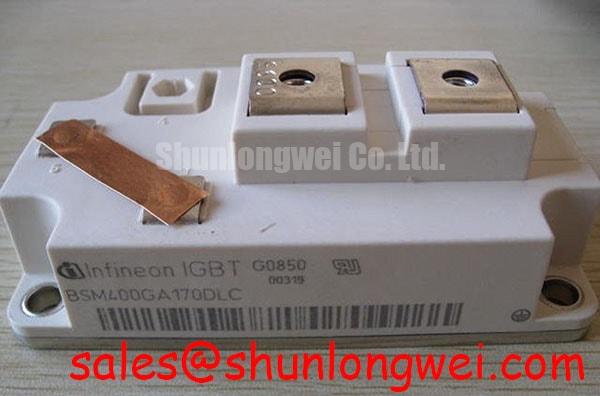
BSM400GA170DLC Infineon 1700V 400A Single Switch IGBT Module
The BSM400GA170DLC is a high-performance power semiconductor designed for medium to high-power conversion, featuring a 1700V collector-emitter voltage and a 400A continuous DC collector current. Utilizing the Infineon Trench/Fieldstop technology paired with the proprietary Diode Low Charge (DLC) technology, this module significantly reduces switching losses in demanding industrial environments. For 1700V traction or industrial drives requiring minimized switching losses, the BSM400GA170DLC is the high-efficiency benchmark.
Application Scenarios & Value
Optimizing Efficiency in High-Voltage Power Conversion
Engineers often face the challenge of managing excessive heat during high-frequency switching in 690V AC grid-connected systems. The BSM400GA170DLC addresses this by integrating a specialized DLC (Diode Low Charge) emitter-controlled diode, which drastically lowers the reverse recovery energy (Erec). In a Wind Power converter or a high-capacity UPS, this reduction in switching energy translates to lower junction temperatures, allowing for either a reduction in cooling hardware or an increase in power density.
This module is particularly effective in Variable Frequency Drives (VFD) and heavy-duty Electric Vehicle (EV) Inverter prototypes where voltage spikes must be suppressed during fast turn-off transitions. While this single-switch configuration is ideal for modular inverter phases, systems requiring a standard half-bridge layout in a similar power class might evaluate the FZ400R17KE3 for different topology requirements. By leveraging Infineon's 62mm package standards, designers can achieve robust mechanical integration in harsh industrial cabinets. What is the primary benefit of the DLC diode? It ensures a significant reduction in reverse recovery losses for efficient high-frequency operation.
Technical Deep Dive
The Engineering Significance of DLC Diode Technology
The "DLC" suffix in BSM400GA170DLC denotes Diode Low Charge, a critical advancement over standard fast-recovery diodes. In high-power switching, the diode's reverse recovery current can cause significant electromagnetic interference (EMI) and power loss. To understand the impact, consider an analogy: standard diodes are like a heavy braking system on a train that generates immense friction heat every time it stops; DLC technology acts like a carbon-ceramic brake, allowing the system to shed speed (current) with minimal energy waste and thermal stress.
Beyond switching efficiency, the module provides a 1700V isolation voltage and a high short-circuit withstand time, typically rated for 10µs. This level of ruggedness is vital for PFC stage designs and Solar Inverter applications where transient overvoltages are common. To better understand these dynamics, engineers can refer to our guide on IGBT Module analysis. Furthermore, the thermal management of this 62mm package is optimized with a low Rth(j-c) (thermal resistance from junction to case), ensuring that heat is efficiently transferred to the heatsink even under full load. Proper thermal design is non-negotiable for long-term reliability; you can explore this further in our technical resource on why Rth matters in thermal performance.
Key Parameter Overview
Decoding the Specs for Enhanced System Reliability
| Technical Parameter | Specifications |
|---|---|
| Manufacturer | Infineon (formerly Eupec) |
| Collector-Emitter Voltage (Vces) | 1700V |
| Continuous DC Collector Current (Ic) | 400A (at Tc = 80°C) |
| Collector-Emitter Saturation Voltage (Vce_sat) | 2.00V (Typical) |
| Diode Type | DLC (Diode Low Charge) |
| Operating Junction Temperature (Tvj) | -40°C to +150°C |
| Package Type | 62mm (Standard High Power) |
Download the BSM400GA170DLC datasheet for detailed specifications and performance curves.
Frequently Asked Questions
How does the DLC diode directly impact the selection of the gate driver?
The DLC (Diode Low Charge) technology reduces the peak reverse recovery current, which in turn reduces the noise floor and the "Miller effect" during switching transitions. This often allows for the use of slightly smaller gate resistors compared to standard 1700V modules, potentially simplifying the Gate Drive design while maintaining stable switching speeds.
What is the significance of the 1700V rating for 690V industrial line applications?
In 690V AC systems, the DC link voltage typically sits around 950V to 1100V. A 1200V IGBT provides very little safety margin for voltage transients caused by motor regeneration or inductive load switching. The 1700V rating of the BSM400GA170DLC offers a robust "voltage cushion," significantly reducing the risk of avalanche breakdown during high-speed turn-off.
How does the thermal resistance Rth(j-c) of this module affect its current de-rating?
The module's ability to maintain 400A depends heavily on the heat sink's efficiency. With a low Rth(j-c), the internal junction stays closer to the case temperature. However, as the switching frequency increases, the "switching losses" rise. Designers must use the Rth values to calculate the maximum allowable power dissipation to ensure the junction temperature never exceeds 150°C under peak loads.
Achieving long-term reliability in high-power systems requires a careful balance of electrical margins and thermal dissipation. The BSM400GA170DLC provides a stable foundation for engineers designing the next generation of industrial energy solutions, from renewable power conversion to advanced motor control.