
Content last revised on September 10, 2026
BSM50GB60DLC Infineon IGBT Module
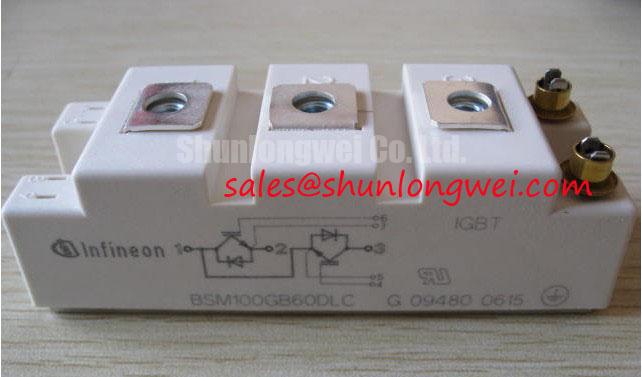
The BSM50GB60DLC, originally developed by Eupec and now part of the Infineon portfolio, is a high-performance 600V | 50A half-bridge IGBT module designed for applications where switching efficiency is the primary engineering constraint. What is the primary benefit of the DLC technology in this module? It significantly reduces switching losses to improve overall inverter efficiency. How does low Vce(sat) affect thermal management? It minimizes conduction losses, allowing for smaller heatsinks or higher power density. For 400V variable frequency drives prioritizing switching efficiency, the BSM50GB60DLC is the optimal choice.
Key Parameter Overview
Decoding the Specs for Enhanced Switching Reliability
The technical parameters of the BSM50GB60DLC reflect a design optimized for high-frequency hard-switching topologies. The 600V collector-emitter voltage provides a robust safety margin for 230V–400V AC line applications, while the 50A continuous collector current rating (at Tc=75°C) supports substantial load handling within a compact footprint.
| Main Specification | Technical Value | Engineering Significance |
|---|---|---|
| Vces (Collector-Emitter Voltage) | 600V | Provides high reliability in industrial voltage environments. |
| Ic (Continuous Collector Current) | 50A (Tc=75°C) | Ideal for medium-power motor control and power conversion. |
| Vce(sat) (Saturation Voltage) | 2.1V (Typical) | Minimizes conduction loss, improving system-level efficiency. |
| Package Type | Half-Bridge | Simplifies circuit layout for phase-leg construction. |
| Ptot (Maximum Power Dissipation) | 250W (Tc=25°C) | Defines the thermal limits for heatsink design and sizing. |
Download the BSM50GB60DLC datasheet for detailed specifications and performance curves.
Application Scenarios & Value
Achieving System-Level Benefits in High-Frequency Power Conversion
In the field of Variable Frequency Drive (VFD) design, the BSM50GB60DLC addresses the critical challenge of thermal buildup during high-speed pulse-width modulation (PWM). By utilizing Trench technology chips, this module balances the trade-off between conduction and Switching Loss, ensuring that the module operates within its safe temperature limits even at high carrier frequencies. For engineers designing for systems requiring higher current handling, the related BSM100GB60DLC offers a Vces of 600V but with a doubled current rating of 100A.
Beyond motor drives, this module is frequently integrated into Uninterruptible Power Supplies (UPS) and industrial welding systems. The integrated freewheeling diode (EmCon) features soft-recovery characteristics, which are vital for reducing electromagnetic interference (EMI) and preventing voltage spikes during high-speed turn-off transitions. This level of technical integration supports high-efficiency power systems that meet stringent energy regulations.
Technical Deep Dive
Analyzing Chip Technology and Thermal Dynamics
The "DLC" designation in the BSM50GB60DLC signifies the use of low-loss chip technology. To understand its impact, consider the Vce(sat) as the internal resistance of a valve. A lower Vce(sat) means less "friction" as current passes through, resulting in less heat generation. However, the true strength of this module lies in its Rth(j-c) (Thermal Resistance Junction-to-Case). Low thermal resistance ensures that the heat generated at the semiconductor junction is quickly moved to the copper baseplate. Think of it like a high-performance heat pipe in a computer: the faster you move the heat away, the more power you can push through the processor without a crash.
Designing a robust Gate Drive is essential to fully realize these benefits. Because this module is optimized for efficiency, the gate charge requirements must be met by a driver capable of providing sufficient peak current to ensure clean switching edges. Failure to provide adequate gate voltage can lead to the device entering its linear region, causing catastrophic failure. Engineers are encouraged to consult resources on preventing overtemperature failure to maximize the lifecycle of these power stages.
FAQ
What is the maximum junction temperature allowed for the BSM50GB60DLC?
The module is typically rated for a maximum operating junction temperature (Tvj) of 150°C. However, for long-term reliability in industrial environments, it is common practice to design thermal systems that keep the continuous operating temperature closer to 125°C.
How does the half-bridge configuration simplify system integration?
The half-bridge (or "Dual") package integrates two IGBTs and two diodes into a single thermal housing with standardized terminals. This reduces the number of components on the heatsink, minimizes parasitic inductance in the DC bus link, and simplifies the mechanical assembly of three-phase inverters.
Is the BSM50GB60DLC suitable for 690V AC applications?
No. With a Vces of 600V, this module is strictly designed for low-voltage power systems (typically 230V or 400V AC lines). For 690V lines, a module with at least 1200V or 1700V ratings, such as the BSM50GB120DN2, would be required to provide the necessary voltage headroom.
Why is the turn-off energy loss (Eoff) a critical metric for this specific module?
The "DLC" series focuses on loss reduction. Lower Eoff values allow the system to operate at higher switching frequencies without exceeding the thermal limits of the package. This enables the use of smaller, lighter, and more cost-effective output filters and inductive components.
Strategic deployment of the BSM50GB60DLC allows for the creation of more compact and energy-efficient industrial power solutions. As global standards for energy efficiency continue to evolve, selecting modules with optimized switching characteristics remains a cornerstone of high-performance power electronic design. For a deeper understanding of module physics, engineers may explore our in-depth analysis of IGBT structures.